




The Right Tires for Last-Mile Delivery Fleets
Last-mile operations place special demands on the tires used on light- and medium-duty delivery vehicles.

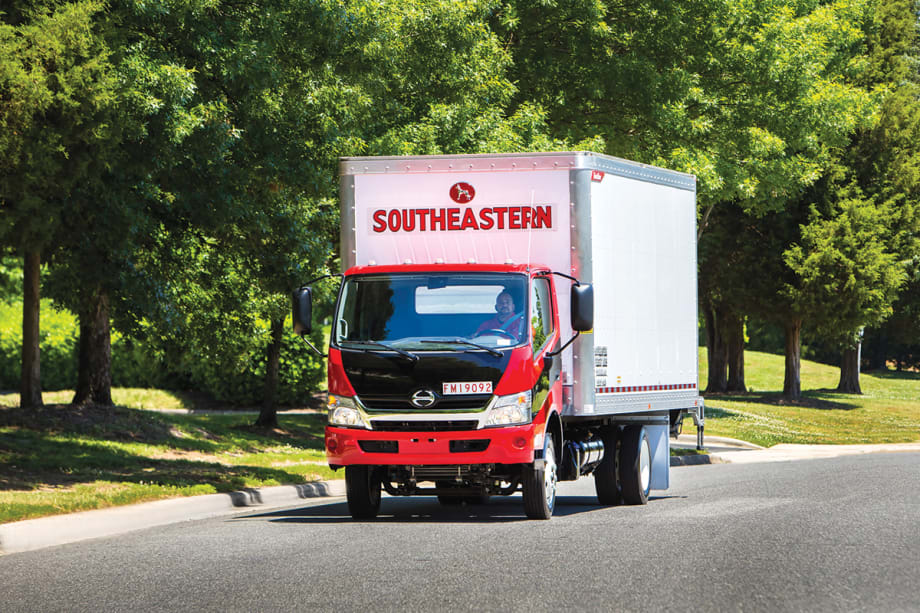
Fleets like Southeastern Freight Lines are looking for final-mile tires as they serve a booming last-mile delivery demand.
Photo: Southeastern Freight Lines
Southeastern Freight Lines recently launched its Final Mile Service system-wide, with a fleet of more than 350 trucks across all 89 service centers. The less-than-truckload carrier spec’ed tires for those vehicles that cost more up front but provide better value over the life of the tire.
“We choose tires based on durability, ease of doing business with the vendor and warranty availability,” says Kerry Stritt, vice president of fleet services at the South Carolina-based less-than-truckload carrier.
SEFL joins a growing number of companies adding smaller last-mile trucks to their fleets, as already rapid growth in online and omnichannel shopping has only been accelerated by the pandemic.
“The growth of e-commerce has leaped 10 years in just a few short months,” says Chris Novak, business model leader for urban mobility at Michelin North America.
For example, since March and its government lockdown restrictions, Amazon has hired 175,000 seasonal workers to meet the surging demands and plans to keep 75% of them permanently, notes Tom Fanning, Continental vice president of sales and marketing for truck tires in North America. “Last-mile delivery and regionalized business has seen continual rise throughout the last decade, with no signs of slowing down.”
These operations place special demands on the tires used on light- and medium-duty delivery vehicles.
“Last-mile delivery driving is mostly local in nature, so [customers] should choose a regional tire that is built for city driving conditions,” says Robert Williams, vice president of truck and bus radial sales for Hankook Tire America. “They should also ensure that vehicles have tires with load capacity to meet the weight demands.”
Demands on Last-Mile Tires
“As is true for any fleet, last-mile delivery fleets need to consider the specific application when choosing tires — even the best tire in the wrong application will not deliver on full performance potential,” says Ben Johnson, director of truck and bus radial brand and channel marketing, U.S. and Canada, Bridgestone Americas Tire Operations. “Last-mile delivery fleets encounter high-scrub, urban environments and demand a highly durable tire solution to keep up with the frequent starts and stops along their route.”
Walt Weller, senior vice president, CMA, maker of Double Coin tires, also notes that tires for this market are smaller, “and due to the local delivery aspect of the vehicles that use them, the demands placed on them are severe. Lots of turning, starts and stops, etc., make original tire life a challenge for fleets.”
“Durability in this high-stress, high-scrub application will be paramount,” says Bob Klimm, director of truck and bus radials for Falken Tires. “Look for features that address the key conditions of high torque and increased braking.”
Standing up to these high-scrub environments, with lots of twisting and turning on city streets, requires a cut- and chip-resistant tread compound in order to deliver the expected mileage. In addition, safety is important, so the ability to handle frequent stops on wet or snowy pavement is another factor. And city driving means curbs, so a reinforced sidewall is a necessity.
The growth of last-mile delivery and grocery delivery “is increasing demand for regional products that can sustain curbing damage,” agrees Dan Funkhouser, Yokohama Tire vice president of commercial sales.
Michelin’s Novak says urban delivery fleets are very focused on tire durability, including:
robust sidewalls to resist curbing damage
puncture-resistant sidewalls that can withstand urban operations
wet traction in high stop-and-start environments.
Looking at Total Costs
“Last-mile delivery fleets need the same as over-the-road fleets, and that is a lower cost per mile over the life of the tire,” says Funkhouser, measured by longevity, efficiency, availability and dependability.
One way to do that is with retreading. “Fleets who are looking to achieve their lowest overall driving cost should look for a retreadable casing,” says Fanning.
CMA’s Weller predicts that all-steel casings in 16-inch, 17.5-inch, up to 19.5-inch wheel diameters will be in high demand, as retreading these sizes will be a must in order to keep last-mile-delivery fleet tire costs down.
While some last-mile delivery operations use medium-duty trucks, other use lighter-duty vans.
“With last-mile delivery, PLT [passenger and light-truck] tires come into play, which does alter the TCO calculation traditionally used in truck tires,” says Gary Schroeder, executive director of Cooper Tire’s global truck and bus tire business. “Retreading is not used in the PLT space, so the TCO calculations need to be adjusted accordingly.”
In addition, “selecting tires and services to help maximize uptime is a top priority for last-mile delivery fleets,” says Dustin Lancy, Goodyear commercial product marketing manager, regional/urban. “This includes programs or services which can help minimize breakdowns,” he says, such as Goodyear Complete Tire Management, breakdown services, and tire pressure monitoring and inflation systems.
Continental’s Fanning agrees, noting that “last-mile delivery can also be very time-sensitive. Fleets who want to increase uptime and help prevent breakdowns should consider a digital tire monitoring solution. ContiConnect Yard, for example, can be mounted at the distribution center and identify any tires with low air pressure or high temperature before they leave.”
Dave Johnston, Toyo Tire U.S.A. senior manager of commercial product and business development, sums it up. “Choosing the right tires comes down to ensuring the safety of the drivers, maximizing uptime, and maintaining the tight schedules of final-mile deliveries to ensure the best return on the fleet’s investment.”
More Equipment

How Volvo Updated Its D13 for EPA 2027 [Watch]
Volvo’s updated D13 promises lower emissions without sacrificing performance or fuel economy. Take a closer look at what changed inside the engine in this HDT Spotlight video.
Read More →
Michelin Tire Improves Efficiency and Durability for Regional Fleets
The Michelin X Multi Energy D2 is a regional haul drive tire engineered to help fleets improve fuel efficiency, durability and traction in demanding stop-and-go operations.
Read More →
ZF Expands Commercial Vehicle Push in North America
ZF is expanding its North American commercial-vehicle presence with new transmission applications, electrification, trailer technology and autonomous-driving systems.
Read More →
Tesla Wants a Self-Driving Semi. Are Cameras Enough?
Could Tesla’s camera-only autonomous driving technology work on an 80,000-pound Semi? In this commentary, HDT's Deborah Lockridge takes a look at Tesla, Cybercab, and how autonomous trucks see the road.
Read More →
Kodiak: Driverless Long-Haul Truck Launch on Track for 2026
Kodiak AI says its driverless long-haul safety case is 93% complete and it remains on track to begin commercial operations by year-end 2026.
Read More →
What DOT’s Automated Vehicle Strategy Means for Trucking
The U.S. Department of Transportation issued a new automated-vehicle strategy that outlines plans for driverless-truck regulations, cross-state freight corridors, and federal safety standards.
Read More →
East Coast Port Launches $45M Electric Truck Push
The Port Authority of New York and New Jersey announced millions in incentives for zero-emission drayage trucks, yard tractors, and new charging hubs near the port.
Read More →
PlusAI Going Public to Fund Autonomous Truck Launch
A SPAC deal could provide PlusAI with up to $300 million as it works toward a 2027 commercial launch of factory-built autonomous trucks.
Read More →
NHTSA Moves to Rewrite Truck Fuel-Economy Rules
The National Highway Traffic Safety Administration says it lacks authority to regulate medium- and heavy-duty truck engines separately from complete vehicles, but the existing standards have not yet been eliminated.
Read More →
Detroit Opens Orders for EPA 2027 Engines
Detroit isn’t starting from scratch to meet EPA 2027 diesel emissions standards. Its Gen 6 DD13 and DD15 engines keep much of today’s platform while updating the fuel and aftertreatment systems.
Read More →