





Related: Major Fleets Saved $477 Million With Fuel-Efficient Tech
The Automated Revolution is Real
After 20 years on the fringes of the heavy-duty transmission world, the switch from sticks to semiconductors may be reaching the tipping point.
May 25, 2015
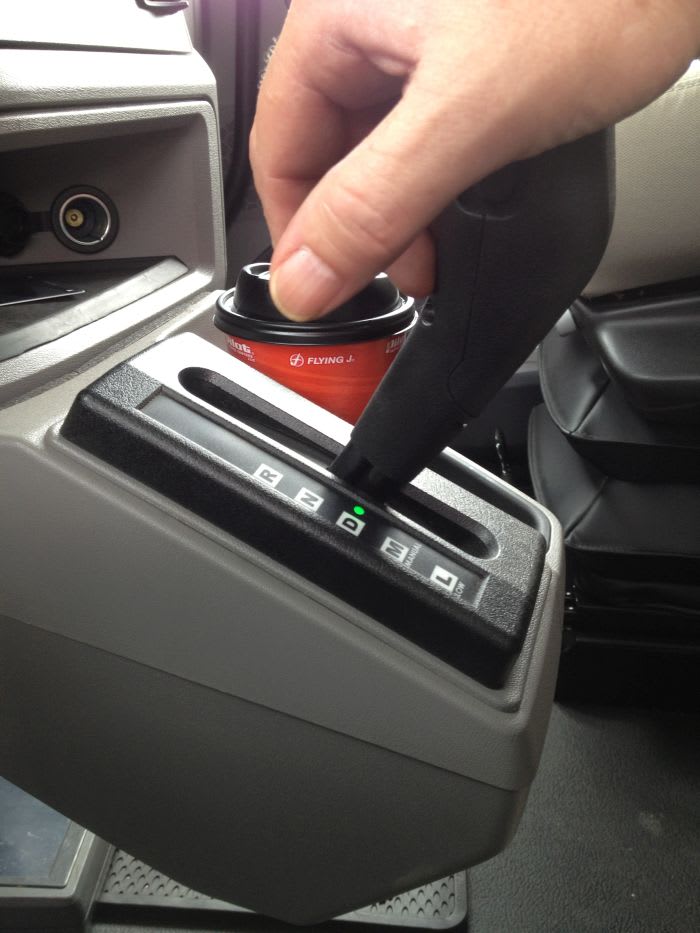
Eaton AMTs come with a choice of a dash-mounted keypad shift control or the more driver-friendly cobra-head shift selector.
7 min to read
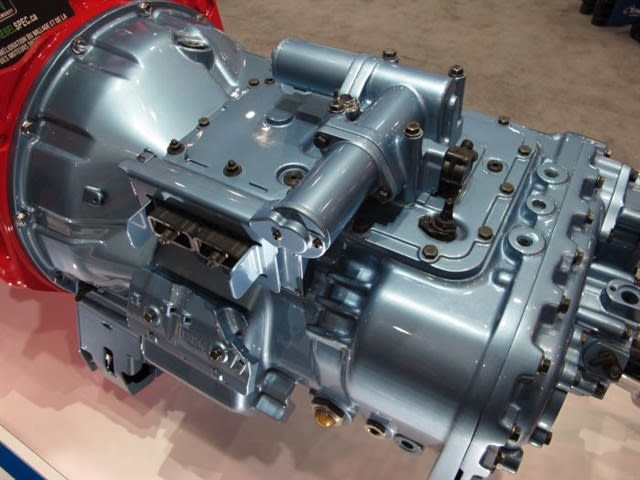
After 20 years on the fringes, the switch from sticks to semiconductors may be reaching the tipping point.
How could a box full of gears save fuel? That was the question fleets were asking in the mid-1990s, when the first automated manual transmissions appeared. Some saw AMTs as a solution in search of a problem, more complexity to deal with, additional cost, more parts to stock — heck, who would hire a driver who couldn’t operate a non-synchronized transmission? Who indeed.
In time, automated manuals were recognized for their ability to flatten the driver-skill bell curve. AMTs could and did improve fuel economy for poorer drivers, but they didn’t help the expert drivers all that much. Besides, it was a struggle to get the veterans to accept automation. Fleets were not going to spend $5,000 extra on a transmission they had to fight to get drivers to accept. The transmission people had their marketing work cut out for them.
That hard work seems finally to be paying off.
Electronically controlled automated manual transmissions enjoyed eye-popping growth in 2014, expanding market share to roughly 30% of all heavy-truck builds, according to Nik Varty, president of Wabco Americas. “In 2014, we saw 110% growth in sales of our automated transmission controls in North America alone.”
Wabco doesn’t make the transmissions, but it designs and produces the electronic controllers and actuators used in many of the world’s AMTs, including several North American models. So while most OEs will not report sales figures other than to say they are seeing steady growth in demand for AMT, Wabco’s contribution to the product gives us a very good idea just how much more popular they have become recently.
When Daimler Trucks North America in 2012 announced it would start building a North American version of its successful automated transmission from Europe, DTNA chief Martin Daum told reporters he was “on a mission to convert the North American truck market to automated manual transmissions.” Many observers thought he was overly optimistic. DTNA projections at the time called for 2015 production of 9,000 of the DT-12. Now the company expects to produce more than four times that number.
Back in 1998, AMTs from Eaton and Meritor were the only game in town. During the Mid-America Trucking Show that year Meritor had launched the SureShift, while Eaton took the wraps off its 18-speed AutoShift following on the 10-speed version launched a year earlier. The question making the rounds at MATS that year was, how soon would half the transmissions ordered in new heavy trucks be fully automated?
The answers varied, but Tim Morscheck, then general manager of automated products at Eaton, told reporters the market might reach 7%-10% by 2000.
Frank Palmeri, director of sales and marketing for Meritor Automotive’s heavy-vehicle transmission business, predicted it would take five to seven years [from 1998] to reach 50% market penetration for automation of all sorts. His guess at the time was that AMTs had reached the 5% mark, and could get as high as 20% — at the very best 25% — by 2000.
Those predictions turned out to be a little optimistic, but the true market drivers for AMTs hadn’t really hit home yet. According to Varty, AMTs are hitting their stride just as the driver shortage threatens to peak at its worst levels ever.
“It’s funny, in Europe more people drive manual cars, but more trucks are automated or synchronized,” he says. “In North America it’s the opposite. We grow up on automatic transmissions and then have to adapt to manual transmissions in the truck. AMTs make it easier to bring new drivers into the industry.”
And while that remains true, the advantage in fuel savings is actually growing.
“The lynchpin was and continues to be the driver shortage,” says Eaton’s product planning manager, Ryan Trzybinski. “Recruiting and retention has always been a big driver, but the icing on the cake that is pushing fleets to invest in automation is fuel economy. The AMTs are now producing fuel savings in their own right.”
Today’s AMTs
Eaton AMTs come with a choice of a dash-mounted keypad shift control or the more driver-friendly cobra-head shift selector.
Transmissions are still essentially a box full of gears, but they are now capable of doing stuff that even the best drivers would be hard pressed to manage, like downspeeding.
Volvo introduced the concept in 2011, and now everyone has such an option. The key to downspeeding is to run the engine at hitherto unheard of speeds where torque gets the job done rather than fuel-guzzling horsepower. Few drivers, left on their own, would lug an engine down to 1,000 or 1,100 rpm and know exactly when to downshift for optimum fuel economy. Thanks to advanced logic and much deeper integration between the engine and the transmission control modules, transmission shift schedules are optimized for fuel economy on every shift, all day long.
More recently, Eaton and Cummins demonstrated the value of deeper integration with the SmartAdvantage powertrain combination. The companies say SmartAdvantage delivers 3%-6% better fuel economy than a previous generation engine and transmission, but with very little physical change to the equipment.
“We went with a smaller step between the top two gears to keep the engine within the sweet spot of the fuel map as much as possible,” says Trzybinski. “Consequently, SmartAdvantage will shift between 9th and 10th more often than a traditional overdrive to keep the engine as close to the fuel-economy sweet spot as much as possible. We also shared fuel maps, grade and mass calculations and much more than we have ever done in the past to facilitate downspeeding the drive line.”
Volvo and Mack now offer an interesting feature called Adaptive Gearing and Load Logic, respectively. The transmission takes cues from a load sensor in the tandem and tells the transmission whether or not to allow 12th gear overdrive to be used. It’s a specialty application for fleets that run empty or lightly load one way and fully loaded the other.
“We use a rear axle ratio of 2.47:1 and an overdrive I-Shift,” says John Moore, Volvo’s product marketing manager. “When the truck is loaded, we lock out 12th gear and run the transmission in 11th gear, which is direct, 1:1. Unloaded, we allow 12th gear overdrive, which is too low for a fully loaded condition.”
At this year’s Mid-America Trucking Show, Mack’s director of product marking, Roy Horton, told reporters it’s like having two transmissions in one.
“Load Logic combines the performance of direct and overdrive transmissions into one,” he said.
Meanwhile, Allison says its latest innovation, a package of enhancements called FuelSense, can adapt to driving conditions, improving fuel economy up to 20% in certain duty cycles compared to Allison’s previous generation products.
According to Allison’s director of North American marketing, Lou Gilbert, the heavy duty automatic TC10 transmission’s fuel economy is about equal to any manual in the top gears at highway speed. He says Allison has made big strides in fuel economy at lower road speeds and in different duty cycles by programming the transmission for the application.
“Allison Transmission’s internal gear ratios produce lower engine rpm in many areas below 40 mph, resulting in less fuel used and better mpg. With most medium duty and vocational truck applications, this is where they spend much of their operational time.”
Automated transmissions have come a long way since the day of hardwired shift cues. Inclinometers, torque and load sensors and much deeper levels of data exchange between the engine and the transmission have improved performance and fuel economy greatly. All they really lacked was eyes.
Drivers have historically had the advantage here, as they could see what was ahead, and the best among them would drive the truck accordingly. The next wave in transmission controls is GPS-enabled predictive cruise control — eyes of a sort for the transmission.
Detroit’s DT12 AMT with the advanced Intelligent Powertrain Management cruise control system uses pre-loaded terrain maps and GPS to “see” the route ahead.
“The effect of knowing what’s ahead allows for early and automatic adjustment of transmission and engine function,” says Tim Norton, product manager, powertrain marketing, for Daimler Trucks North America. “We can get the engine speed up before we start climbing a hill, or we can let the engine speed drop before we start into a downgrade. It all makes for a smoother and much more efficient ride.”
In the early days of AMTs, fleets looked at the premium price tag and weighed whether they had value in attracting or retaining drivers. Early adopters did see some advantage, but then they noticed fuel consumption was improving as well. Today, with wider market penetration, the novelty has worn off a little, but the fuel savings are still there and actually improving.
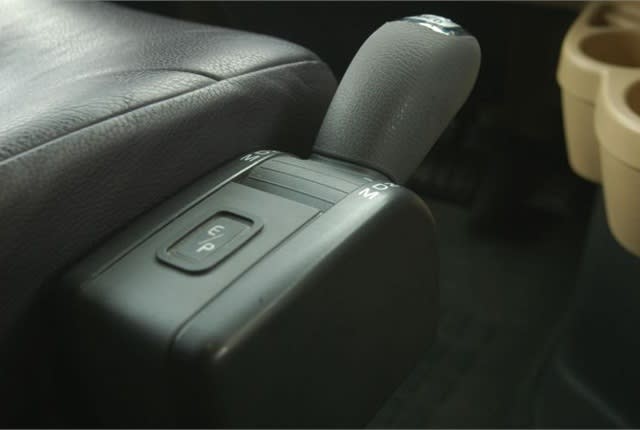
Volvo was not the first to use a seat-side driver interface, but it placed the transmission controls in a familiar place.
Yet to come?
“The future will bring more of what you see Eaton and Cummins doing,” says Wabco’s Varty.
“Tighter integration and better communication. More data moving back and forth faster, for one thing,” he says. “I see a trend where everyone works more closely, and begins talking about the project much sooner.
“As for the hardware, I think the two-clutch transmission is the next wave. Volvo has one in service in Europe and Eaton’s medium-duty Procision is a two-clutch design. There’s a lot of value in that design for customers. We’ll see them here in Class 8 sooner or later.”
Subscribe to Our Newsletter
More Drivers

From One Generation to the Next: How Mentorship Builds Safer Truck Drivers
After three decades in trucking, Harold Perry shares what he's learned about driver safety, mentorship, and helping the next generation build confidence behind the wheel.
Read More →
Truck Drivers Need More Than Another Alert
Fleets have more visibility into truck health, safety events, and driver activity than ever. The next challenge is turning all that information into useful guidance for the person who has to decide what to do next.
Read More →
FMCSA Removes 110 Truck Driver Training Schools from Certified ELDT List
Federal regulators also are targeting more than 160 additional training providers and launching a nationwide audit of third-party CDL skills testers as part of a broader crackdown on trucking fraud.
Read More →
Hours of Service Pilot Programs: FMCSA Readies for 2027 Rollout
Two pilot programs could eventually reshape hours-of-service rules, giving truck drivers options to pause their 14-hour clock or use longer split sleeper rest periods.
Read More →
Medical Cards, English Proficiency Reshape Roadcheck Violations
Medical-card violations jumped to the top of the driver out-of-service list during CVSA’s 2026 International Roadcheck, while English-language proficiency violations appeared among the leading violations for the first time.
Read More →
Driver Trust Can Make or Break the Success of Fleet Safety Technology
New Teletrac Navman research suggests that onboarding, transparency about driver data, and positive feedback can play a significant role in how commercial drivers respond to safety and coaching technology.
Read More →
EEOC Sues KLLM Over Alleged Sex Discrimination in Driver Training
KLLM is facing a federal sex-discrimination lawsuit over policies the EEOC alleges put female truck driver trainees at a disadvantage.
Read More →
FMCSA Moves to Codify English Language Requirements for Commercial Drivers
By changing regulations on English-language proficiency requirements for commercial drivers, rather than relying on a guidance memo, the FMCSA said future administrations won't be able to walk back the Trump administration's stricter enforcement with just a memo.
Read More →
Drivers Put Western Star Trucks to the Test at Star Nation Experience
Watch to get an inside look at the Western Star trucks, technology, and community behind the Star Nation Experience 2026!
Read More →
Trump Administration Looks to Put More Veterans Behind the Wheel
The Freedom Haulers program pulls together existing and expanded programs at several federal agencies to recruit veterans to drive commercial heavy-duty trucks and cut the red tape for them to get a CDL, training, and employment.
Read More →