




Test Drive: New MX-11 Engine Performs for Peterbilt
Truckers who used to crave a long-nose Pete with a big-bore engine might be surprised by Paccar’s new smaller powerhouse.

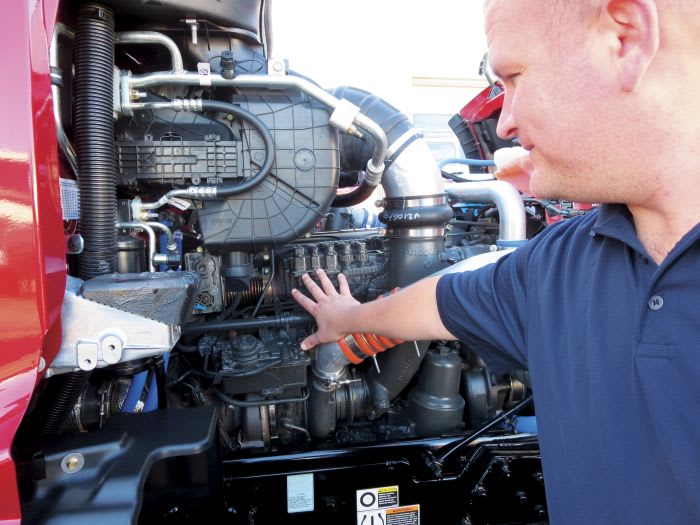
Peterbilt service engineer Chadd Christian’s fingers indicate sensors for EGR, turbocharger and humidity. His thumb points to the variable-geometry turbo’s water-cooled electronic controls. The big U-shaped device is the air cleaner box with the intake air filter inside. Photos: Tom Berg
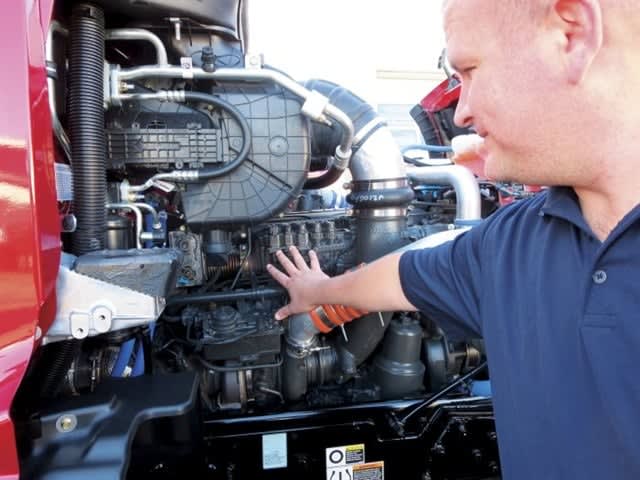
Peterbilt service engineer Chadd Christian’s fingers indicate sensors for EGR, turbocharger and humidity. His thumb points to the variable-geometry turbo’s water-cooled electronic controls. The big U-shaped device is the air cleaner box with the intake air filter inside. Photos: Tom Berg
In the 1970s, when guys stormed grades like The Grapevine and Donner Pass in California, they wanted 400 horses to do it. Back then it took 855 cubic inches or 14 liters, as in Cummins’ NTC series diesels, to make that much power, and its torque output was 1,250 lb-ft.
Today, however, high-pressure fuel injection, advanced combustion chambers and precise electronic controls allow engine manufacturers to coax more than 400 hp out of a block with 200 fewer cubes.
Paccar just introduced the 660-cubic-inch (10.8-liter) MX-11, with a top rating of 435 hp and 1,550 lb-ft. And it feels strong enough to blow the doors off a rig with one of those old NTC-400s.
Paccar will put the MX-11, which will be offered by its truck-making companies Kenworth and Peterbilt, into production at its Mississippi plant in January. Several months ago, Paccar began promoting it as a lighter-weight (by about 400 pounds) alternative to the bigger MX-13 and the Cummins ISX12.
In addition to the 435-hp version, other ratings are 355, 375, 385 and 425 hp, plus there’s a 430 with multi-torque capability of 1,350 to 1,550 lb-ft. Depending on the rating, peak torque on these engines begins at a low 1,000 RPM and lasts to as high as 1,600, so the MX-11 can really lug.
For low fuel consumption and noise levels, the engine uses a common rail fuel system with injection pressures of over 36,000 psi. And Peterbilt says that along with precise electronic controls, the turbo spools up quickly for good response to a driver’s push on the accelerator. That seems true.
While the MX-11 looks similar on the outside to its MX-13 sibling, few parts are interchangeable between the two engines. Compacted graphite iron forms the MX-11’s block, double overhead camshafts actuate the valves, a “lube module” consisting of two filters cleanses the motor oil, and a composite plastic material is used for the oil pan.
Last month, we wrote about the MX-11 in a couple of Kenworth trucks, and now it’s Peterbilt’s turn. In late October, I drove a Model 579 highway tractor with the new diesel. Hitched to a loaded van, it was ready for our departure on a bright, sunny morning at Peterbilt’s plant in Denton, Texas.
We eased past forklifts extracting components from curtain-sided trailers in an alley next to the plant and headed out of town. Find Denton on a map and look for U.S. 380 as it heads west; that’s what we followed to Bridgeport and Texas 101, then north to Sunset and U.S. 287, then a hard right south to Decatur, where we rejoined 380 eastward and back to Denton a few hours later.
The tech people promised us some grades, and they were there. Though moderate and short in length, they were enough to put the engine to work. On the first incline on U.S. 380 I could feel how well the engine pulled. It was ideal for the rig’s gross combination weight of about 65,000 pounds — typical of real-world tractor-trailer weights in the U.S., Peterbilt marketing people say — and in this kind of terrain the engine would’ve been OK at the full legal GCW of 80,000.
The MX-11 in the Kenworth tractor I had driven seven weeks earlier near Seattle had to work harder while climbing mountain grades with a rig that was 5,000 pounds heavier. So did I, as the KW had an Eaton Roadranger 13-speed manual transmission.
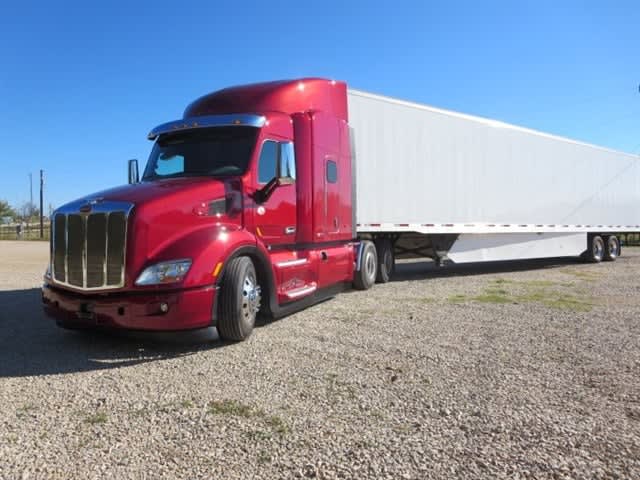
The metallic red 579 is Peterbilt’s main aerodynamic highway model. The compact 56-inch mid-roof sleeper weighs several hundred pounds less than long-and-tall boxes, but has decent interior room with well-thought-out storage places.
I believe the Peterbilt and its engine would’ve proved as capable on the same hills, and it had an advantage — a 10-speed Eaton Advantage automated manual transmission, which took most of the work out of driving and let me concentrate on the roads, traffic and what the diesel was doing.
We stopped at a small truckstop that resembled a convenience store and treated ourselves to cheeseburgers with lots of fried onions. Outside, three lines of older, dusty rigs idled at the diesel pumps, pulling end-dump trailers and covered with gray powder. As we got ready to climb back aboard the shiny Pete, one driver came over to admire the paint job — “classic red,” it’s called, and is Peterbilt’s show color for this year.
Then we were back on the road. The federal and state routes we used were four lanes with wide medians and, though they approached Interstates in appearance, were not controlled access except at junctions with other principal routes, some of which were interchanges with overpasses. Speed limits were 65, 70 and 75 mph for all vehicles, and the Pete’s MX-11 was happy at any speed. The tractor seemed geared more like a vocational truck, with cruising rpm of 1,500 to 1,650 instead of the 1,100-or-so-rpm downspeeding we’ve seen in other trucks recently.
The truck had adaptive cruise control, which worked well throughout the run, with absolutely no inappropriate braking and very accurate speed control, indicating the antenna in the front bumper was precisely aimed and the system well tuned.
The cruise control was also predictive. Through GPS locating, it knows what the terrain’s like and what’s up ahead, and modulates the throttle accordingly. This was rolling countryside where the engine got an occasional workout but encountered no mountain-like grades. Sometimes I got on the gas when we approached an upgrade and sometimes I left it alone. Usually road speed fell by 5 or so mph as we climbed, then we recovered our cruising speed on the other side of a hill. Not running for the next grade saves fuel, which is why Paccar engineers programmed their predictive CC this way.
In every instance, the Paccar MX-11 delivered more than adequate power. It accelerated the rig well and maintained any desired road speed, even when bucking sometimes brisk cross winds. Paccar says the engine’s B10 life is 1 million miles, meaning 90% of MX-11 engines should still be running at that point, which is noteworthy. And for its performance alone it certainly deserves consideration from thoughtful truck operators.
Tom Berg is a CDL licensed driver who does Test Drives of all classes of trucks, while also specializing in maintenance, vocational, medium-duty trucks, trailers and bodies, and alternative fuels.
More Equipment

PlusAI Going Public to Fund Autonomous Truck Launch
A SPAC deal could provide PlusAI with up to $300 million as it works toward a 2027 commercial launch of factory-built autonomous trucks.
Read More →
NHTSA Moves to Rewrite Truck Fuel-Economy Rules
The National Highway Traffic Safety Administration says it lacks authority to regulate medium- and heavy-duty truck engines separately from complete vehicles, but the existing standards have not yet been eliminated.
Read More →
Detroit Opens Orders for EPA 2027 Engines
Detroit isn’t starting from scratch to meet EPA 2027 diesel emissions standards. Its Gen 6 DD13 and DD15 engines keep much of today’s platform while updating the fuel and aftertreatment systems.
Read More →
Carrier Transicold Adds All-Electric TRU for Stationary Cold Storage
Carrier Transicold’s new Vector 8200 all-electric transport refrigeration unit gives fleets a diesel-free option for temporary refrigerated and frozen trailer storage.
Read More →
A Closer Look at Kenworth’s Electric T880E Vocational Truck [Video]
Learn more about Kenworth's T880E battery-electric vocational truck at the Paccar Technical Center, including its range, applications, upfitting considerations, and PTO options, in this HDT Spotlight video.
Read More →
Kenworth T880E Brings EV Power to Vocational Trucks
A closer look at the Kenworth T880E’s range, charging, powertrain and upfit options — and where fleets are showing the most interest.
Read More →
What the U.S.-Canada Trade War Means for Trucking
Escalating U.S.-Canada tariffs could disrupt cross-border freight, reduce truck volumes, raise costs, and create new uncertainty for carriers on both sides of the border.
Read More →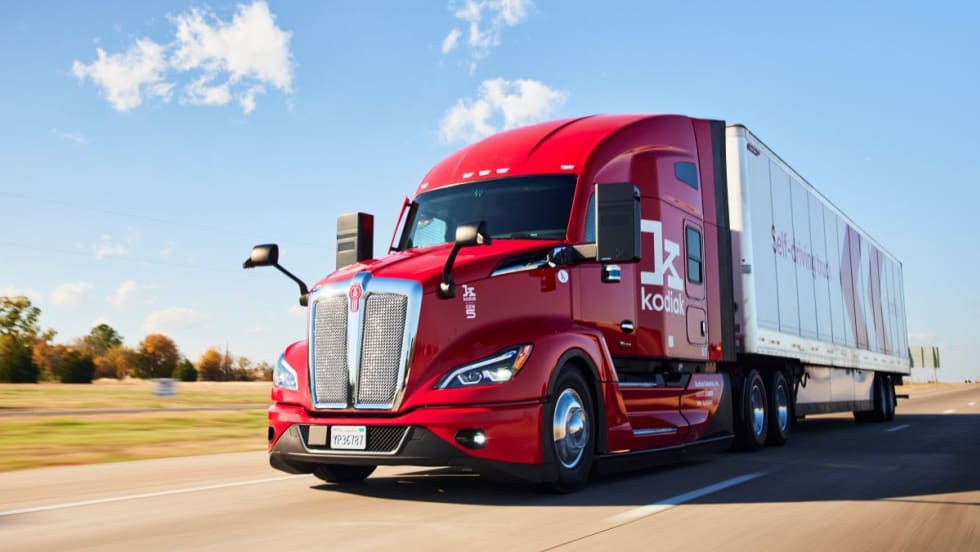
Autonomous Truck Testing Moves Ahead in California as Teamsters Challenge Rules
California has begun permitting heavy-duty autonomous truck testing, with Aurora and Kodiak among the first to receive approval, as the Teamsters sue the DMV over the new regulations.
Read More →
Behind the Wheel of the New Mack Anthem [Video]
HDT takes the new Mack Anthem around Mack’s Pennsylvania test track to see how its driver-focused design, technology, visibility and handling perform from behind the wheel.
Read More →
DTNA Plans New U.S. Truck Plant as Manufacturing Footprint Shifts
Daimler Truck North America is evaluating sites for a new assembly plant expected to open in 2029 while winding down operations at its longtime Portland manufacturing facility.
Read More →