




Strong Trailers Take Trash to Landfills
Trash-transfer trailers are highly specialized vehicles that must endure potentially destructive cargoes, yet they hold up for years of constant service.

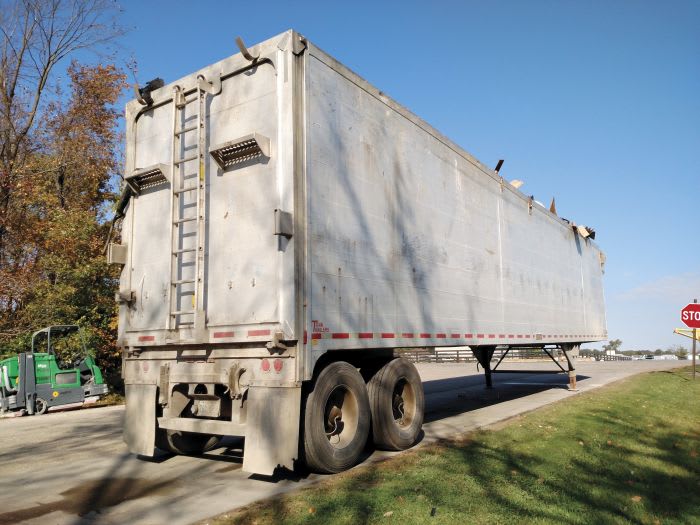
A loaded Titan Thinwall trash-transfer trailer awaits transport outside a county facility near Delaware, Ohio. Though far from new, its aluminum welded-tube sides remain straight and unbowed. Photo: Tom Berg
A loaded Titan Thinwall trash-transfer trailer awaits transport outside a county facility near Delaware, Ohio. Though far from new, its aluminum welded-tube sides remain straight and unbowed. Photo: Tom Berg
The trash you discard every week is picked up by a collection truck and taken someplace. Where it goes for burial depends on where you live and who’s in charge of its disposal. That truck with its “packer” body might go directly to a landfill. More likely, however, it travels to a nearby transfer station where the garbage is deposited, then transferred to a semitrailer for its final trip to a landfill.
These trailers are highly specialized vehicles that must endure potentially destructive cargoes, yet they hold up for years of constant service. Operators also need high capacity to maximize tonnage on each run.
Trash-transfer trailers are very similar to those that haul wood chips in forested regions of Canada and the United States, though the latter sometimes have low “possum belly” floors to maximize volumetric capacity. Both are constructed as rigid “tippers” that back onto platforms which tip their front ends so contents flow out the opened back doors, or have “live” floors whose powered metal slats move cargo through doors at one or both ends.
Trailers vary in configuration and construction, but here we’ll focus on one type: panel-walled and smooth-sided.
After spotting one sitting at the entrance to a solid-waste facility operated by Delaware County, Ohio, I had a brief communication with the fleet that operates the trailer and others like it. Its owner preferred not to be quoted, but it seemed like his company was well-run.
This one was produced by Titan Trailers in Ontario, Canada (not to be confused with Titan Trailer in Kansas). The “Thinwall” label pasted on the trailer’s nose describes its wall width of 1.5 inches, according to Titan spokesman Robert Adeland. He said the walls consist of extruded aluminum tubes that interlock and are welded together in a patented process devised in the mid-1990s by Titan’s president, Mike Kloepfer. Like corrugated paper, the four-sided oblong tubes provide high strength with low weight.

Aluminum tubing is continuously machine-welded to wall lengths up to 53 feet. Wall width is 1.5 inches. Photo: Titan Trailers
The tube’s inner aluminum sheet is slightly thicker than the one that faces outside. This allows the inside of the wall to absorb impacts while the outside remains smooth. Tubes are stacked horizontally and, like a log cabin, resist the lateral bulging you often see in older transfer trailers with sheet-and-post walls. The welded-tube type resists bulging better, and even if bulging occurs during compacting, the walls return to their original straight shape, according to Verspeeten Cartage in Ingersoll, Ontario, which several years ago began using Titan Thinwall trailers to haul Toronto’s trash.
Mac Trailers and East Manufacturing produce products that are similar in concept but differ in details. Mac’s tubes are also stacked and welded horizontally, but the tubes are larger. East’s tubes are arranged vertically, and horizontally braced on top and bottom, a design it calls Genesis; its wall width is 2 inches. Like Titan, Mac and East tout the smooth-sided vehicles’ ruggedness and sleek looks, and suggest (but don’t claim) that they’re also more aerodynamic than traditional outside-braced walls (which they also offer.)
The Thinwall trailer photographed in Delaware County appeared commendably straight, even though the vehicle was obviously far from new and the aluminum was dulled from weathering, road salt and acid baths. “They look good right to the day they’re retired,” Adeland commented.
More Equipment

How Volvo Updated Its D13 for EPA 2027 [Watch]
Volvo’s updated D13 promises lower emissions without sacrificing performance or fuel economy. Take a closer look at what changed inside the engine in this HDT Spotlight video.
Read More →
Michelin Tire Improves Efficiency and Durability for Regional Fleets
The Michelin X Multi Energy D2 is a regional haul drive tire engineered to help fleets improve fuel efficiency, durability and traction in demanding stop-and-go operations.
Read More →
ZF Expands Commercial Vehicle Push in North America
ZF is expanding its North American commercial-vehicle presence with new transmission applications, electrification, trailer technology and autonomous-driving systems.
Read More →
Tesla Wants a Self-Driving Semi. Are Cameras Enough?
Could Tesla’s camera-only autonomous driving technology work on an 80,000-pound Semi? In this commentary, HDT's Deborah Lockridge takes a look at Tesla, Cybercab, and how autonomous trucks see the road.
Read More →
Kodiak: Driverless Long-Haul Truck Launch on Track for 2026
Kodiak AI says its driverless long-haul safety case is 93% complete and it remains on track to begin commercial operations by year-end 2026.
Read More →
What DOT’s Automated Vehicle Strategy Means for Trucking
The U.S. Department of Transportation issued a new automated-vehicle strategy that outlines plans for driverless-truck regulations, cross-state freight corridors, and federal safety standards.
Read More →
East Coast Port Launches $45M Electric Truck Push
The Port Authority of New York and New Jersey announced millions in incentives for zero-emission drayage trucks, yard tractors, and new charging hubs near the port.
Read More →
PlusAI Going Public to Fund Autonomous Truck Launch
A SPAC deal could provide PlusAI with up to $300 million as it works toward a 2027 commercial launch of factory-built autonomous trucks.
Read More →
NHTSA Moves to Rewrite Truck Fuel-Economy Rules
The National Highway Traffic Safety Administration says it lacks authority to regulate medium- and heavy-duty truck engines separately from complete vehicles, but the existing standards have not yet been eliminated.
Read More →
Detroit Opens Orders for EPA 2027 Engines
Detroit isn’t starting from scratch to meet EPA 2027 diesel emissions standards. Its Gen 6 DD13 and DD15 engines keep much of today’s platform while updating the fuel and aftertreatment systems.
Read More →