




Trailer Update: A Vehicle for Every Haul
Our annual roundup of the latest trailer products and trends.

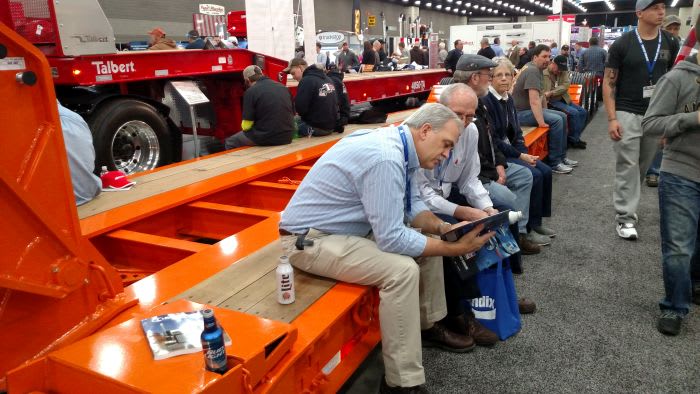
The Mid-America Trucking Show featured many trailer makers. Showgoers here make use of a lowbed trailer to take a break. Photos: Tom Berg
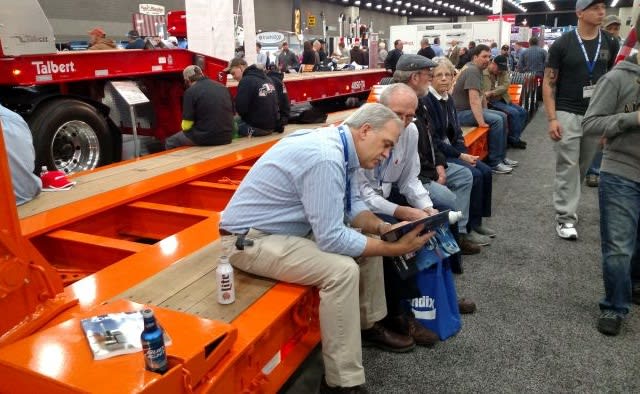
The Mid-America Trucking Show featured many trailer makers. Showgoers here make use of a lowbed trailer to take a break. Photos: Tom Berg
Prosperity provides healthy business and revenue that manufacturers use to expand to meet customer demand, which this year is at near-record levels. Orders ebb and flow, but overall 2015 has been a very good year for trailer builders, and would be even better if they could get the workers and materials and components to build even more trailers.
Over the years, advanced materials and processes have become trends. For example, destructive corrosion has become such a major concern among truck operators that manufacturers now offer more aluminum and galvanized steel components, plus special coatings that ward off aggressive road de-icing salts from ferrous metals.
Light weight is a goal of customers who haul certain cargoes, though not all need or want to pay for the materials and engineering needed to get extra capacity. Loads that go on flatbed and drop-deck trailers can go from one extreme, of high density and weight, to the other, of outsized objects with lots of air inside. Happily, there are products to accommodate both, and those in between. The trailers usually use variations on two basic materials, steel and aluminum.
“I get the question all the time,” Keith Limback, Manac Trailer’s general sales manager for the U.S., told HDT when we visited his booth at the Mid-America Trucking Show in March. “‘What’s the difference in weight and cost for different materials?’”
He had graphic answers right there: three spread-tandem, drop-deck trailers he dubbed “good, better and best.” Here’s how they stacked up, literally:
On top was the good one, a steel trailer, the least costly at about $28,000 but heaviest at 11,700 pounds.
At the bottom, carrying the other two, was the better one, a “combo” – a combination of a steel underframe and crossmembers with an aluminum deck, that costs $2,500 more but saves 1,000 pounds.
In the middle was the all-aluminum model, priced at another $3,000 (or $5,000 more than steel) but saving another 1,000 pounds in tare weight.
In corrosion resistance, anticipated life and probably resale value, the best choice would be the all-aluminum (“all” except for running and landing gear, of course). Next is the combo, and finally the steel. Different buyers have different considerations, which is why manufacturers offer the three different types.
In dry-van trailers, shedding weight has become more important as tractors have become heavier with exhaust aftertreatment equipment. More aluminum and composites are being used in undercarriages, walls and ceilings. With plate-wall trailers, various manufacturers have devised variations on a basic theme: two pieces of thin metal sandwiching a foam core, yielding walls a fraction of an inch thick, and reinforced in places to be strong enough to take battering during cargo handling.
Refrigerated trailers have made the transition to new Thermo King and Carrier reefer units that emit fewer exhaust emissions demanded by EPA, and are ever-more capable of monitoring and keeping loads at exactly the right temperatures.
Meanwhile, refrigerated trailer builders continue to improve the thermal performance of walls, ceilings and floors, and address demands for durability and longevity.
The Latest Offerings
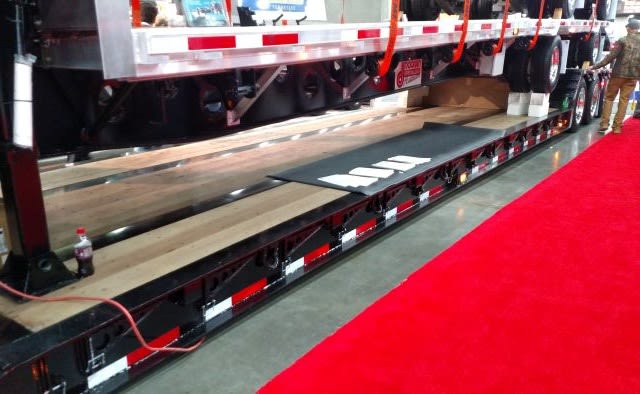
Doonan Specialized – At MATS, featured an RGN hydraulic-gooseneck lowboy with an 18-inch deck height, a Honda 13-hp pony motor and a 35-ton rating with three axles; a folding-gooseneck, four-axle lowboy with four main beams, 40- to 42-inch deck height and 60-ton rating; and a 48-foot by 102-inch-wide aluminum flat on a spread tandem with a 7,800-pound tare weight rated at 50,000 pounds in 4 feet.
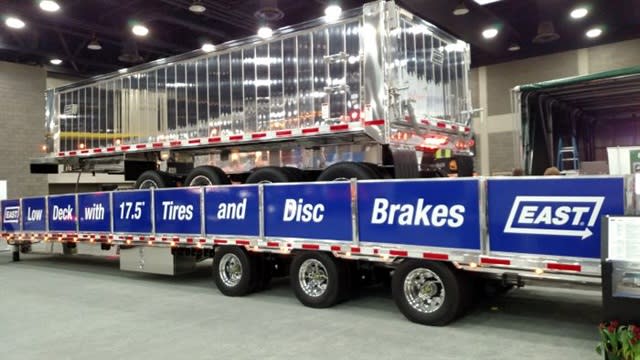
East Manufacturing – Featured a BST II low-deck (36 inches) platform at MATS using three Ingersoll axles and six Wabco air disc brakes riding on 17.5-inch wheels and tires, for tall loads like air conditioning towers. Disc brakes cost more to buy, but pads last three to four times longer than drum linings due to better air flow that dissipates heat. Strapped aboard was a four-axle (tandem and two pushers) Genesis end-dump made to meet bridge-formula weight regulations in Ohio and other states.
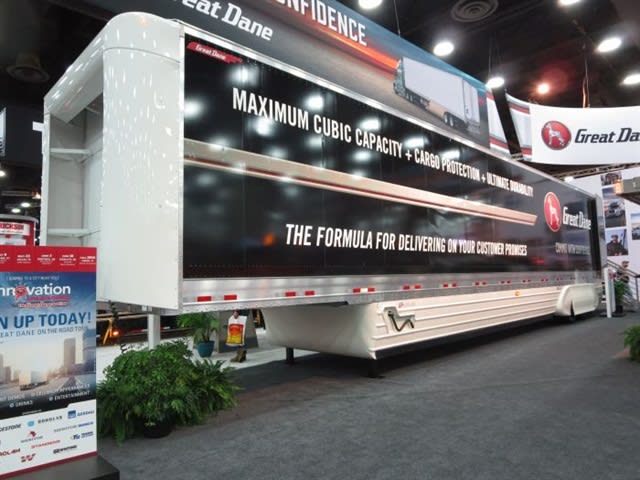
Great Dane – Looking on the move just sitting there was at its MATS booth a prototype, streamlined version of a Champion CP composite plate van with bonded lap-joint side walls and several anti-corrosion treatments on rear doors, undersides and frame rails. Laydon Composite gap-sealing nose faring and long side skirts with front air dam were the primary aerodynamic improvers.
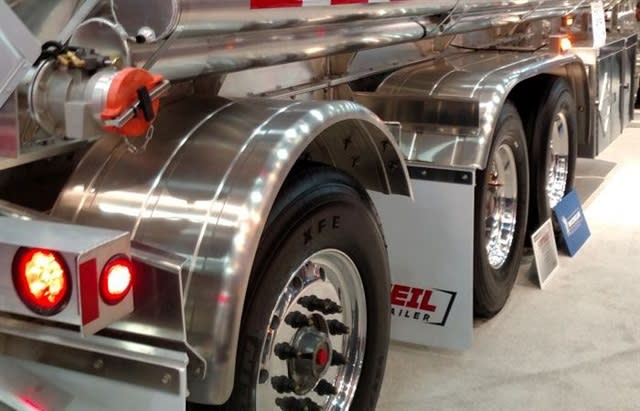
Heil – MATS booth featured a 53-foot, 9,300- to 9,500-gallon aluminum petroleum tanker with a steerable, liftable 20,000-pound tag axle behind the 34,000-pound tandem for use in over-80,000-pound CGW states like Nebraska, Colorado and Wyoming. In Oklahoma and other states, they have hauled crude oil from wellheads directly to close-by refineries, bypassing bottle-necked pipelines.
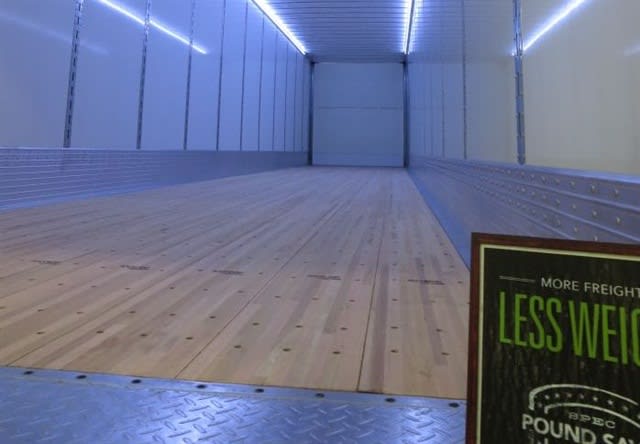
Hyundai Translead – Two dry vans and two reefers had the latest wall and floor technology at MATS. The reefers had LED strip lighting instead of traditional fluorescent lamps; LEDs use fewer amps and provide bright-white illumination. Coming next: sliding mounts so the LEDs can move to where activity is; wiring to allow movement is being worked on. Hyundai also showed a composite flatbed, a 53-footer with (among other things) aluminum winch rails and galvanized steel crossmembers.
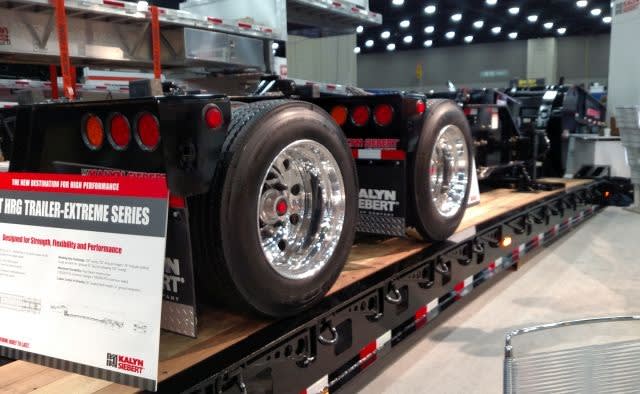
Kalyn Siebert – Extreme-series lowboy at its MATS booth had a removable gooseneck, Hydraload tandem equalizing system and a 60-ton rating. A steel step-deck had 48- and 68-inch deck heights, was extendable from 53 to 77 feet, and was set up for coupling to a “jeep” trailer and mounting rear booster axles. It was capable of doing the work of four or five separate trailers.
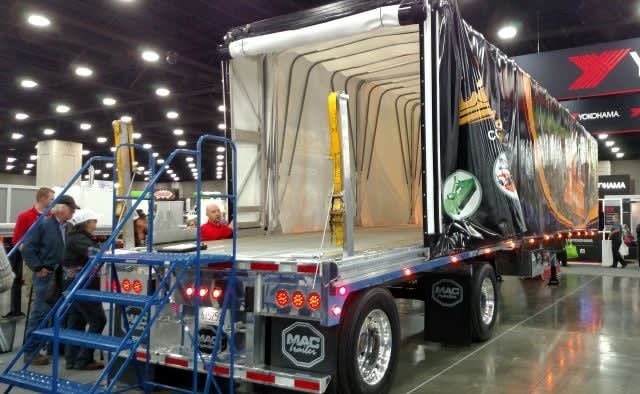
Mac Trailer – Among 14 flatbed, dump, wet and dry tanker, and trash-transfer trailers Mac exhibited in its large booth at MATS were a lightweight flatbed (9,840 pounds) that had a narrow neck and long (47-inch) upper coupler area, and Lo-Pro Elite curtain-side sliding mechanism for side handling of sensitive cargo. And an aggregates and asphalt hauler with a Keith V-slat moving floor, allows discharge inside buildings, under trees and other areas with restricted overhead clearances.
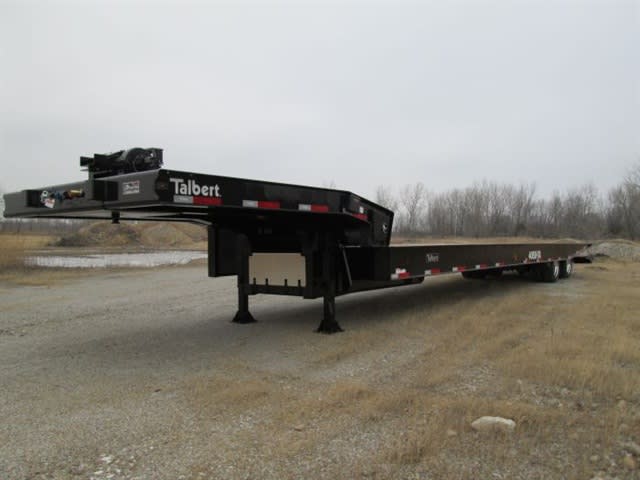
Talbert – TA-series traveling-axle lowbed shown at MATS had structural changes that raise bed height slightly but lower tare weight and add about 5 tons of payload. Ratings range from 40 to 55 tons, more tie-down points are standard and a larger hydraulic cylinder moves the axles quicker. Talbert promotes Valspar Aquaguard undercoating that guarantees three-year protection against corrosion (and usually lasts seven years) at a quarter of the cost of galvanizing.
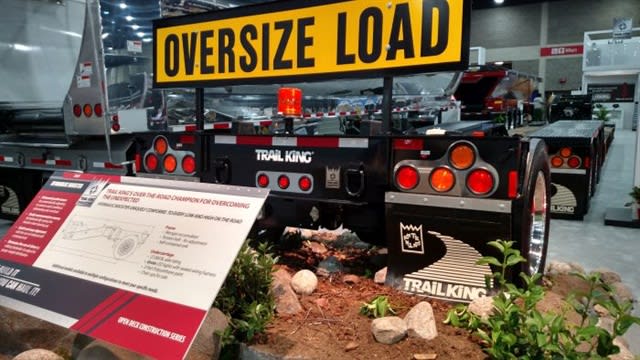
Trail King – Hydraulic booster axle adds thousands of pounds of capacity to the lowboy it’s attached to, then folds up for travel aboard the empty trailer (not a new item, by any means, but creatively shown at MATS climbing over fiberglass dirt and rocks). Trail King announced it will return to the steel end-dump business which it left during the Great Recession, and recently acquired aluminum grain trailer maker Dakota Trailer Manufacturing.
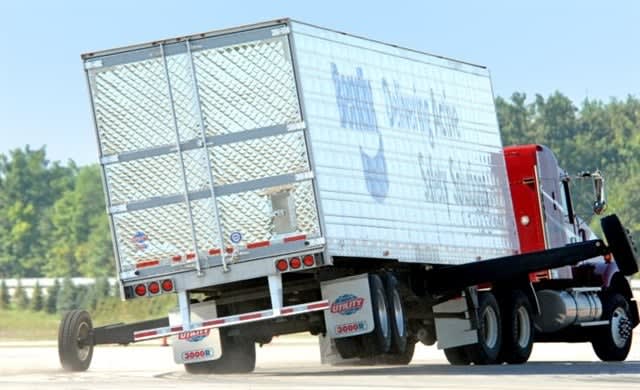
Utility Trailer Manufacturing – Says it’s the first manufacturer to include roll stability as standard equipment on a refrigerated trailer, making stability protection from Bendix Commercial Vehicle Systems a standard feature on the 3000R base model refrigerated trailer.
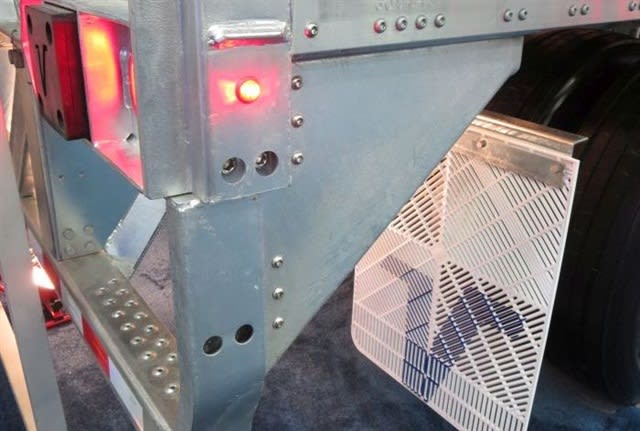
Vanguard National – At MATS booth, an extra-strong rear-impact guard had large gussets at each end in addition to Canadian-spec vertical braces, and note the “fly swatter” mudflap. AeroSail side skirts on another van had polypropylene fabric (like that on curtain-side trailers) braced by fiberglass dowels for light weight, low cost and ease of installation. And a 33-foot dry van anticipated possible legalizing of twin 33s by Congress.
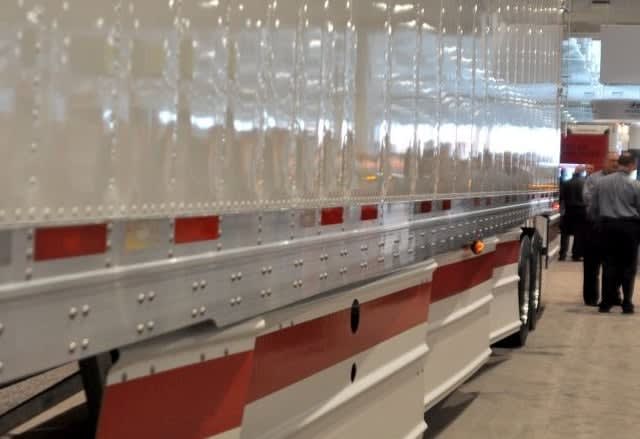
Wabash National – Introduced the Ventix DRS trailer drag reduction system and aerodynamic tail device at TMC. Together they provide over 9% in fuel economy improvement, classifying as an EPA SmartWay Elite aerodynamic device combination. Ventix DRS patent-pending segmented design manages air flow across the entire length of the trailer and eliminates drag points. The AeroFin aerodynamic tail device, which deploys automatically, manages airflow across the rear of the trailer.
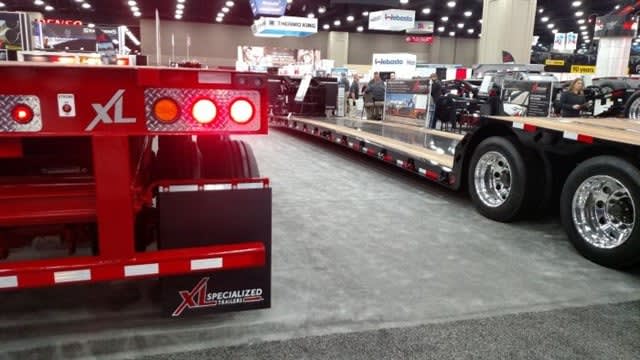
XL Specialized – XL60 Mini-Deck lowboy with a main deck height of 12 inches and a 30-ton rating. XL80 lowboy had a hydraulic gooseneck and a 40-ton rating were on the floor at MATS. And an XL80 flat-deck extendable could stretch from 53 to 91 feet, and had an air-powered locking mechanism.
More Equipment

How Volvo Updated Its D13 for EPA 2027 [Watch]
Volvo’s updated D13 promises lower emissions without sacrificing performance or fuel economy. Take a closer look at what changed inside the engine in this HDT Spotlight video.
Read More →
Michelin Tire Improves Efficiency and Durability for Regional Fleets
The Michelin X Multi Energy D2 is a regional haul drive tire engineered to help fleets improve fuel efficiency, durability and traction in demanding stop-and-go operations.
Read More →
ZF Expands Commercial Vehicle Push in North America
ZF is expanding its North American commercial-vehicle presence with new transmission applications, electrification, trailer technology and autonomous-driving systems.
Read More →
Tesla Wants a Self-Driving Semi. Are Cameras Enough?
Could Tesla’s camera-only autonomous driving technology work on an 80,000-pound Semi? In this commentary, HDT's Deborah Lockridge takes a look at Tesla, Cybercab, and how autonomous trucks see the road.
Read More →
Kodiak: Driverless Long-Haul Truck Launch on Track for 2026
Kodiak AI says its driverless long-haul safety case is 93% complete and it remains on track to begin commercial operations by year-end 2026.
Read More →
What DOT’s Automated Vehicle Strategy Means for Trucking
The U.S. Department of Transportation issued a new automated-vehicle strategy that outlines plans for driverless-truck regulations, cross-state freight corridors, and federal safety standards.
Read More →
East Coast Port Launches $45M Electric Truck Push
The Port Authority of New York and New Jersey announced millions in incentives for zero-emission drayage trucks, yard tractors, and new charging hubs near the port.
Read More →
PlusAI Going Public to Fund Autonomous Truck Launch
A SPAC deal could provide PlusAI with up to $300 million as it works toward a 2027 commercial launch of factory-built autonomous trucks.
Read More →
NHTSA Moves to Rewrite Truck Fuel-Economy Rules
The National Highway Traffic Safety Administration says it lacks authority to regulate medium- and heavy-duty truck engines separately from complete vehicles, but the existing standards have not yet been eliminated.
Read More →
Detroit Opens Orders for EPA 2027 Engines
Detroit isn’t starting from scratch to meet EPA 2027 diesel emissions standards. Its Gen 6 DD13 and DD15 engines keep much of today’s platform while updating the fuel and aftertreatment systems.
Read More →