




Staples Runs Electric Trucks in its Fleet
Getting office-supply products to Staples’ 2,000-plus stores around the world and directly to business customers takes more than pushing an Easy button, even if Mike Payette, director for fleet equipment, has four of the advertising-theme props, “in four languages,” on his desk.

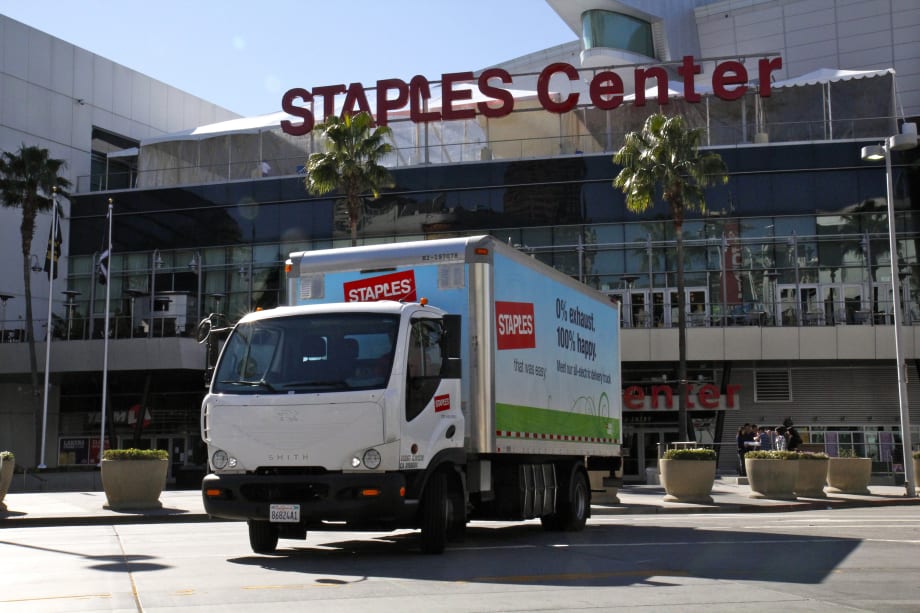
Short routes with many stops, including some in downtown Los Angeles, are ideal for Staples’ Smith Newton electric trucks.
Getting office-supply products to Staples’ 2,000-plus stores around the world and directly to business customers takes more than pushing an Easy button, even if Mike Payette, director for fleet equipment, has four of the advertising-theme props, “in four languages,” on his desk.
Out on the streets he’s got 1,770 medium-duty trucks to carry the goods, most of them diesels. But 53 are Smith Newton battery-power electrics, which are working so well that he’s adding five updated models. More might be added as leases end on Staples’ conventional trucks.
Short routes with many stops, including some in downtown Los Angeles, are ideal for Staples’ Smith Newton electric trucks.
“These electric trucks were made for urban delivery,” he says from his office in Framingham, Mass. “That’s where they shine and deliver the savings.”
They’re at work in or near eight cities across the U.S. on routes that include lots of stops and limited miles. They cost more to buy – how much more he wouldn’t say – but state and federal grants offset some of that expense, and operating and maintenance costs are low enough to make a good business case.
“The truck has to carry its own weight,” Payette says. “It has to pay for itself, justify itself and fit in the fleet profile. We don’t place it on an artificial route created for it; it runs a regular route.”
In Los Angeles, one of the Newtons is on a route that covers only 35 miles. On one stop alone it might back up to a dock where the driver delivers to 12 customers in that building. The truck waits, consuming almost no electricity, so it needs to be charged up only every couple of days.
Some routes include 50 to 70 stops a day, and are up to 120 miles. The ones over 65 miles are better suited to diesels. But on short runs the diesels become inefficient, burning fuel not just to move the truck but, on those with EPA 2007 and 2010-spec engines, to burn off soot in their particulate filters.
A diesel might burn 8 gallons of fuel worth $32 or more compared to $6.50 to recharge an electric truck’s batteries.
At the end of a shift, the Newtons return to a home base, often inside buildings, and are plugged in with their chargers set to activate at 9 p.m., when non-peak electricity rates go into effect.
Charging usually takes about four hours. Many trucks come in with the batteries only 20% depleted due to low speeds and proper driving. Drivers are trained to avoid jackrabbit starts and to take advantage of regenerative braking whenever possible. “Maintenance is 50% that of a diesel, or less,” Payette says, because there’s no engine, transmission or driveline. Like other electric vehicles, Newtons have motors, batteries and electronic controls with few moving parts.
Staples’ first-generation models have induction motors and large, heavy battery packs, and are rated at 19,000 pounds gross. The second-generation Newtons will have more efficient permanent-magnet motors and smaller battery packs that cut tare weight and allow higher payloads. Both are rated at 22,000 pounds gross, compared to 19,500 pounds for comparable diesel trucks.
Staples has had no problems with the lithium-ion batteries. Lightning struck a building in which one Newton was parked and it burned out the truck’s electronic control module, but Smith replaced it under warranty, Payette says.
“Drivers would rather drive an electric,” he says. “Once they’re in one, they never want to drive a diesel again. Ask any driver out there. It’s a peaceful experience. Traffic doesn’t bother them. There’s no vibration, no noise, no odor; they compare it to driving a recliner chair.
“Many of our customers enjoy having their goods delivered in an electric truck. ‘I’d love to give you my business,’ some of them say. ‘Can you ensure that they’ll come in an electric truck?’ We will if we have one in their area. An electric truck helps reduce their carbon footprint and has a bigger impact on cleaning the air than anything they can do to their buildings or by themselves.”
More Fuel Smarts

Wex Adds Cardless Fuel Payments for Over-the-Road Customers
A new fuel card feature for Wex customers offers convenience and security.
Read More →
New California Law Could Shed Light on Electric Truck Prices
Why do battery-electric Class 8 trucks remain so expensive? A California bill signed by Gov. Gavin Newsom would give fleets and state agencies more visibility into what manufacturers charge.
Read More →
How Volvo Updated Its D13 for EPA 2027 [Watch]
Volvo’s updated D13 promises lower emissions without sacrificing performance or fuel economy. Take a closer look at what changed inside the engine in this HDT Spotlight video.
Read More →

Diesel Price Spike Shortens Payback for Natural Gas Trucks, Report Says
Energy Vision estimates fleets could recover the higher purchase price of an RNG-fueled Class 8 tractor in 1.3 to 2.8 years under current fuel-price scenarios.
Read More →
Calstart Becomes Catalyst Mobility, Reflecting Broader Focus
Calstart is now Catalyst Mobility, reflecting the nonprofit’s growing national role in clean transportation, including zero-emission trucks, infrastructure and incentive programs.
Read More →
Record Diesel Prices Squeeze Trucking Fleets
Average U.S. diesel prices have climbed to nearly $6 a gallon, surpassing the 2022 record as tight refinery capacity and Middle East disruptions keep fuel costs elevated.
Read More →
How Fuel Delivery Shapes Engine Performance
Fuel delivery depends on more than what happens at the injector. For fleet, maintenance and technical professionals, looking at the full path from pump to injector can provide useful context for understanding engine performance.
Read More →
East Coast Port Launches $45M Electric Truck Push
The Port Authority of New York and New Jersey announced millions in incentives for zero-emission drayage trucks, yard tractors, and new charging hubs near the port.
Read More →
Detroit Opens Orders for EPA 2027 Engines
Detroit isn’t starting from scratch to meet EPA 2027 diesel emissions standards. Its Gen 6 DD13 and DD15 engines keep much of today’s platform while updating the fuel and aftertreatment systems.
Read More →
Zero-Emission Truck Corridor Planned for West Coast
California, Oregon, Washington, British Columbia and Baja California are coordinating plans for truck charging and hydrogen fueling from Canada to Mexico.
Read More →