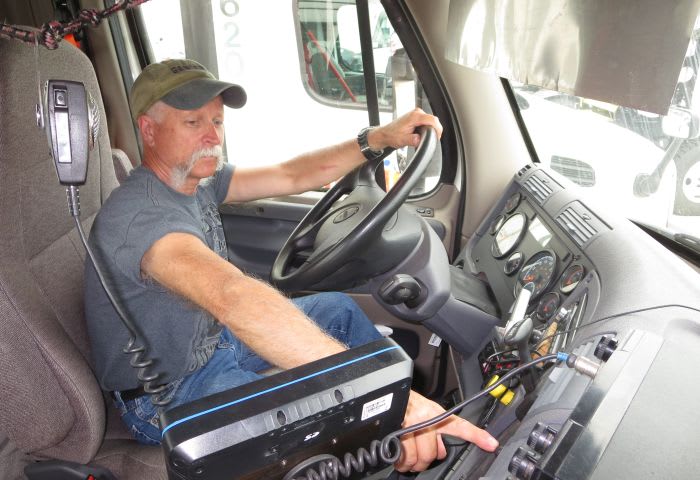
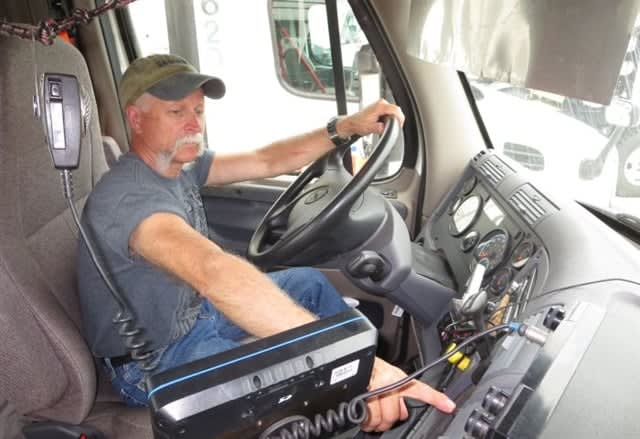
Meijer Logistics driver Ron Diamond points to the button that can save him considerable work and time — and prevent an injury — during a hookup.
2 min to read
Meijer Logistics driver Ron Diamond points to the button that can save him considerable work and time — and prevent an injury — during a hookup.
Ron Diamond is typical of the drivers who run out of Meijer Logistics’ distribution facility in Newport, Mich., south of Detroit. He drops and hooks trailers about 10 times a day, and it can be tiring. But dropping and hooking are integral to the operation of Grand Rapids-based Meijer Stores, which has 228 tractors and 2,850 trailers in its private fleet.
Ad Loading...
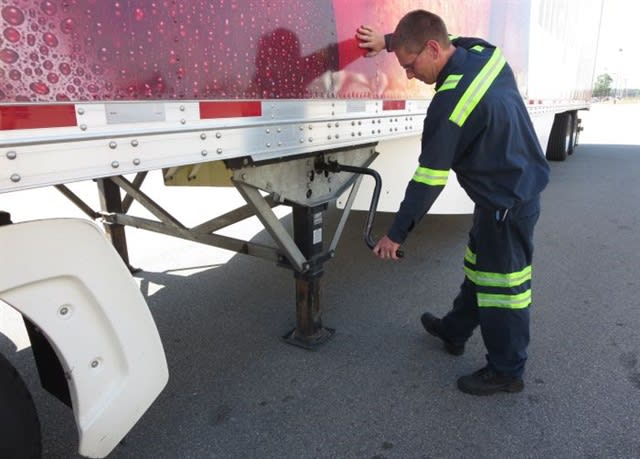
“Cranking the landing gear is the hard part,” Diamond says. Cranking is required not only to raise and lower the gear for travel and parking, but also to adjust the nose height of trailers before coupling onto them with the tractor’s fifth wheel.
Even if the landing gear is in low range, it takes arm, shoulder and back muscles to raise a nose so the upper coupler plate and kingpin matches the height of the fifth wheel. Of course, it’s harder if the trailer’s loaded. Dan Scherer, Meijer Logistics’ fleet maintenance manager, says back injuries can be a plague to drivers and employers alike.
Ad Loading...
But those injuries may be a thing of the past because Meijer has adopted the Hadley SmartValve, which turns the tractor and its air suspension into a jack that does the heavy work.
The Hadley SmartValve is primarily an adjustment valve that keeps the tandem suspension at a preset height. If a trailer’s nose is too low, using the normal dump valve bleeds air from the bags and lets the tractor’s rear end settle down so the frame and fifth wheel slides under the nose. If it still can’t get under, the driver backs up a bit more so two ramps atop the frame rails — specially spec’d by Meijer — wedge against the nose and upper coupler.
Then, instead of having to get out to start
cranking, the driver pushes a button on the dash. This sends air back into the bags and re-raises the tractor’s rear along with the trailer, unloading the weight off of the landing legs. Now he can resume backing under the nose and couple onto the kingpin. The SmartValve also helps if the trailer’s nose is too high because the tractor’s rear can be raised over normal ride height to match it.
A Hadley SmartValve is now on 200 of Meijer’s tractors. It’s part of the normal spec on all new equipment, and it’s almost completely phased into its fleet. “This device not only reduces injuries, but it’s a real time-saver for the drivers,” Scherer says. “It also reduces trailer landing leg and gearbox damage.”
Cranking to adjust a trailer nose’s height is the hard part of hooking, and can cause back, shoulder and arm injuries.
Fleet Snapshot
Who: Meijer Logistics
Where: Newport, Mich.
Fleet: 228 tractors and 2,850 trailers (system-wide)
Operations: Regional distribution supporting Meijer Stores
Fun Fact: Meijer’s 220 “supercenters” in six states sell groceries and merchandise, from electronics and auto supplies to housewares and clothing.
Challenge: Injuries and time associated with drop-and-hook operations
Fleets have more visibility into truck health, safety events, and driver activity than ever. The next challenge is turning all that information into useful guidance for the person who has to decide what to do next.
Federal regulators also are targeting more than 160 additional training providers and launching a nationwide audit of third-party CDL skills testers as part of a broader crackdown on trucking fraud.
Two pilot programs could eventually reshape hours-of-service rules, giving truck drivers options to pause their 14-hour clock or use longer split sleeper rest periods.
Medical-card violations jumped to the top of the driver out-of-service list during CVSA’s 2026 International Roadcheck, while English-language proficiency violations appeared among the leading violations for the first time.
New Teletrac Navman research suggests that onboarding, transparency about driver data, and positive feedback can play a significant role in how commercial drivers respond to safety and coaching technology.
By changing regulations on English-language proficiency requirements for commercial drivers, rather than relying on a guidance memo, the FMCSA said future administrations won't be able to walk back the Trump administration's stricter enforcement with just a memo.
The Freedom Haulers program pulls together existing and expanded programs at several federal agencies to recruit veterans to drive commercial heavy-duty trucks and cut the red tape for them to get a CDL, training, and employment.