





Part 3: Align the Truck Before the Need Arises
Regular Tire Inspections Save Time in the Long Run
National Tire Safety Week is more for consumers and passenger car drivers, but given tires' third-place ranking in trucking fleets' operating costs, we figured a few timely reminders wouldn't hurt. This is part one in a five-part series for National Tire Safety Week.
May 29, 2017
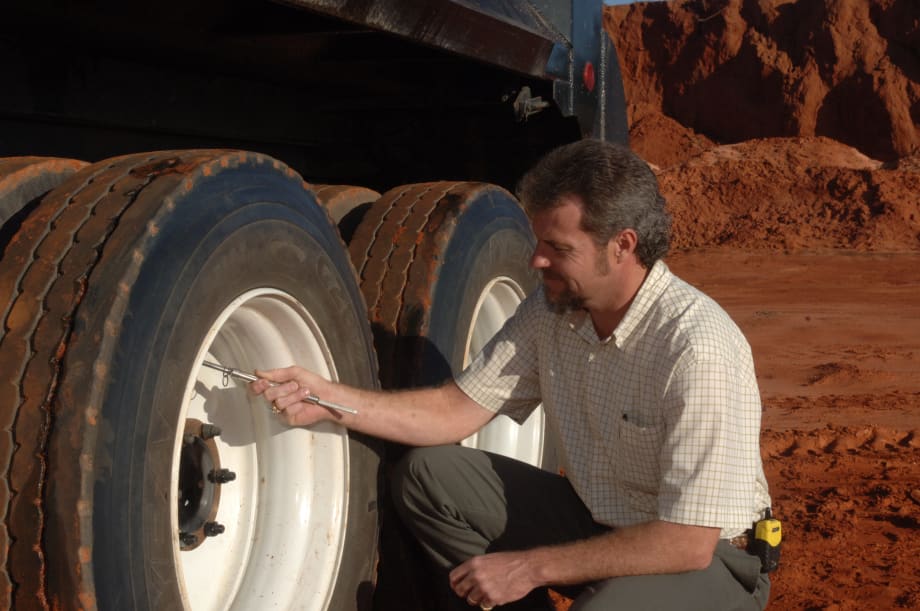
Stay on top of tire inflation and most of your roadside failures will disappear. Photo from Goodyear.
3 min to read
While National Tire Safety Week is a consumer-focused initiative presented by the Rubber Manufacturers Association designed to remind passenger car drivers and owners to get their tires into tip-top shape prior to the long holiday weekend, it's a good time to be aware of truck tire safety as well. Every day of the year, long haul trucks run the equivalent of an average family's "big summer road trip" or cross-state visit to Grandma's place, so reminders such as this one could be easily dismissed. However, we all know that tire maintenance isn't one of trucking's strongest suits.
If there are problems with your tires, you might need some time to schedule service to sort out the problem. Even if time is tight, remember that a thorough tire and wheel inspection will take a lot less time than the service call required to repair a tire gone bad.
"Not practicing proper tire care is the biggest pitfall we see," says Jason Evans, director of store operations for GCR Commercial Tires & Service, a division of Bridgestone Americas' Tire Operations. "We expect our tires to do a lot for us, and they need to be inspected frequently. By being proactive in tire maintenance, fleets can feel confident that their trucks are operating in a way that promotes safety and productivity."
To kick off National Tire Safety Week, Evans urges fleets and drivers to carefully inspect their tires before elevated summer temperatures and hot pavement take their toll on weak tires.
Check tire inflation pressure at each wheel position when the tire is cold with a reliable or calibrated pressure gauge, and inflate the tire to the fleet's recommended pressures. Running underinflated tires increases the risk of a blowout or casing damage due and the opportunity for irregular wear to set in. Never bleed or reduce air pressure from a hot tire.
Make a thorough check for uneven wear due to some mechanical deficiency. Consider rotating tires that already show signs of irregular wear to even out the wear, and of course, determine the cause of the wear and repair it.
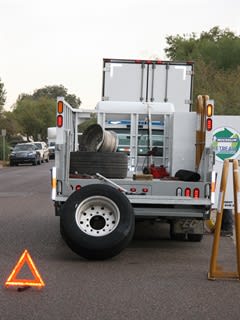
The inevitable result of poor tire maintenance is an expensive and time consuming road call. Photo from Michelin
Juan Britos, the senior technical services specialist at Hankook Tire, reminds drivers that inspections should be carried out weekly at a minimum, but more frequent inspections won't do any harm.
"Unless you look, you may not be aware of a developing problem, such as nail or screw that hasn't yet completely penetrated the casing," he says. "Frequent visual inspection can reveal problems like recent cuts or sidewall damage that may have just occurred."
Here's what to look for on thorough tire inspection:
Check tread conditions for tread depth, signs of uneven wear, damage such as flat-spotting, cuts, penetrations, etc. And don't overlook the sidewalls, particularly the inside sidewalls that you can't see from curbside.
If the tires are getting close to the minimum tread depth, (4/32 on a steer tire and 2/32 on a drive or trailer tire) start making plans to replace them. Tire with less than the minimum tread depth can be placed out of service during a roadside inspection.
While you're at it, check the lubricant level in the wheel hubs, where applicable, and look for signs of leakage around the hubcap or for oil on the inner sidewalls of the tire.
Downtime is always a concern, but from July through October – or peak season – fleets are faced with heavy demands, making uptime a premium and tire maintenance a necessity. While National Tire Safety Week is typically aimed at drivers of passenger vehicles, take it as a reminder that commercial tires need periodic attention too. You don't want to be going into your peak hauling season with weak tires.
Subscribe to Our Newsletter
More Safety & Compliance

FMCSA Pauses Biennial-Update Enforcement Amid Motus Transition
Carriers whose updates were due on or after June 1 have more time, while FMCSA works to stabilize its new registration system and warns of phishing sites impersonating its new carrier registration system, Motus.
Read More →
ZF Expands Commercial Vehicle Push in North America
ZF is expanding its North American commercial-vehicle presence with new transmission applications, electrification, trailer technology and autonomous-driving systems.
Read More →
Truck Drivers Need More Than Another Alert
Fleets have more visibility into truck health, safety events, and driver activity than ever. The next challenge is turning all that information into useful guidance for the person who has to decide what to do next.
Read More →
Tesla Wants a Self-Driving Semi. Are Cameras Enough?
Could Tesla’s camera-only autonomous driving technology work on an 80,000-pound Semi? In this commentary, HDT's Deborah Lockridge takes a look at Tesla, Cybercab, and how autonomous trucks see the road.
Read More →
What DOT’s Automated Vehicle Strategy Means for Trucking
The U.S. Department of Transportation issued a new automated-vehicle strategy that outlines plans for driverless-truck regulations, cross-state freight corridors, and federal safety standards.
Read More →
NYC Expands Speed, Pedestrian Safety Tech Across Fleet
New York City is expanding intelligent speed assistance and pedestrian-alert systems across its municipal fleet, moving the technologies from pilot programs into vehicle procurement and retrofit requirements.
Read More →
FMCSA Removes 110 Truck Driver Training Schools from Certified ELDT List
Federal regulators also are targeting more than 160 additional training providers and launching a nationwide audit of third-party CDL skills testers as part of a broader crackdown on trucking fraud.
Read More →
Beyond DOT Compliance: What Makes a Trucking Fleet Truly Safe?
A trucking fleet can follow every rule and still make unsafe decisions. The real test comes when safety conflicts with freight, productivity, or cost.
Read More →
Hours of Service Pilot Programs: FMCSA Readies for 2027 Rollout
Two pilot programs could eventually reshape hours-of-service rules, giving truck drivers options to pause their 14-hour clock or use longer split sleeper rest periods.
Read More →
New Guide Offers Pet Safety Tips for Truck Drivers
Hundreds of thousands of pets travel in truck cabs. A new safety guide from Volvo Trucks and the Center for Pet Safety offers practical advice for truck drivers who bring dogs and cats along for the ride.
Read More →