




Refrigerated Trucks to Keep Their Cool Thanks to Fuel Cell Technology
Grocery merchants in Texas, California and New York will soon have ice cream, frozen foods and fresh produce delivered by tractor trailers whose refrigeration units are powered by fuel cells, a clean technology that makes energy silently and with dramatically reduced emissions.
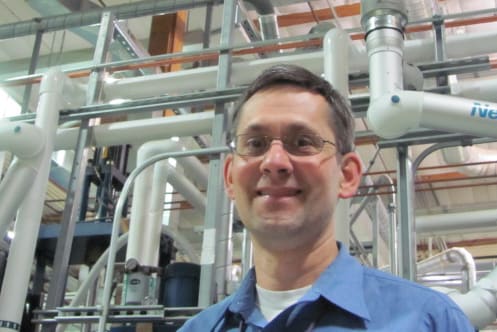
Kriston Brooks at the Applied Process Engineering Laboratory.
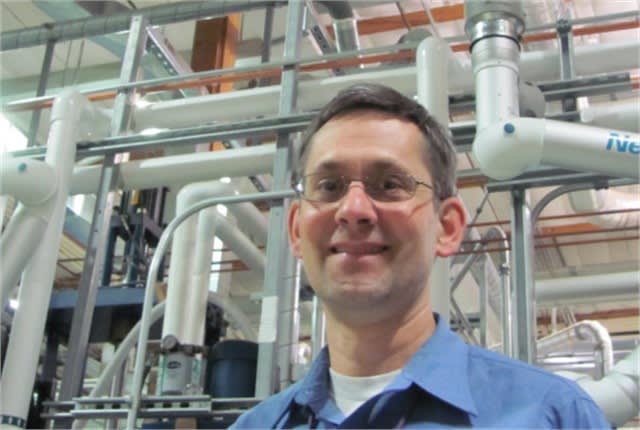
Kriston Brooks at the Applied Process Engineering Laboratory.
Grocery merchants in Texas, California and New York will soon have ice cream, frozen foods and fresh produce delivered by tractor-trailers whose refrigeration units are powered by fuel cells, a clean technology that makes energy silently and with dramatically reduced emissions.
The fuel cells will do the work normally done by a small diesel engine, which keeps the cargo at the proper temperature while the trucks are making deliveries. Each of the four trucks will still be equipped with a main diesel engine that actually powers the truck.
Researchers at the U.S. Department of Energy's Pacific Northwest National Laboratory, which is overseeing the project, believe this will be the first time that refrigerated trucks making deliveries have been equipped with a fuel cell — a device that creates electricity by driving chemical reactions using hydrogen and air. The only byproducts are heat and water.
"This is a great application for a fuel cell," said Kriston Brooks, the PNNL researcher leading the project. "A trailer refrigeration unit traditionally is powered by a small diesel engine or electric motor that drives compressors to provide cooling to the cargo. A fuel cell can potentially provide a clean, quiet and efficient alternative by powering the electric motor."
Two leading fuel cell manufacturers, Massachusetts-based Nuvera and Albany, N.Y.-based Plug Power Inc., will each receive $650,000 from DOE's Office of Energy Efficiency and Renewable Energy. The companies will provide matching funds and labor of their own. A PNNL team led by Brooks will oversee and evaluate the two-year program.
Industry officials estimate that approximately 300,000 refrigerated trucks with auxiliary power units are on the road in the United States. By replacing the small diesel engines with the more efficient fuel cell, users will see fuel savings of approximately 10 gallons a day per unit, in addition to reduced emission of pollutants and significantly quieter operation.
"Accelerated fuel cell use in this application is also expected to create jobs in the energy sector, increase fuel cell manufacturing volume, decrease costs, and catalyze a stronger domestic supplier base," said Jamie Holladay, PNNL's sector manager for fuel cell technologies.
Fuel cells are becoming more common as energy sources in buildings and in vehicles such as buses. While the devices are generally more expensive than traditional forms of energy generation, many scientists and product developers expect that as they become more widely adopted and production levels increase, their cost will come down, similar to what has happened to products like cell phones.
"One of the goals is to accelerate fuel cell use in industry," said Brooks. "In spite of their higher costs now, the higher efficiency and zero emissions from fuel cells are enough to convince many companies not to wait to implement this technology. Fuel cell products are already used widely in warehouses, and this project broadens their reach."
In one project, Nuvera will work with Thermo King to develop the refrigeration unit to keep the truck cool using Nuvera's Orion fuel cell stack. That truck will make deliveries for a Sysco Corp. food distribution facility in Riverside, Calif., and for a San Antonio, Texas, food distribution center for the H-E-B grocery store chain.
In the other project, Plug Power will work with Carrier Transicold and Air Products to equip trucks making deliveries for a Sysco Corp. food distribution facility on Long Island. The trucks will be equipped with Plug Power's GenDrive fuel cell product.
Both the Sysco and the H-E-B facilities already use forklifts powered by hydrogen fuel cells, part of a trend fostered by DOE to increase the use of the technology in industry. At both companies, the infrastructure to provide hydrogen for the fuel cells is already in place; the hydrogen is generated on site from natural gas and water using Nuvera's PowerTap hydrogen generator and refueling system. For the site using the Plug Power technology, the hydrogen will be supplied by Air Products using an outdoor hydrogen dispenser.
Each fuel-cell powered refrigerated trailer will run for at least 400 hours at each demonstration site, delivering goods from the distribution centers to stores or other outlets.
More Fuel Smarts

How Volvo Updated Its D13 for EPA 2027 [Watch]
Volvo’s updated D13 promises lower emissions without sacrificing performance or fuel economy. Take a closer look at what changed inside the engine in this HDT Spotlight video.
Read More →
Diesel Price Spike Shortens Payback for Natural Gas Trucks, Report Says
Energy Vision estimates fleets could recover the higher purchase price of an RNG-fueled Class 8 tractor in 1.3 to 2.8 years under current fuel-price scenarios.
Read More →
Calstart Becomes Catalyst Mobility, Reflecting Broader Focus
Calstart is now Catalyst Mobility, reflecting the nonprofit’s growing national role in clean transportation, including zero-emission trucks, infrastructure and incentive programs.
Read More →

Record Diesel Prices Squeeze Trucking Fleets
Average U.S. diesel prices have climbed to nearly $6 a gallon, surpassing the 2022 record as tight refinery capacity and Middle East disruptions keep fuel costs elevated.
Read More →
How Fuel Delivery Shapes Engine Performance
Fuel delivery depends on more than what happens at the injector. For fleet, maintenance and technical professionals, looking at the full path from pump to injector can provide useful context for understanding engine performance.
Read More →
East Coast Port Launches $45M Electric Truck Push
The Port Authority of New York and New Jersey announced millions in incentives for zero-emission drayage trucks, yard tractors, and new charging hubs near the port.
Read More →
California Bill Could Shed Light on Electric Truck Prices
Why do battery-electric Class 8 trucks remain so expensive? A California bill headed to Gov. Gavin Newsom would give fleets and state agencies more visibility into what manufacturers charge.
Read More →
Detroit Opens Orders for EPA 2027 Engines
Detroit isn’t starting from scratch to meet EPA 2027 diesel emissions standards. Its Gen 6 DD13 and DD15 engines keep much of today’s platform while updating the fuel and aftertreatment systems.
Read More →
Zero-Emission Truck Corridor Planned for West Coast
California, Oregon, Washington, British Columbia and Baja California are coordinating plans for truck charging and hydrogen fueling from Canada to Mexico.
Read More →
A Closer Look at Kenworth’s Electric T880E Vocational Truck [Video]
Learn more about Kenworth's T880E battery-electric vocational truck at the Paccar Technical Center, including its range, applications, upfitting considerations, and PTO options, in this HDT Spotlight video.
Read More →