





Dig Deeper: How Technology is Making Logistics More Efficient
Raising the Bar on Customer Service in the Supply Chain
The customer-service experience can make or break a trucking or logistics provider, says HDT's David Cullen in this commentary.
May 10, 2023

Image: HDT Graphic
3 min to read
Trucking is a high-touch business. Your customers up and down the supply chain must know where their shipments are and when they will arrive or be picked up, among other critical data points along the way.
Keeping your customers informed when they want to be and how they want to be requires answering — even anticipating — their queries quickly and efficiently, whether with email, text, various high-tech avenues, and even the good old telephone.
A study by DDC Freight Process Outsourcing, a provider of front- and back-office solutions to trucking and logistics firms, recently delved into customer service in the supply chain. The Evergreen, Colorado-based company surveyed key stakeholders, including shippers, carriers, third-party logistics providers, freight brokers, and other players on their approach to customer service.
As the study’s authors put it, your customer service team is your “primary touchpoint.” Customers are “looking for quick answers, responsive agents, omnichannel support, and convenient hours across the board.” And what customers experience will color their overall impression of your organization.
The study found that the ongoing shortage of customer service workers is a significant concern to companies that need to scale up.
“Customer support expectations were already rising before 2020, and the COVID-19 pandemic accelerated this shift,” the study report. What’s more, these expectations meant customer service teams had to raise the bar for customer care. “Providing excellent customer service is vital to a positive brand reputation and customer retention.”
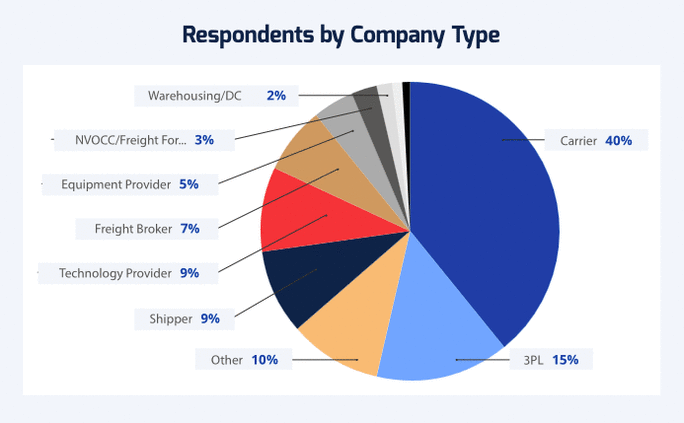
DDC Freight Process Outsourcing surveyed key trucking and logistics stakeholders on their approach to customer service.
Source: DDC FPO
Survey Finds Areas for Improving Customer Service in Logistics
Eye-opening is the finding that most companies provide only two primary support channels: phone and email. That’s despite the growing popularity of live chat, chatbots, self-service portals, and other high-tech methods. Some 88% of the respondent firms provide phone support and about 90% email support. Only about 22% and 7% offer live chat and chatbots, respectively.
Because many modern supply chains are global, “seamless support [is required] across continents, time zones, languages, and regulatory frameworks. This can be a hurdle for companies whose customer care teams are on the small side, especially if they’re centralized in one location.”
The survey found that “customer expectations” is the most common customer service issue, with 55% of respondents regarding it as a challenge. That makes sense given that factors such as response time, available support channels, and time to resolution can result in failing to meet customer expectations.
You Can't Manage What You Don't Measure
Yet there’s another shocker: Some companies aren’t even tracking key performance indicators — including those they deem important, such as customer retention, first-contact resolution, and cost per resolution.
“One significant customer-care gap uncovered by this survey pertains to measuring support performance,” the authors point out. “Thirty-five percent of respondents said their companies don’t track the quality of their customer support.”
When asked why, responses from carriers include examples such as:
Technology has not been instituted to measure this area yet.
We just don’t have anything set up to do that.
Unsure on how to best measure.
We handle any situation as it occurs.
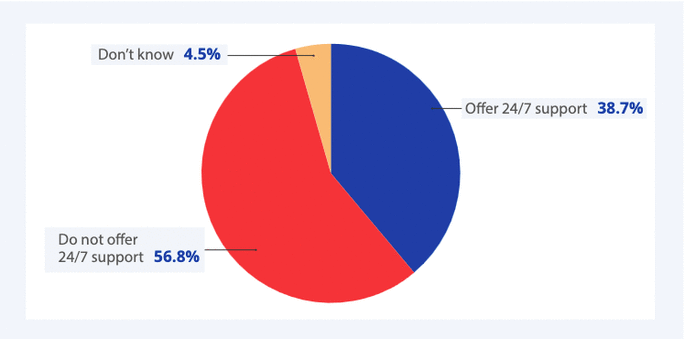
About 58% of teams with more than 75 agents provide 24/7 support, compared to 29% for those with 1-25 agents.
Source: DDC FPO
And size matters. The survey showed that the average number of support channels tends to increase as the size of the customer support staff increases. While the overall average number of channels is about three, teams of over 75 agents offer an average of 4.5 channels.
In the same vein, larger customer support teams are more likely to offer 24/7 support. About 58% of teams with more than 75 agents provide 24/7 support, compared to 29% for those with 1-25 agents. Still, about 57% of teams do not offer 24/7 support.
The report recommends strategies to improve customer experience:
Track/analyze customer-support KPIs
Offer more customer-support channels
Provide 24/7 multilingual support
Incorporate automation and AI
Consider outsourcing for scale.
Improve transparency/visibility.
Regularly train staff.
Subscribe to Our Newsletter
More Fleet Management

Sponsored•September 16, 2026
Color Match Smarter: Tools That Restore & Perform
For fleet managers and collision repair professionals keeping heavy-duty trucks on the road, getting the color right the first time isn't just about appearance — it's about efficiency, turnaround time, and bottom-line results. Discover how today's digital color tools are transforming the repair process from guesswork to precision.
Read More →
FMCSA Pauses Biennial-Update Enforcement Amid Motus Transition
Carriers whose updates were due on or after June 1 have more time, while FMCSA works to stabilize its new registration system and warns of phishing sites impersonating its new carrier registration system, Motus.
Read More →
Sponsored•September 14, 2026
2026 Blueprint for Countering Smarter Supply Chain Theft
Cargo theft is no longer just the cost of doing business. It's a multi-billion-dollar criminal enterprise exploiting vulnerabilities across your fleet, drivers, and supply chain.
Read More →


Sponsored•September 1, 2026
How Telematics Improves Visibility, Control, and Performance in Refrigerated Fleets
Explore how telematics help refrigerated fleets improve visibility, uptime, efficiency, compliance, and cargo protection across connected cold chain operations.
Read More →
What the U.S.-Canada Trade War Means for Trucking
Escalating U.S.-Canada tariffs could disrupt cross-border freight, reduce truck volumes, raise costs, and create new uncertainty for carriers on both sides of the border.
Read More →
What Are Trucking’s Top Concerns for 2026?
The American Transportation Research Institute wants to know what's worrying trucking fleet managers, drivers, and other stakeholders in its annual Industry Issues survey.
Read More →
American Trucking Associations Looks for a New Leader
ATA President and CEO Chris Spear abruptly left his job at the association on August 21, at a pivotal time for the trucking industry.
Read More →
Public Wi-Fi Cybersecurity Risks: How Truck Drivers and Fleets Can Protect Their Data
Public Wi-Fi can expose truck drivers and fleets to credential theft, malware, and other cyber threats. Here’s how to reduce the risk on the road.
Read More →
For Nicky Cupp, Fleet Innovation Starts With Frustration
HDT Truck Fleet Innovator Nicky Cupp turns everyday pain points at Fraley & Schilling into opportunities for better technology and smarter processes.
Read More →
Adam Buttgenbach’s Approach to Electric Trucks: Start With Where They Fit
HDT Truck Fleet Innovator Adam Buttgenbach helped PepsiCo build one of North America’s largest EV fleets by focusing on where electric trucks make operational sense.
Read More →