Workhorse’s W56 electric walk-in delivery van is poised to fill in a gap in the market, occupied by only a handful of walk-in vans in the Class 5-6 space.
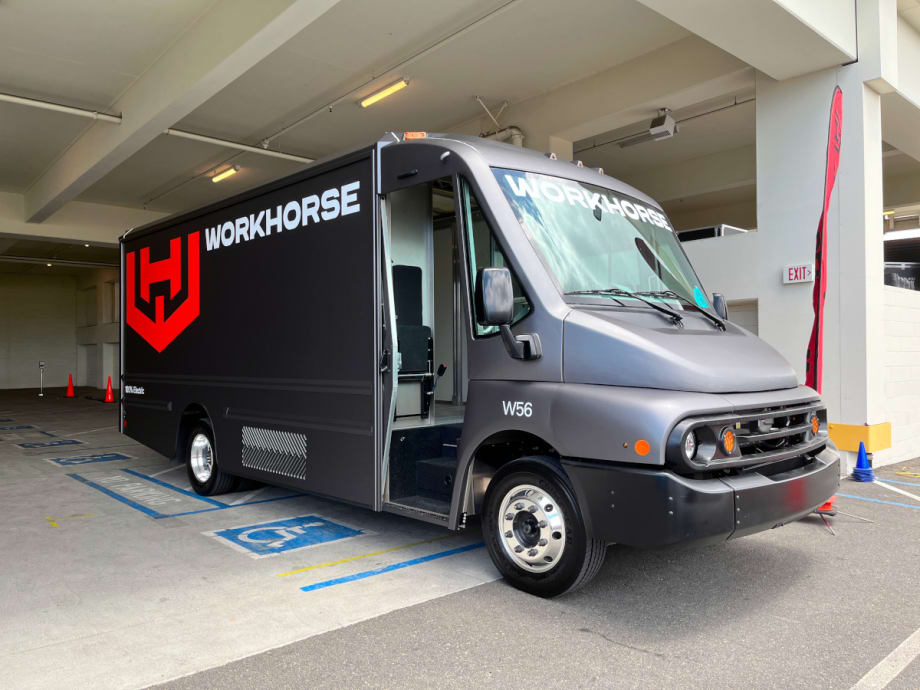
The grille on the W56 is futuristic/retro, reminiscent of early Ford or International trucks, but with more stylized lines. It’ll be easy to recognize on the street.
Photo: Jim Park
6 min to read
Workhorse’s W56 electric package delivery van is poised to fill a gap in a market that is occupied by only a handful of walk-in vans in Class 5-6 space.
Ad Loading...
Considering the size of the package truck market, there’s likely plenty of room for a few more up-and-comers. Several such trucks were on display at ACT Expo, earlier this month in Anaheim, California. We got a short spin in a Workhorse W56 during the media ride-and-drive portion of the show.
The truck I drove was just the second copy of the truck ever built. It’s still a work in progress, but it was enough to provide a taste of what we can expect when it goes into production this fall. Workhorse CEO Rick Dauch said the company plans to build 200 trucks this year, followed by up to 2,000 of them in 2024.
Ad Loading...
About the Workhorse W56
The truck is a fairly standard chassis measuring about 27 feet long, 8 feet wide, and 10.5 feet high. It has a 178-inch wheelbase, an advertised turning radius of 52 feet, and offers more than 1,000 cubic feet of cargo space. The curb weight with the standard battery complement is 13,000 pounds, leaving 10,000 pounds for payload on the 23,000-lb GVWR chassis.
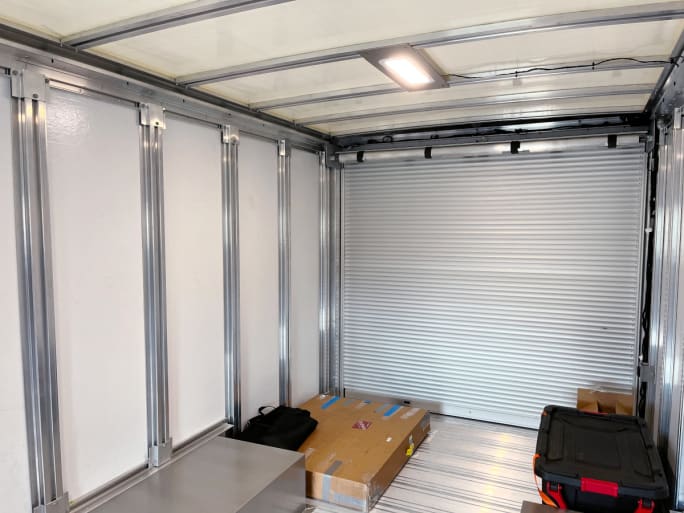
The structure of the van body is aluminum mated to one-piece sides made of foam-core with thermoplastic on both sides. Workhorse says it’s lighter and stronger than traditional body panels and will not delaminate with even significant impact. It’s also intended to help reduce the flexing of the body, which over time stresses the body panels and the structural members.
New to the market and unique to the W56 at this point are cylindrical crossmembers rather than the traditional ladder frame.
“That’s given us a lot less torsion in the frame, and also less flex than with some other designs we tried,” said my tour guide on the brief drive. “A lot of the thinking there was to protect the battery, but we’ve seen other benefits as well.”
Workhorse is in the process of applying for a patent on the design.
Ad Loading...
The W56 is powered by a 210-kWh lithium-iron-phosphate battery known for faster charging times and good bi-directional performance. It uses a Linamar e-axle propulsion system with a 690-volt motor.
Side and forward visibility is good, the driver’s seat is easy to climb into, and Workhorse is working on the noise from the cargo area.
Photo: Jim Park
Driving the W56
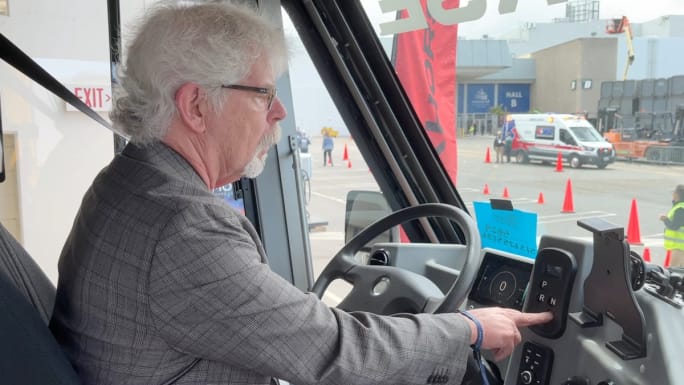
The ride-and-drive course was pretty short, maybe 2 to 3 miles, but it was exactly the environment the truck will see in real-world service — traffic, tight turns, and lots of stop-and-go driving. There wasn’t a whole lot of opportunity to put the truck through its paces, but I think I got a good taste of how it performs.
It’s got gobs of torque at launch, as most electric trucks do, and equally exciting regenerative braking capability. This truck was “opened up,” shall I say. It was basically operating at its full potential. My tour guide told me the software can be tailored to a fleet’s specifications, with up to three regen braking settings. They would typically not all be available to the driver but set by the fleet to suit its needs.
The settings on the test vehicle were pretty aggressive and the van was unladen, so it was a bit shocking when I took my foot off the accelerator pedal. With the correct settings and a little practice on the driver’s part, this will be a one-pedal truck. There’s definitely enough regen braking power there to cruise comfortably in traffic without ever using the hydraulic brakes. The regen braking engages as you lighten the pressure on the accelerator pedal. In other words, it’s not on or off. It can be “blended” for smoother operation.
It also has a creep mode, making it much like driving a traditional internal-combustion engine mated to an automatic transmission. Lift your foot off the brake pedal and the truck will creep forward slowly. The acceleration is linear and very smooth up to about 40 mph, which is as fast as I went on the short drive.
Ad Loading...
The power steering had a good road feel, and it was quite responsive. It uses an (obviously) electric power steering motor, some models of which I have found a little overly sensitive. This one was nice, albeit rather noisy. My tour guide was quick to point out that a newer version is in the works that promises to be much quieter.
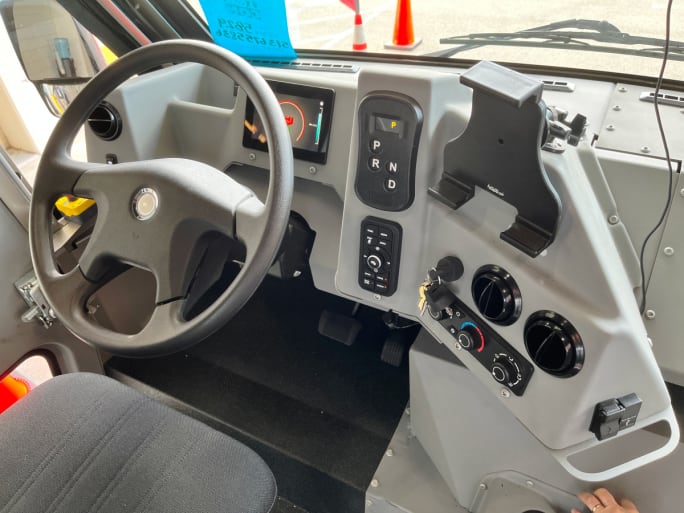
The dash is pretty basic, with just a need-to-know instrument package that includes a speedometer and battery state of charge indicator. A multifunction switch allows the driver to scroll through several other menus.
Photo: Jim Park
The Driver’s Station
The step-in height of the driver’s station is a very comfortable 12.5 inches, so it’s easy to climb into. The door easily slides open to the rear and latches solidly when pulled closed.
The dashboard is pretty sparse, really a need-to-know affair. The driver sees a ready indicator and battery state of charge when the system is turned on. When driving, he or she sees only a speedometer, the state of charge indicator, and a regen gauge to show how much energy is recovered from a braking event. It has the familiar HVAC controls, several air circulation vents, and a couple of 12-volt ports and USB charging ports.
It ain’t sexy, but it’s functional. I guess that’s why it’s called Workhorse.
Mounted high up in the center of the windshield is the display for the side and rear-view cameras. Frankly, I thought it was a bit small, but making it larger might have run afoul of the forward vision obstruction rules. That’s standard equipment on the truck, but there’s an optional 360-camera system available.
Ad Loading...
I’m of two minds on such displays. I think the displays should be located in the direction of the driver’s natural view when making a maneuver, so somewhere near the left mirror or the left side window for left turns, or centrally located on the dash for a more comprehensive view of the world outside. Making a driver look in some other, less intuitive, direction seems to me like an unnecessary step and one that might result in something critical being missed during a visual sweep of the mirrors and side windows.
I found this copy of the truck — being only the second one ever built — a bit noisy. I’ve driven similar walk-in vans and found them to be pretty noisy as well, with the whole cargo box acting as a reverberation chamber. I’m told reducing the chassis noise is an engineering priority as the truck is readied for series production, so I won’t pass harsh judgment on it at this point.
The structure of the van body is aluminum mated to one-piece sides made of foam-core with thermoplastic on both sides. Workhorse says it’s lighter and stronger than traditional body panels.
Photo: Jim Park
The Workhorse W56 is aimed squarely at last-mile package delivery fleets. Being a pretty familiar size and shape, it should fit in well there. Workhorse is also targeting utility services, construction and maintenance contractors, and industrial services such as linen and office supply companies.
Dauch told ACT Expo attendees during a press briefing that the company plans to roll out three versions of the truck: the 158, 178, and 208 in stripped chassis, cab/chassis, and a full-step van variant. That sounds like they have the market just about covered.
Workhorse W56 Specifications
Vehicle Class: Class 5 & 6
Interior Volume: 1,000+ cubic ft.
Payload (Class 6): 10,000 lbs.
GVWR (Class 6): 23,000 lbs.
Front axle: 8,000 lb.
Rear axle: 15,500 lb.
Estimated Range: Up to 150 miles
Battery Capacity: 210 kWh
Certification Targeted: FMVSS, ZEP, ZEV
Charging: Level 2 at 20kW / 12 hrs. Level 3 at 100kW / 3-4 hrs.
Volvo’s updated D13 promises lower emissions without sacrificing performance or fuel economy. Take a closer look at what changed inside the engine in this HDT Spotlight video.
The Michelin X Multi Energy D2 is a regional haul drive tire engineered to help fleets improve fuel efficiency, durability and traction in demanding stop-and-go operations.
ZF is expanding its North American commercial-vehicle presence with new transmission applications, electrification, trailer technology and autonomous-driving systems.
Could Tesla’s camera-only autonomous driving technology work on an 80,000-pound Semi? In this commentary, HDT's Deborah Lockridge takes a look at Tesla, Cybercab, and how autonomous trucks see the road.
The U.S. Department of Transportation issued a new automated-vehicle strategy that outlines plans for driverless-truck regulations, cross-state freight corridors, and federal safety standards.
The Port Authority of New York and New Jersey announced millions in incentives for zero-emission drayage trucks, yard tractors, and new charging hubs near the port.
The National Highway Traffic Safety Administration says it lacks authority to regulate medium- and heavy-duty truck engines separately from complete vehicles, but the existing standards have not yet been eliminated.
Detroit isn’t starting from scratch to meet EPA 2027 diesel emissions standards. Its Gen 6 DD13 and DD15 engines keep much of today’s platform while updating the fuel and aftertreatment systems.