





Related: TRW’s New Steering Systems Improve Control and Efficiency
Quick Spin: TRW's Smart Power Steering
TRW’s new ReAX electric/hydraulic power steering senses vehicle speed and proportionately assists the steering effort, which is great in tight spots.
May 28, 2015

ReAx reduces the steering effort dramatically, making it possible to one-finger the wheel. Try that with regular power steering.
4 min to read
TRW Automotive showed off a new commercial steering technology at the 2015 Mid-America Trucking Show. Called ReAx, it merges the company’s hydraulic power steering system with an electrically powered drive. The result reduces steering effort at low speeds, while increasing on-center stiffness at highway speed to enhance lane-keeping stability. That’s a tall order, but ReAx handles it deftly.
ReAx is not an add-on or a switchable driver assist system. It’s fully integrated into the traditional hydraulic power steering gear – built right onto the gear itself, in fact. The control module, electric motor, gearbox and the steering column position sensors are all inside, so the system functions as a single unit, not an electric-over-hydraulic arrangement.
The traditional power steering system provides the torque needed to steer the vehicle, while the electric motor and its sensors and electronics provide precision control to the hydraulic gear. Together, they exercise proportional control over the steering, based, in this case, on vehicle speed.
At low speeds, the system reduces the steering effort to nearly zero, yet it retains the feel drivers would expect from a truck steering system. It returns quickly to center as you are pulling out of a turn. While reversing, it resists the steering geometry’s natural inclination to return to center.
At higher speed, the steering feels stiffer, more like the driver would expect. And at highway speeds, TRW says the system actually adds stiffness to the steering to enhance stability and lane position retention.
ReAx uses proprietary torque and angle sensors, coupled with other vehicle signals such as a speed sensor, to prompt the ECU to calculate the required electrical assistance to provide the desired steering feel.
“Because the system is electronically controlled, OEs can dial in the precise ‘feel’ they want in their trucks, or customize the level of assistance to suit different applications,” explained Mark Cartwright, chief engineer of systems integration at TRW, who was along on our short evaluation of the system. “Drivers will appreciate how much their steering effort is reduced at low speeds and how much more stable the steering feels at high speed. It really gives them the best both ends of the steering spectrum.”
It’s failsafe, too. ReAx will revert to normal straight hydraulic power in the event of a failure of the electric drive. It’ll feel just like regular power steering.
I had a chance to try ReAx during the Mid-America Trucking Show in March, in a parking lot adjacent to the fairgrounds. We were without a trailer, but I don’t think that made much of a difference. It was installed in a Peterbilt 387, which, like most Peterbilts, has a very nice feel to the steering, good on-center stability and good cornering. It’s on the firm side, making quick full-swing turns of the wheel a bit of work. For all the times I would have preferred an easier turning while backing into a tight spot, I would never have agreed to lightening up the feel while driving on the highway. ReAx gives us the best of both worlds.
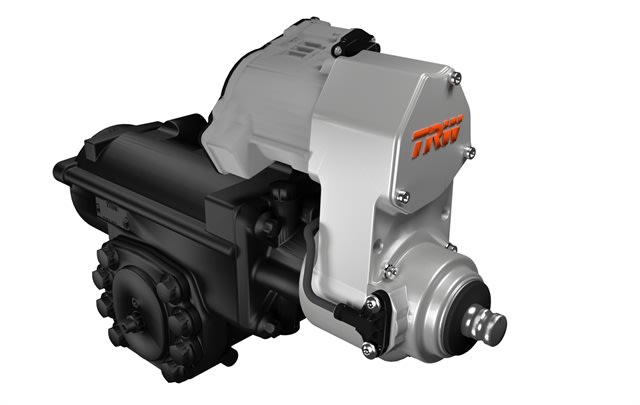
The ReAx electric drive is fully integrated into the body of the power steering gear.
The truck had an on/off switch to make the comparison easier, so we ran a couple of laps around the parking lot and through a backing maneuver with the system off and then with the system on.
The difference was like night and day. I didn’t get much higher than 20 mph in the parking lot, so I never experienced the proportional transition from full electric assist to minimal at higher speeds and extra stability at highway speed.
It was an unaccustomed luxury having to use no more energy than I would while reversing a boat trailer with a pickup truck. I suspect drivers will warm to this idea pretty quickly. It was very useful, too, in making those quick full-cut turns sometimes necessary to shoehorn the truck into tight loading docks. ReAx would be equally welcome on a downtown street with 90-degree corners and no room to spare. Here again, getting the wheels cut around while covering the shortest possible distance will be very advantageous.
I’m trying to imagine a possible downside to ReAx, but I can’t. Short of an electrical problem or a sensor failure, the system seems almost bullet proof. Even its complete failure would leave you no worse off than you are today with full hydraulics. It won’t add much weight, though it will likely cost more. I think the real benefits will become quickly obvious once drivers get a hold of it.
TRW says ReAx should be on the market by 2017.
Subscribe to Our Newsletter
More Equipment

Used-Truck Remarketing Math Is Changing
Used-truck value is no longer just a concern at trade-in. Decisions made throughout a truck’s first life can influence what it’s worth years later.
Read More →
How Volvo Updated Its D13 for EPA 2027 [Watch]
Volvo’s updated D13 promises lower emissions without sacrificing performance or fuel economy. Take a closer look at what changed inside the engine in this HDT Spotlight video.
Read More →
Michelin Tire Improves Efficiency and Durability for Regional Fleets
The Michelin X Multi Energy D2 is a regional haul drive tire engineered to help fleets improve fuel efficiency, durability and traction in demanding stop-and-go operations.
Read More →
ZF Expands Commercial Vehicle Push in North America
ZF is expanding its North American commercial-vehicle presence with new transmission applications, electrification, trailer technology and autonomous-driving systems.
Read More →
Tesla Wants a Self-Driving Semi. Are Cameras Enough?
Could Tesla’s camera-only autonomous driving technology work on an 80,000-pound Semi? In this commentary, HDT's Deborah Lockridge takes a look at Tesla, Cybercab, and how autonomous trucks see the road.
Read More →
Kodiak: Driverless Long-Haul Truck Launch on Track for 2026
Kodiak AI says its driverless long-haul safety case is 93% complete and it remains on track to begin commercial operations by year-end 2026.
Read More →
What DOT’s Automated Vehicle Strategy Means for Trucking
The U.S. Department of Transportation issued a new automated-vehicle strategy that outlines plans for driverless-truck regulations, cross-state freight corridors, and federal safety standards.
Read More →
East Coast Port Launches $45M Electric Truck Push
The Port Authority of New York and New Jersey announced millions in incentives for zero-emission drayage trucks, yard tractors, and new charging hubs near the port.
Read More →
PlusAI Going Public to Fund Autonomous Truck Launch
A SPAC deal could provide PlusAI with up to $300 million as it works toward a 2027 commercial launch of factory-built autonomous trucks.
Read More →
NHTSA Moves to Rewrite Truck Fuel-Economy Rules
The National Highway Traffic Safety Administration says it lacks authority to regulate medium- and heavy-duty truck engines separately from complete vehicles, but the existing standards have not yet been eliminated.
Read More →