





Related: Quick Spin - Peterbilt Model 567
Paccar Shows Off Modern, Green, and Clean MX Engine Plant
Paccar’s MX engine plant in Columbus, Mississippi is among the most modern, and environmentally friendly on the planet.
September 25, 2018
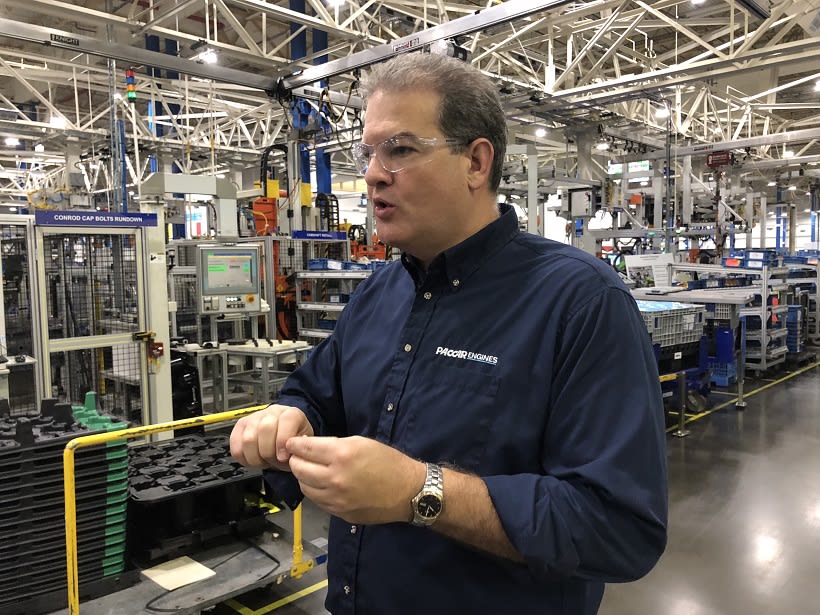
Lance Walters, plant manger of the Paccar Engine Company’s Columbus Engine Plant in Columbus, Mississippi, briefs journalists on production techniques during a tour of the facility.
Photo: Jack Roberts
2 min to read
In a former cotton field not far from the Mississippi-Alabama state line, sits one of the most modern diesel engine manufacturing plants on the planet. The unlikely setting is home to Paccar Engine Company’s Columbus Engine Plant. The 450,00 square foot facility, which sits mid-way between Columbus and Starkville, Mississippi, produces all the Paccar MX11 and MX13 engines for North America today. From the plant, engines are shipped to the company’s Peterbilt and Kenworth truck plants in Denton, Texas, and Chillicothe, Ohio. There are also occasional shipments to the Mexicali, Mexico, plant and to the Kenworth Truck Plant in Renton, Washington, as production demands dictate.
Lance Walters, plant manager of the Columbus facility, said the plant employs about 600 workers who man three shifts that produce about 150 engines daily. “All told, this plant has produced more than 175,000 engines since production kicked off in 2010,” he said. “And despite the spike in Class 8 demand today, thanks to our modern and lean manufacturing processes, we are keeping up with demand easily, with about a week’s lag time from the time an order is placed to when production of the engine begins.”
Currently, Walters said, around 10% to 20% of the plant’s daily production are MX11 engines, with the bulk being MX13 engines. “We expect those ratios to even out some as our customers become more familiar with the Paccar 11-liter engine and its capabilities,” he noted.
Walters said both the Paccar facility and the land it is situated on were designed with expansion in mind, noting that the plant interior itself can accommodate additional production lines if needed. “We are only using about 50 acres of this 400-acre site,” he added. “So, we have the space here to expand substantially."
Walters said he is extremely proud of the plant’s well-deserved reputation as a globally recognized green manufacturing facility, which has Zero Waste-to-Landfill processes in place to help both the environment and Paccar’s bottom line. “The plant interior is extremely well-lit,” he said, “thanks to modern LED lights. But those lights also have motion detectors, which automatically dim them if activity in a certain area falls off to save power.”
Another innovative practice at the Columbus plant is the proactive recycling effort that every day sends around 40,000 pounds of waste metal chips and shavings from the manufacturing process out to recycling centers in Alabama and elsewhere in the U.S. “That process alone adds about $1 million a year to our operating costs,” Walters noted.
Subscribe to Our Newsletter
More Fuel Smarts

New California Law Could Shed Light on Electric Truck Prices
Why do battery-electric Class 8 trucks remain so expensive? A California bill signed by Gov. Gavin Newsom would give fleets and state agencies more visibility into what manufacturers charge.
Read More →
How Volvo Updated Its D13 for EPA 2027 [Watch]
Volvo’s updated D13 promises lower emissions without sacrificing performance or fuel economy. Take a closer look at what changed inside the engine in this HDT Spotlight video.
Read More →
Diesel Price Spike Shortens Payback for Natural Gas Trucks, Report Says
Energy Vision estimates fleets could recover the higher purchase price of an RNG-fueled Class 8 tractor in 1.3 to 2.8 years under current fuel-price scenarios.
Read More →

Calstart Becomes Catalyst Mobility, Reflecting Broader Focus
Calstart is now Catalyst Mobility, reflecting the nonprofit’s growing national role in clean transportation, including zero-emission trucks, infrastructure and incentive programs.
Read More →
Record Diesel Prices Squeeze Trucking Fleets
Average U.S. diesel prices have climbed to nearly $6 a gallon, surpassing the 2022 record as tight refinery capacity and Middle East disruptions keep fuel costs elevated.
Read More →
Sponsored•September 9, 2026
How Fuel Delivery Shapes Engine Performance
Fuel delivery depends on more than what happens at the injector. For fleet, maintenance and technical professionals, looking at the full path from pump to injector can provide useful context for understanding engine performance.
Read More →
East Coast Port Launches $45M Electric Truck Push
The Port Authority of New York and New Jersey announced millions in incentives for zero-emission drayage trucks, yard tractors, and new charging hubs near the port.
Read More →
Detroit Opens Orders for EPA 2027 Engines
Detroit isn’t starting from scratch to meet EPA 2027 diesel emissions standards. Its Gen 6 DD13 and DD15 engines keep much of today’s platform while updating the fuel and aftertreatment systems.
Read More →
Zero-Emission Truck Corridor Planned for West Coast
California, Oregon, Washington, British Columbia and Baja California are coordinating plans for truck charging and hydrogen fueling from Canada to Mexico.
Read More →
A Closer Look at Kenworth’s Electric T880E Vocational Truck [Video]
Learn more about Kenworth's T880E battery-electric vocational truck at the Paccar Technical Center, including its range, applications, upfitting considerations, and PTO options, in this HDT Spotlight video.
Read More →