




Owner-Operator Learns Keys to Fuel Efficiency -- and Profitability
Here's a tale that, if it were from any other industry, might inspire a feel-good feature film. It's about a struggling rookie lease-operator who, as he is driving back to the terminal to hand back the keys, decides to try something different

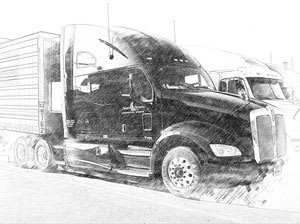
Carlos Cruz says he went from 6.21 mpg to 7.85 mpg in 30 days by changing his driving habits.
Here's a tale that, if it were from any other industry, might inspire a feel-good feature film. It's about a struggling rookie lease-operator who, as he is driving back to the terminal to hand back the keys, decides to try something different.
Carlos Cruz has been trucking all of three years, yet he's wiser than his time in the trenches might suggest. He's a lease operator working for a nationwide refrigerated truckload carrier. He was six months into a truck-lease program with the carrier and he had concluded what many of his colleagues had warned him about: He couldn't make any money on a lease deal.
"After all the payments had been taken out and the expenses paid, I was left with about $300 a week," he says. "That wasn't enough after all the work I was doing."
Many drivers had warned about such programs. Yet all the while, he watched and talked to other owner-operators going up and down the road, seemingly doing pretty well for themselves. He wondered: "If those other guys are making money, why wasn't I?"
Cruz wasn't just sitting there hanging on to the steering wheel. He says he listened to many of the trucker shows on SiriusXM radio so he can learn more about the industry, paying particular attention to Kevin Rutherford's program about how to truck more profitably. He admits, however, that he wasn't putting everything he heard into practice. Sure, he tried progressive shifting. He checked his tire pressure fairly regularly, but his measly $300 take-home pay just wasn't cutting it.
So, on what was to be his last trip, a return load right to the terminal, he decided to try, really try, everything he was hearing about on the radio. Lo and behold, when he fueled up in the yard, he'd burned considerably less fuel than on previous trips. In fact, he'd gained a mile per gallon, an astronomical improvement in fuel-economy terms.
Buoyed by his accomplishment, he decided to give it another 60 days.
Today, he worries about his engine's torque curves, whether he's running too much pressure in his tires, and whether using cruise control or good old fashioned right-foot throttle management is the best way to save fuel.
"I'm a changed man," he says. "I know I can make money here now, maybe not a lot of money, but certainly enough to get by comfortably. These lease deals don't pay that great, but if you manage it right, there's more than enough left over at the end of the week."
Cruz says his fuel mileage went from the low 6s to the high 7s in just one month -- a 1.6 mpg improvement that more than quadrupled his net revenue. Cue the big orchestral arrangement and the majestic scenery.
So, what's his secret? The biggie was slowing down from 65 to 55 mph. He never idles, he's a progressive shifting machine, and he's forgotten where the cruise control switch is.
"I found with the cruise control, it was always powering me up the hills like it wanted to get to the top as fast as possible," he notes. "Now I use the throttle and watch the rpm so I can take advantage of the torque the engine makes. Sometime have need to drop a gear, but if I think I can get over the top without a downshift, I'll lug it and let the engine work a little harder."
At this point his engine may actually not be delivering optimum efficiency. At 55, he says he's running about 1,270 rpm, which is actually a little low, considering the torque curve of the engine. He's close to the lower end of the curve, and that requires more frequent downshifts.
"Now I'm experimenting with different speeds going into a hill," he says. "It seems that hitting a rolling hill at 58 rather than 55 gets me further up the hill before I need to downshift, and sometimes I don't need to downshift, so a little extra speed may actually help in some cases."
Nothing has really changed since he slowed down except his fuel economy, he says enthusiastically. "I thought it would take me longer to get where I was going, but it doesn't make much difference at all. I stop a little less often, and I watch a lot of guys pass me, but I've never been late on a load because I drive slower."
I "met" Cruz when he emailed me about the Cascadia Evolution story from late May, where Freightliner says the truck averaged 9.31 mpg on a cross-country trip -- averaging 62 mph. He was incredulous. He was already doing the math. That's almost 1.5 mpg better than his hard-earned 7.85 mpg. And a far cry from his former 6.2 mpg.
"What if I ran a truck like that at 55 and do everything I do now?" he speculated.
We talked on the phone for nearly an hour and he sounded like a kid looking in a toy store window. We talked about tires and torque and aerodynamics and best driving practices and all sorts of stuff. He was tapping me for everything I know, and I think mostly he was trying to figure a way to push his mileage up closer to 9 mpg.
Here was a guy, a relatively new driver, who had discovered the key to success was discipline and little bit of study. It was like he had a new lease on life, upping his fuel mileage and his net revenue. He'd made the connection between the two, and he's not going to give up getting better.
More Fleet Management

Geotab Links Fleet Card to Vehicle Data
The new card combines fuel discounts with telematics-based purchase controls. Geotab’s analysis also points to potential savings from choosing lower-priced fuel stops.
Read More →
How MFA Helps Protect Trucking Fleets
Multi-factor authentication adds protection when passwords are stolen. Here’s how it works and where fleets should start.
Read More →
How Better Freight Data Helps Trucking Teams Get Ahead of Disruption
Trucking and logistics teams have plenty of data. The problem is getting the right information in front of the right people soon enough to act. Better-connected data can help teams spot trouble earlier and make smarter decisions before small problems become big ones.
Read More →

Trimble: Taking Artificial Intelligence in Trucking Beyond Faster Tasks
At Insight 2026, Trimble executives argued that fleets may need to redesign workflows to get more from AI as it introduced new products and enhancements. AI’s value will depend on how fleets combine automation with their people's knowledge.
Read More →
Build a bulletproof fleet: Uniting ELDs and dash cams for total compliance
An ELD can prove compliance, but it cannot always prove what happened on the road. Discover how uniting accurate ELD data with AI-powered dash cam video can help your fleet strengthen compliance, defend against liability, protect drivers and reduce operational costs.
Read More →
Nominations Open for HDT Emerging Leaders
Heavy Duty Trucking is looking for accomplished trucking fleet professionals under 40 who are making an impact and helping lead the industry forward.
Read More →
Why Private Fleets Are Taking More Freight
Private fleets are putting their own trucks on demanding customers and high-cost lanes as companies seek greater control over service, costs, and capacity.
Read More →
Color Match Smarter: Tools That Restore & Perform
For fleet managers and collision repair professionals keeping heavy-duty trucks on the road, getting the color right the first time isn't just about appearance — it's about efficiency, turnaround time, and bottom-line results. Discover how today's digital color tools are transforming the repair process from guesswork to precision.
Read More →
FMCSA Pauses Biennial-Update Enforcement Amid Motus Transition
Carriers whose updates were due on or after June 1 have more time, while FMCSA works to stabilize its new registration system and warns of phishing sites impersonating its new carrier registration system, Motus.
Read More →
2026 Blueprint for Countering Smarter Supply Chain Theft
Cargo theft is no longer just the cost of doing business. It's a multi-billion-dollar criminal enterprise exploiting vulnerabilities across your fleet, drivers, and supply chain.
Read More →