




Omnitracs CEO Wants Fleets to Focus on Time, Not Miles
Omnitracs CEO Ray Greer kicked off the company's User Conference 2019 by advising fleets to maximize time through smart routing rather than focus on total miles.

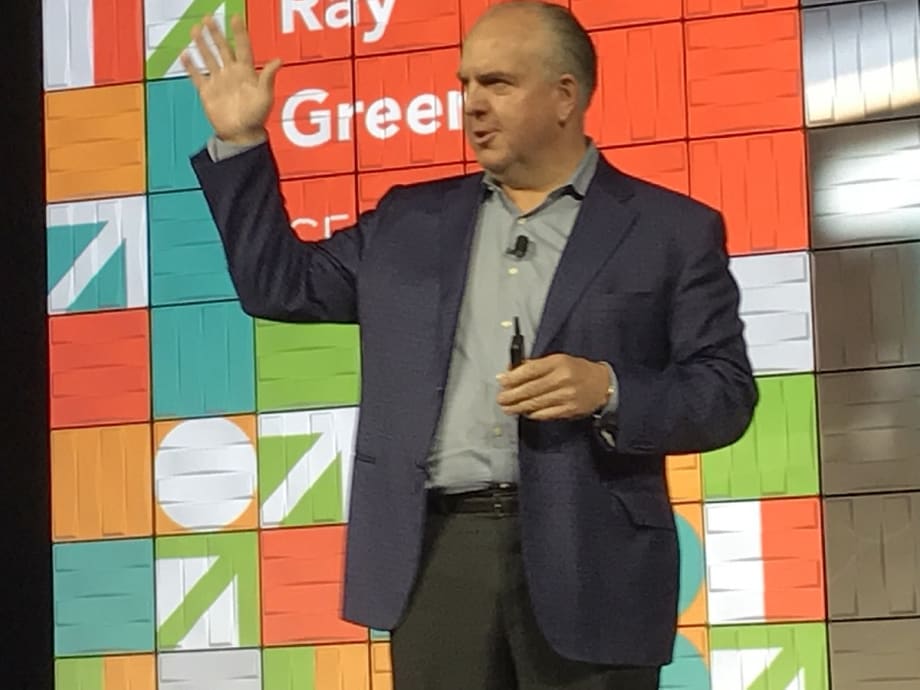
Omnitracs CEO Ray Greer kicked off the company's User Conference 2019 by advising fleets to maximize time through smart routing rather than focus on total miles.
Photo: Jim Beach
Dallas, Texas — Trucking technology provider Omnitracs kicked off its Outlook User Conference 2019 with company CEO Ray Greer hosting the conference's open session where he advised fleets to focus on time rather than total miles.
Approximately 800 users of the company’s various product lines attended the Outlook User Conference for three days of workshops and learning sessions on topics from ranging from electronic logging devices and other compliance issues to workflow and vehicle diagnostics.
During the conference’s opening session Greer covered several topics, including the industry’s focus on miles – a focus he thought was misplaced. “One of the things that’s clear to me is that the industry spends a lot of time talking about miles,” he said. “What I’m learning is that miles are increasingly mattering less and less – I’m of the opinion that they don’t matter at all.” Instead, what really matters is time, he said. Time constraints are everywhere, from congestion, to prolonged waits at customer docks, to the time drivers spend trying to find a place to park.
As such, a trucking company’s technology needs to be able to maximize time, via better routing to account for where drivers can find parking when they need to rest or to begin charging customers not on the miles a load takes, but the time it takes.
In reviewing the last 12 months, Greer said one of the things that became clear to him when he joined the last year was the need to “redefine our mission,” and to leverage the company’s size and industry experience to “move technical innovation.” That vision foresees becoming a leader in transportation and logistics technology and to provide integrated solutions for their customers.
He described their customers as using different aspects of the company’s technology “and they use it differently.” That means customers need a unified architecture and secure architecture. That means listening to and collaborating not only with their customers, but across their product lines.
Part of redefining their mission was establishing a “seasoned” management team, many of whom joined the company within the last 12 months. Greer described assembling the team as “one of my greatest satisfactions,” and said the common thread linking all of them was their software and software as a service backgrounds.
Aside from the new team, 2018 saw the company devote significant time in development for the new ELD standards and creating what he termed a “complex ecosystem” to conform to the new rules.
The also devoted time to improving the stability of their products or “getting the bugs out.”
The company unveiled their new integrated Omnitracs 1 platform and started developing the next generation of hardware, which included the new 4G LTE IVG (intelligent vehicle gateway) to replace the MCP devices.
A mobile gateway, allowing customers to more easily integrate mobile devices into their business was also developed. This acknowledges the trend of companies moving away from an either/or choice of fixed devices or mobile devices to allow them to use both.
As for ELDs, he urged attendees that if they have not developed a plan for phasing out their grand-fathered AOBRD devices and deploying ELDs by this December’s deadline, to start now. The complexity of the new rules requires people to quite “kicking the can down the road,” he said. “You can’t put this off any longer.” Fleets need to have a plan and to implement the plan. “Every chance I get, I’m pounding the drum on this.”
For the future, technology can help fleets in a number of ways from finding places for drivers to park to avoiding congestion. “Technology is beginning to understand where these problem pockets are,” he said. It allows the back office to know when driers need rest long before they arrive at an area. The same with traffic. He said technology can make use of the data many states have accumulated to do a better job planning routes, not just to avoid traffic but to make sure there is sufficient parking when a driver needs to rest.
Other time wasters Greer identified: navigation that takes a driver to the front door of a facility rather than the specific dock he needs to reach; time wasted waiting to get loaded or unloaded or at a fuel stop; engine software upgrades that require trucks to be taken into a dealer, rather than delivered over the air which costs a fleet time.
“It’s my belief, because of our scale and customer base, we have wait times for every location in the country.” That data can be used to help carriers become more efficient.
The bottom line, according to Greer is that time is the key element technology solutions need to save for their customers. “We identified applications that can begin the revolution” in how carriers operate, he said. These include applications for dock scheduling, intelligent load management so fleets can focus on revenue per hour, automated workflow and event management (parking, fueling, etc.)
In closing, Greer argued that driver retention depends on using technology to help them become more efficient, productive and satisfied with their job.
More Fleet Management

Color Match Smarter: Tools That Restore & Perform
For fleet managers and collision repair professionals keeping heavy-duty trucks on the road, getting the color right the first time isn't just about appearance — it's about efficiency, turnaround time, and bottom-line results. Discover how today's digital color tools are transforming the repair process from guesswork to precision.
Read More →
FMCSA Pauses Biennial-Update Enforcement Amid Motus Transition
Carriers whose updates were due on or after June 1 have more time, while FMCSA works to stabilize its new registration system and warns of phishing sites impersonating its new carrier registration system, Motus.
Read More →
2026 Blueprint for Countering Smarter Supply Chain Theft
Cargo theft is no longer just the cost of doing business. It's a multi-billion-dollar criminal enterprise exploiting vulnerabilities across your fleet, drivers, and supply chain.
Read More →


How Telematics Improves Visibility, Control, and Performance in Refrigerated Fleets
Explore how telematics help refrigerated fleets improve visibility, uptime, efficiency, compliance, and cargo protection across connected cold chain operations.
Read More →
What the U.S.-Canada Trade War Means for Trucking
Escalating U.S.-Canada tariffs could disrupt cross-border freight, reduce truck volumes, raise costs, and create new uncertainty for carriers on both sides of the border.
Read More →
What Are Trucking’s Top Concerns for 2026?
The American Transportation Research Institute wants to know what's worrying trucking fleet managers, drivers, and other stakeholders in its annual Industry Issues survey.
Read More →
American Trucking Associations Looks for a New Leader
ATA President and CEO Chris Spear abruptly left his job at the association on August 21, at a pivotal time for the trucking industry.
Read More →
Public Wi-Fi Cybersecurity Risks: How Truck Drivers and Fleets Can Protect Their Data
Public Wi-Fi can expose truck drivers and fleets to credential theft, malware, and other cyber threats. Here’s how to reduce the risk on the road.
Read More →
For Nicky Cupp, Fleet Innovation Starts With Frustration
HDT Truck Fleet Innovator Nicky Cupp turns everyday pain points at Fraley & Schilling into opportunities for better technology and smarter processes.
Read More →
Adam Buttgenbach’s Approach to Electric Trucks: Start With Where They Fit
HDT Truck Fleet Innovator Adam Buttgenbach helped PepsiCo build one of North America’s largest EV fleets by focusing on where electric trucks make operational sense.
Read More →