




Natural Gas Fuel Loses Some of its Luster, But Not Going Away
The enthusiasm for natural gas fueled vehicles seems to be stuttering a bit. Editor in Chief Deborah Lockridge offers insights from the Mid-America Trucking Show into the status of this alternative fuel for trucking.

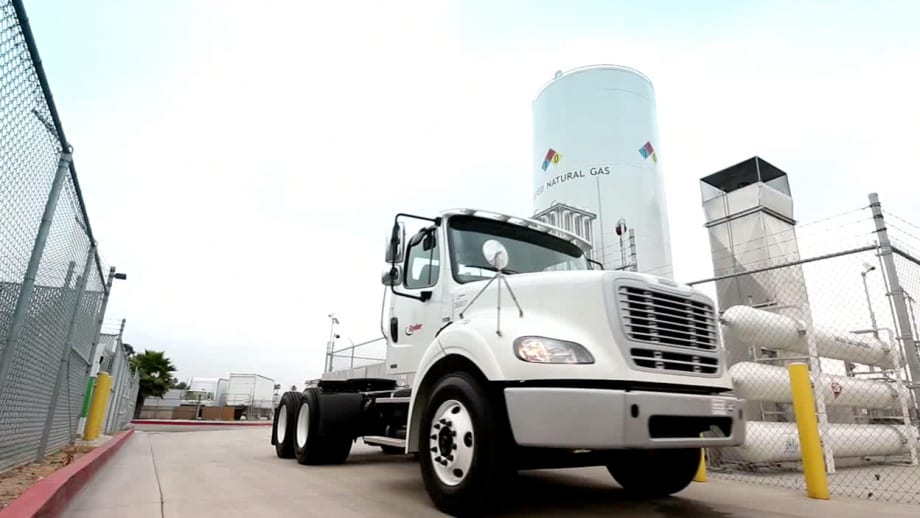
Ryder's natural gas fleet of more than 500 natural gas vehicles has travelled more than 20 million miles, but not every fleet has been so successful.
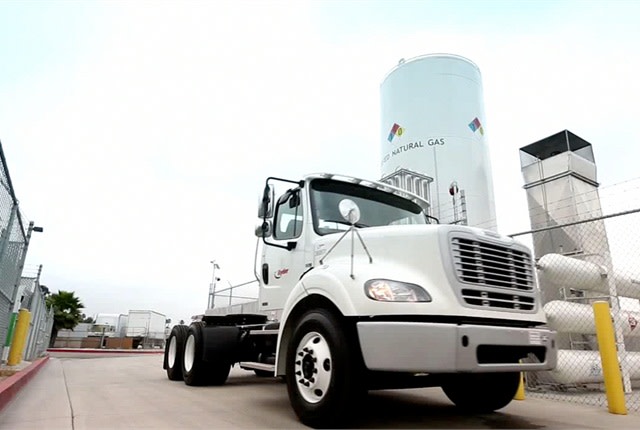
Ryder's natural gas fleet of more than 500 natural gas vehicles has travelled more than 20 million miles, but not every fleet has been so successful.
The enthusiasm for natural gas fueled vehicles seems to be stuttering a bit. Cummins recently announced it would "pause" development on its 15-liter engine, and Volvo said at the Mid-America Trucking Show recently that its new natural gas engine, originally announced with a 2015 time frame for availability, would not even be in pre-production until late next year.
When asked about the development of the ISX 15 G at MATS, Dave Crompton, who heads up Cummins' Heavy Duty, MidRange and Light Duty Worldwide Product Businesses, explained, "We've paused a little bit to let the market and customers dictate how fast we will pull that through. It's not an indication at all that we're less committed or less excited about the market opportunities."
In fact, he pointed out that Cummins recently shipped its 3,000th natural gas ISX 12 G from the Janesville plant. And at MATS, OEMs were quick to show off their natural gas fueled tractors equipped with the engine.
[The ISX 12 G] has been a great launch," said Gordon Exel, president of Cummins Westport. "We think we will probably double production in 2014, so we're looking for a really good year."
That's despite a recent recall of more than 25,000 engines, he said. "It was a voluntary recall. We were challenged with some cold-weather operations – we found it more difficult this year due to the cold weather we saw in the Northeast. We do have a fix. That issue was seen because of a sensor on both the 8.9 and 12-liter."
In a roundtable with reporters, Daimler Trucks North America CEO Martin Daum said natural gas at this point is finding a bigger niche in local applications that can come home every night to a CNG filling station.
"Diesel is a better energy agent to propel heavy loads over up-and-down terrain," Daum said. "Natural gas is the cheaper fuel at the moment. It seems at the moment the balance is more for certain applications, heavy loads, long distances, is going to diesel."
Daum noted that DTNA sells only about 2,000-3,000 trucks a year with natural gas, and that the company has about half of the natural gas market.
"It's interesting, it's important, we take it serious," Daum said. "A lot of customers run it very successfully in local applications. We want to drive the technology because you might find the golden solution, but it's a little more difficult than thought and a little more expensive than thought."
In fact, transportation analysts at Stifel Nicolaus noted in an email to investors, "Most conference attendees had a more favorable outlook for the future of CNG rather than LNG, at least for most applications in the U.S."
That's borne out in a recent Reuters article about liquefied natural gas, which reported that most of the fleets it talked to that had adopted LNG had run into technical problems and unexpected costs that are pushing out the return on investment. One company had to install solar panels on truck roofs to power methane detectors. Another had early rigs stall on the road after LNG tanks were filled at the wrong pressure. Unexpected maintenance costs were another common headache.
On the Truck Fleet Innovators panel at the MATS Fleet Forum, NFI's Bill Bliem noted that his company has found that to get the desired return on investment, LNG-powered trucks need to run at least 140,000 miles a year, which they are doing in their Texas fleet with a slip seat operation.
Speaking at a sold-out Heavy Duty Manufacturers Association MATS Breakfast Briefing, Daimler Trucks head Wolfgang Bernhard acknowledged that natural gas is gaining more importance.
"You all know about the shale gas boom," he said. "However, if I look back a year ago, it looks like the wave has been building up and the wave might be breaking, some of the enthusiasm has been broken, the height is gone. More realism sets in. But it's not going away."
However, he pointed out that we still have 200 times more diesel fueling stations than natural gas, and they don't all have the loading capacity a truck might need. "And you have to make sure those engines are up to the task of hauling long distances – this is a different thing than urban stuff."
When asked in the question-and-answer session following his remarks about his favorite alternative fuel, Bernhard quipped, "My favorite alternative fuel is diesel," drawing a chuckle from the audience, "because I don't see any replacement for diesel, not even in the long run."
No, natural gas likely won't replace diesel, but for some fleets in certain applications, it can work. It's probably just going to take longer to reach the kind of adoption hoped for by LNG fans.
On the other hand, we have to note that UPS has started deploying a fleet of 1,100 heavy-haul LNG trucks, which have a 600-mile range. This is a company with a lot of experience with all types of alternative fuels, so it will be interesting to see how their adoption goes and if it helps drive the use of LNG in the industry.
More Fuel Smarts

Trucking’s Diesel Squeeze Isn’t Letting Up
With diesel topping $6 a gallon nationally, ATA's Bob Costello explains why fleets should prepare for continued pressure at the pump.
Read More →
FlowBelow Redesigns Trailer AeroSlider to Cut Fuel Use
The lighter trailer aerodynamic system installs in less than 45 minutes, according to the company, with potential payback in under a year depending on fuel prices and trailer mileage.
Read More →
Why Diesel Price Relief Efforts May Fall Short
Diesel prices have eased from September’s record high, but doubts about additional Russian supply and limits on dyed-diesel tax relief mean trucking fleets still face expensive fuel. And prices could go higher.
Read More →
Why Small Fuel Savings Matter in Trucking
Can better fuel economy help pay for driver raises? In this podcast, GP Transco explains how small efficiency gains create room to reinvest in its people.
Read More →
How GP Transco Cuts Trucking Fuel Costs, a Tenth of a Gallon at a Time
What’s another tenth of a mile per gallon worth? GP Transco shares how equipment upgrades and driver coaching turn small gains into meaningful fuel savings.
Read More →
Electric Yard Tractors Move Beyond Pilots
Operating-cost savings have overtaken sustainability goals as the leading reason surveyed fleets are adopting battery-electric terminal tractors, according to new NACFE research.
Read More →
Geotab Links Fleet Card to Vehicle Data
The new card combines fuel discounts with telematics-based purchase controls. Geotab’s analysis also points to potential savings from choosing lower-priced fuel stops.
Read More →
Fleet Economics Shape Electric Truck Outlook
ACT Research expects costs, charging infrastructure, and technology improvements to drive zero-emission commercial vehicle adoption as federal regulations and incentives retreat.
Read More →
Wex Adds Cardless Fuel Payments for Over-the-Road Customers
A new fuel card feature for Wex customers offers convenience and security.
Read More →
New California Law Could Shed Light on Electric Truck Prices
Why do battery-electric Class 8 trucks remain so expensive? A California bill signed by Gov. Gavin Newsom would give fleets and state agencies more visibility into what manufacturers charge.
Read More →