





Related: Fuel Savings vs. Shorter Tire Life
Mining Data for Fuel Savings
Fleet use of technologies to reduce costs is nothing new. Along with increased productivity and efficiency, cutting fuel costs was a big reason fleets adopted technologies such as automated routing and dispatch, GPS tracking and mobile communications.
June 16, 2015

From routing to gamification to spotting equipment issues, information technology can help save fuel.
7 min to read

From routing to gamification to spotting equipment issues, information technology can help save fuel.
Fleet use of technologies to reduce costs is nothing new. Along with increased productivity and efficiency, cutting fuel costs was a big reason fleets adopted technologies such as automated routing and dispatch, GPS tracking and mobile communications.
For local pickup and delivery fleets and less-than-truckload operations, these systems reduce miles, which saved them fuel. For over-the-road carriers, real-time visibility of their fleet helps reduce unloaded and out-of-route miles, again saving fuel.
Mobile communications and telematics systems transmit engine data that allows managers to better manage idling.
Fuel network automation provides fueling plans right along with a route plan, which helps carriers pay the lowest possible cost for fuel purchased on the road.
While the fuel savings from these technologies are significant, fleet managers are looking at ways they can leverage their on-board and back office technologies to gain even more.
After getting a handle on routing/dispatching and idling, “the next area we’ve seen a lot of our customers look at is driver behavior in general,” says Mark Wallin, vice president of product marketing for Telogis. He’s referring to identifying specific areas where individual drivers need extra coaching or training.
Telematics systems offer a way to monitor, in near real-time, vehicle performance and generate alerts for things such as exceeding the speed limit, improper shifting, hard braking/acceleration, lane departure and other events. Advances in mobile communications mean not only can the back office be alerted to such instances, but in-cab alerts also can let the driver know that he or she is speeding, for instance.
Software tools also allow fleets to better manage when and where they fuel and to prevent fuel theft. “Outside of controlling idling and speeding, fuel card integration helps save on fuel,” says Ryan Driscoll, director of marketing, GPS Insight. “That helps fleets understand how the fleet is using fuel.”
Integrating fuel card data with fleet telematics data allows fleets to know when and where a fuel card was used and which vehicle was being fueled. If a fuel transaction and a vehicle’s location do not match up, “that’s a red flag.” Another sign of possible fuel theft is a vehicle taking on more fuel than the fuel tank can actually hold.
Another area where driver behavior comes into play: following the route plan. “Companies can develop more efficient routes,” says Kevin Haugh, vice president of Roadnet Technologies. “Even if they do, there is an issue around to what degree does the actual driver comply with that – how do you know that and how efficiently do you know that.”
Technologies allow managers to “tie together” what’s planned and what is actually going on. For example, telematics data gives a clear understanding of the degree to which drivers adhere to company policies regarding things such as routing and speeds. Companies that combine routing policies and procedures to ensure those policies are followed can see significant savings.
But it goes beyond just the drivers, Haugh says. “The second thing we see is companies want to be able to compare the effectiveness of different parts of their operations.” By using scorecards to measure not only drivers, but driver managers as well, carriers get a more overall view.
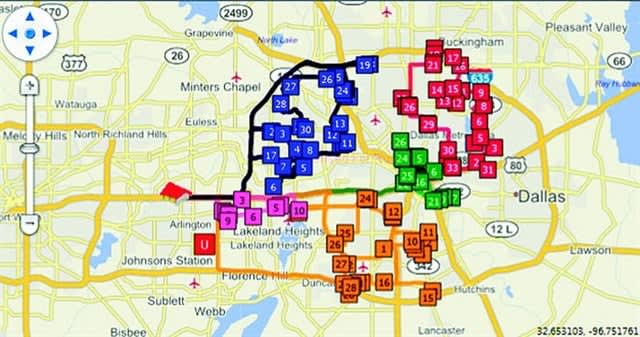
Telematics data that fleets use goes beyond just dots on a map and includes vehicle and driver performance metrics.
Making it a Game
While driver scorecards are not new to trucking, one new term making the rounds is gamification — using mobile apps to help drivers understand how well they are doing compared to their peers. Telogis’ Wallin says such apps “close the loop with the driver and make a game out of it. We have an app that drivers can use to check their performance,” he says. Drivers get a notification with their ranking, the areas where they are doing well and those where they need more work. “We find that regardless of their age, everyone wants to be a top performer. It’s really a way to give them a better way” to see how they are doing. Wallin adds that a scorecard and a connection to a mobile device is key – “at the end of a trip, they can see immediately how they’ve performed.”
Additionally, fleets can integrate training into a mobile app and allow for driver feedback, which gives drivers “a little more feedback and accountability,” he says.
Driscoll says a friendly competition between drivers can help fleets get the results they want. Gamification makes it “cool. Instead of coaching after the fact, these guys are coaching themselves.”
Transport America is launching a mobile app designed to keep the fleet’s drivers connected, which will include scorecards and other elements. Speaking at an industry conference in May, Chief Information officer Tom Benusa for the Minnesota-based fleet, added that as mobile technology advances, it’s a “challenge” to keep the mobile app beefy enough.
Speaking on the same panel, John Pappe, vice president of technology for Wisconsin-based Roehl Transport, said the fleet’s mobile app does all the driver’s paperwork and includes a gamification element that shows drivers how they are performing against their peers and other company benchmarks.
Haugh says the concept of gamification comes down to “giving drivers visibility to what they are doing and introducing a competition among them,” making their performance competitive and more like a game. Such apps are a “value-added” service, he says, that telematics vendors within the industry are increasingly offering.
Fleets also can take the competition beyond fuel savings, he says, and help drivers save money on fuel while still providing exceptional customer service. While some may think there is a trade-off, “the reality is that if you are really dialed in, you can do both better,” Haugh says. “When I think about gamification and scorecards, really what I think companies want, is how to achieve [fuel savings] and provide good customer service.”
Real-time feedback to the driver can help. While there are distraction issues, Roadnet and others have mobile apps that show drivers how they are doing on their schedule, how long they are spending at each stop, and other information.
“A local driver may want to know if he’s on schedule or ahead of schedule and customers are looking for ways to provide more real time feedback to the driver so they can respond immediately to a problem.”
Beyond drivers
Wallin notes that the ability to integrate OEM diagnostic data into a telematics system gives fleets the ability to see beyond driver behavior.
“You start looking at more diagnostics,” he says. Integrating with OEM data can show exactly how people are driving and also how the truck is performing mechanically. A drop in fuel mileage could mean equipment problems. “The better data you can get out, the more insight you can provide.”
Haugh notes that “there is a whole bunch of stuff we can do around the actual performance of the vehicle. From the bus, we can get all kinds of information to monitor fault codes and other things that may be impacting that particular vehicle.”
The data provides benchmarks, which allows fleet operators to get a better handle on poorer-performing vehicles that may need maintenance.
“You see an aberration, you can pull richer information about the vehicle – not just mpg – but fault codes and other codes that may point to a transmission problem or the DPF, or any number of things” that are having an effect on that vehicle’s performance.
Fleets also improve their mpg by buying the vehicles that best fit their operations – and analyzing maintenance and other data can help fleets in this area.
“There is an opportunity to bring in better data so companies can make better decisions on which vehicles to buy and how to spec them,” Haugh says. Dealer personnel can offer general recommendations based on past customer experiences, he notes, but ultimately the dealer will lack a detailed understanding of a particular fleet’s operation. By analyzing their data, fleets can get a much better picture of which trucks and which drivetrains have worked best for them.
The commonality in all of these fuel-saving strategies is data.
“I am a real believer in big data — there is so much to mine,” Haugh says. “The data from the vehicle is growing, the ability to blend it with other data, to bring it all together and get a better picture, gives you a sharper focus on the problems.”
Subscribe to Our Newsletter
More Fuel Smarts

How Volvo Updated Its D13 for EPA 2027 [Watch]
Volvo’s updated D13 promises lower emissions without sacrificing performance or fuel economy. Take a closer look at what changed inside the engine in this HDT Spotlight video.
Read More →
Diesel Price Spike Shortens Payback for Natural Gas Trucks, Report Says
Energy Vision estimates fleets could recover the higher purchase price of an RNG-fueled Class 8 tractor in 1.3 to 2.8 years under current fuel-price scenarios.
Read More →
Calstart Becomes Catalyst Mobility, Reflecting Broader Focus
Calstart is now Catalyst Mobility, reflecting the nonprofit’s growing national role in clean transportation, including zero-emission trucks, infrastructure and incentive programs.
Read More →

Record Diesel Prices Squeeze Trucking Fleets
Average U.S. diesel prices have climbed to nearly $6 a gallon, surpassing the 2022 record as tight refinery capacity and Middle East disruptions keep fuel costs elevated.
Read More →
Sponsored•September 9, 2026
How Fuel Delivery Shapes Engine Performance
Fuel delivery depends on more than what happens at the injector. For fleet, maintenance and technical professionals, looking at the full path from pump to injector can provide useful context for understanding engine performance.
Read More →
East Coast Port Launches $45M Electric Truck Push
The Port Authority of New York and New Jersey announced millions in incentives for zero-emission drayage trucks, yard tractors, and new charging hubs near the port.
Read More →
California Bill Could Shed Light on Electric Truck Prices
Why do battery-electric Class 8 trucks remain so expensive? A California bill headed to Gov. Gavin Newsom would give fleets and state agencies more visibility into what manufacturers charge.
Read More →
Detroit Opens Orders for EPA 2027 Engines
Detroit isn’t starting from scratch to meet EPA 2027 diesel emissions standards. Its Gen 6 DD13 and DD15 engines keep much of today’s platform while updating the fuel and aftertreatment systems.
Read More →
Zero-Emission Truck Corridor Planned for West Coast
California, Oregon, Washington, British Columbia and Baja California are coordinating plans for truck charging and hydrogen fueling from Canada to Mexico.
Read More →
A Closer Look at Kenworth’s Electric T880E Vocational Truck [Video]
Learn more about Kenworth's T880E battery-electric vocational truck at the Paccar Technical Center, including its range, applications, upfitting considerations, and PTO options, in this HDT Spotlight video.
Read More →