




Mack Debuts LR Electric Refuse Truck
Mack makes a major move into the electric truck market on the streets of New York City.

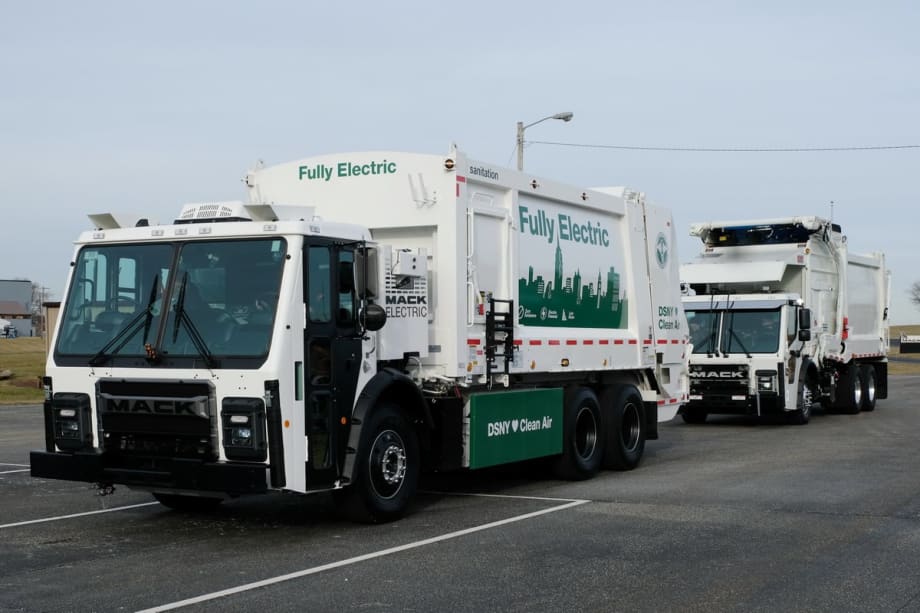
Mack's LR Electric, trailed by its diesel cousin.
Photo: Jim Park
Under New York City's Clean Fleet plan, the Big Apple will have to cut its fleet-vehicle CO2 emissions by 80% by 2035 from a 2005 baseline. It's an aggressive target, but the city has managed to replace 2,200 gas-powered on-road fleet vehicles with plug-in electric models six years ahead of schedule. With that success, the city doubled its goal and now says it will have at least 4,000 on-road electric vehicles in use by 2025, including electric refuse trucks.
Replacing the light-duty and passenger vehicles with plug-in electrics was easy. Doing the same for the city's heavy-duty vehicle fleet, which includes street sweepers, salt trucks, dump trucks, and the city's 2,346 refuse trucks will take a bit more ingenuity.
"The targets we have are very aggressive, and there's no way we could get to 80% by 2035 without [Mack]," said Rocky DiRico, deputy commissioner of the New York City Department of Sanitation (DSNY). "Without electric tucks that's not happening."
Speaking at the Mack Customer Center in Allentown, Pennsylvania during a demonstration of the Mack LR Electric, DiRico described some of the challenges facing his department.
"We have done some computer modeling of the truck's performance on simulated collections routes, and what we have seen is very positive but it's not real-world," he told HDT. "When we get it home, we'll start the testing by validating the computer modeling on our Class 8 dynamometer in our lab in Queens. After that, we'll start running it on actual collection routes."
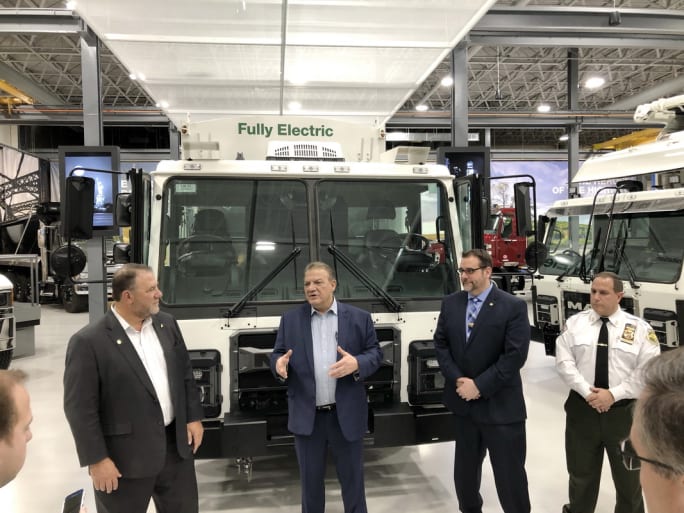
Rocky DiRico, deputy commissioner of the New York City Department of Sanitation (center) explains to journalists how the LR Electric will have to do double duty as a refuse collector and a snow plow.
Photo: Jim Park
The initial test route will be about 18 miles through a middle-class neighbor hood of single-family homes. He couldn't say how many stops it would make, but the department tends to measure collection routes in the number of stops rather than miles. "We'll see how long it lasts, whether we can finish the route in 8 hours," he said. "If that goes well, we can see how much battery capacity is left and from there we can determine if we can do some plowing with it."
NYC is one of a handful of municipalities in the US that equips its refuse collection trucks with snowplows in winter. That's brings huge efficiencies to fleet operations, where they don't have to call in plows to cover the same streets a collection truck is operating. With the diesel collection trucks, range and capacity are nothing to worry about. It's a new ball game with battery-powered trucks.
"Ultimately, we have to get to plowing," DiRico said. "We have to. We can't have two separate fleets. Battery technology has already improved dramatically from the first time we looked at this and we feel that within the next year, the battery capacity will be 50% better still, and that should take us to plowing. If we can't plow with it yet, that's okay. We'll get there. We have to take baby steps."
DSNY collects 10,500 tons of residential and institutional refuse and 1,700 tons of recyclables each day from the five boroughs that make up "New York City." It's also responsible for snow removal on 6,300 miles of streets.
The LR Electric Mack had at the demonstration event is the first of its kind. There's another one in the works that will be delivered later this year to Republic Services in North Carolina for a similar evaluation.
"The timing is right for this type of truck," says Mack's senior vice president for North American Sales & Marketing, Jonathan Randall. "It's a confluence of ideas whose time has come. We have tried other ideas as they came up, such as electric and hydraulic hybrids, CNG, hydrogen fuel cells, LNG; there's no one solution for everything. We just want to continue to try new things. The battery density is getting to the point where we can move 70,000 plus pounds over time and we can handle all the parasitic loads too."
Randall says as the cost and efficiency of batteries improves, more fleets will start testing and eventually adopt. "It's bringing commercial viability closer and closer, but we need fleets like DSNY and Republic Services to make the investment with the resources they have so that the technology becomes viable and available to fleets across the country."
Meet the Mack LR Electric
Mack's LR low-cab refuse truck has been in production since 2015, and has seen diesel and natural gas engines. Now, the time is right to convert it to battery electric, says Roy Horton, Mack's director of product strategy. "The refuse sector has predetermined routes with much lower range requirements than in regional or long-haul, which are important considerations when you're evaluating a new-technology powertrain. The predictability and repeatability helps facilitate the R&D that's needed to get a product to market faster.
"Refuse has a lot of start/stop duty-cycles, so we can take full advantage of regen braking to improve battery life, performance, and the range of the vehicle," Horton adds.
Horton also said the LR Electric will be less expensive to operate because of the reduced need for powertrain related maintenance, such as filters, fluids, DPF service, etc., and the expected reduction in break wear and related maintenance due to the regenerative braking function. "Brake maintenance has been a huge for refuse operators," he noted. "That's all about to change."
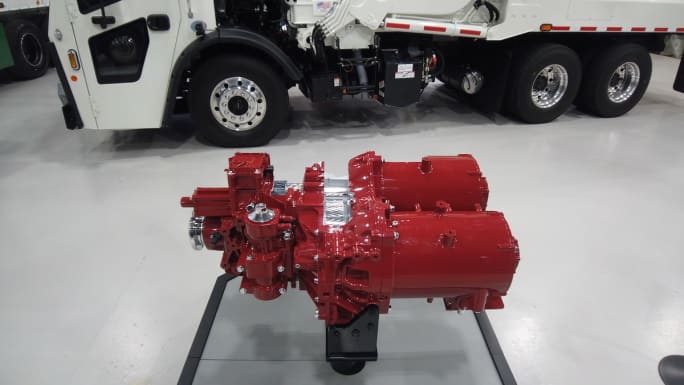
The entire drive assembly, two electric motors and a two-speed Powershift transmission, take up less space in the chassis than a typical transmission.
Photo: Jim Park
A casual observer would be hard pressed to distinguish between a diesel LR and an electric LR without the engine running. The electric version is much quieter of course, and that will be a benefit to the customers located along the routes and the drivers. The chassis isn't visibly different.
"We didn't have to make any big changes," says Randall. "We were able to package what was needed into the existing chassis for the most part. The batteries are along the left side of the chassis, much of the controllers and electronics are located where the engine and transmission used to be, and the motor/transmission assembly is located between the frame rails just forward of the drive axles. I probably make is sound easier than it was, but it actually isn't that much of a departure from the diesel chassis."
The LR Electric was to be moved up to Brooklyn, to it's now home, DSNY Brooklyn North 1 yard, just a few blocks from the Brooklyn Zoo a few days after the demonstration event, which took place in early January. Deputy Commissioner DiRico said he has a battery of tests planned for the truck over the coming months, including range, miles/kWh, payload, acceleration, regen braking, gradeability, charge time/duration, and not inconsequentially, driver feedback.
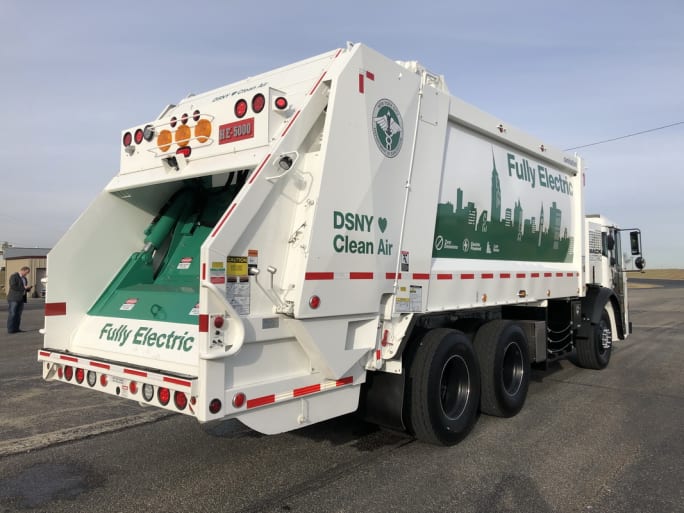
The packer body, a Heil 25-yard DuraPack 5000 rear-loader, is battery-powered and driven by electric/hydraulic pumps.
Photo: Jim Park
"I'm very excited at this point to get it to NY and show it off," he says. "I'm looking at a major media blitz on Earth Day in April to show off the truck, but in the meantime, we'll begin the process of testing and evaluating and validating and beating the hell out of that truck."

Rather than the gold bulldog signifying an integrated Mack powertrain, the bulldog on the electric Mack trucks will be copper.
Photo: Mack Trucks
Mack LR Electric Specs
Mack Integrated Electric Powertrain
• Two 600-volt AC motors combined 496 peak horsepower
• 4,051 lb. ft. torque
Transmission:
• Two speed Mack Powershift
Axles:
• Mack FXL20 20,000 lb. front axle
• Mack S522R 52,000 lb. rear axles
Batteries:
• Four lithium NMC (nickel manganese cobalt oxide) batteries
Charging System:
• Up to 150kW charging power at 200 amps maximum current
• SAE J1772 compliant
• Regenerative braking system can be dialed up and down driver preference
Accessory Power:
• All accessories are electrically driven, HVAC, power steering, air compressors, etc.
including body hydraulics
Electrical system:
• 600-volt circuits: for the drive motors and the PTO for the body,
• 24-volt circuits: electric-over-hydraulic power steering, HVAC, and sir compressors 24V two 24-v
• 12-volt circuits: lighting, cab electrics
Body:
• Heil 25-yard DuraPack 5000 rear-loader
More Fuel Smarts

Wex Adds Cardless Fuel Payments for Over-the-Road Customers
A new fuel card feature for Wex customers offers convenience and security.
Read More →
New California Law Could Shed Light on Electric Truck Prices
Why do battery-electric Class 8 trucks remain so expensive? A California bill signed by Gov. Gavin Newsom would give fleets and state agencies more visibility into what manufacturers charge.
Read More →
How Volvo Updated Its D13 for EPA 2027 [Watch]
Volvo’s updated D13 promises lower emissions without sacrificing performance or fuel economy. Take a closer look at what changed inside the engine in this HDT Spotlight video.
Read More →

Diesel Price Spike Shortens Payback for Natural Gas Trucks, Report Says
Energy Vision estimates fleets could recover the higher purchase price of an RNG-fueled Class 8 tractor in 1.3 to 2.8 years under current fuel-price scenarios.
Read More →
Calstart Becomes Catalyst Mobility, Reflecting Broader Focus
Calstart is now Catalyst Mobility, reflecting the nonprofit’s growing national role in clean transportation, including zero-emission trucks, infrastructure and incentive programs.
Read More →
Record Diesel Prices Squeeze Trucking Fleets
Average U.S. diesel prices have climbed to nearly $6 a gallon, surpassing the 2022 record as tight refinery capacity and Middle East disruptions keep fuel costs elevated.
Read More →
How Fuel Delivery Shapes Engine Performance
Fuel delivery depends on more than what happens at the injector. For fleet, maintenance and technical professionals, looking at the full path from pump to injector can provide useful context for understanding engine performance.
Read More →
East Coast Port Launches $45M Electric Truck Push
The Port Authority of New York and New Jersey announced millions in incentives for zero-emission drayage trucks, yard tractors, and new charging hubs near the port.
Read More →
Detroit Opens Orders for EPA 2027 Engines
Detroit isn’t starting from scratch to meet EPA 2027 diesel emissions standards. Its Gen 6 DD13 and DD15 engines keep much of today’s platform while updating the fuel and aftertreatment systems.
Read More →
Zero-Emission Truck Corridor Planned for West Coast
California, Oregon, Washington, British Columbia and Baja California are coordinating plans for truck charging and hydrogen fueling from Canada to Mexico.
Read More →