




Liftgates for the Final Mile
Downsizing the truck for last-mile delivery doesn’t mean compromising on the liftgate. Carrying capacity, durability, and driver safety all still matter when spec'ing final-mile bodies and trailers.

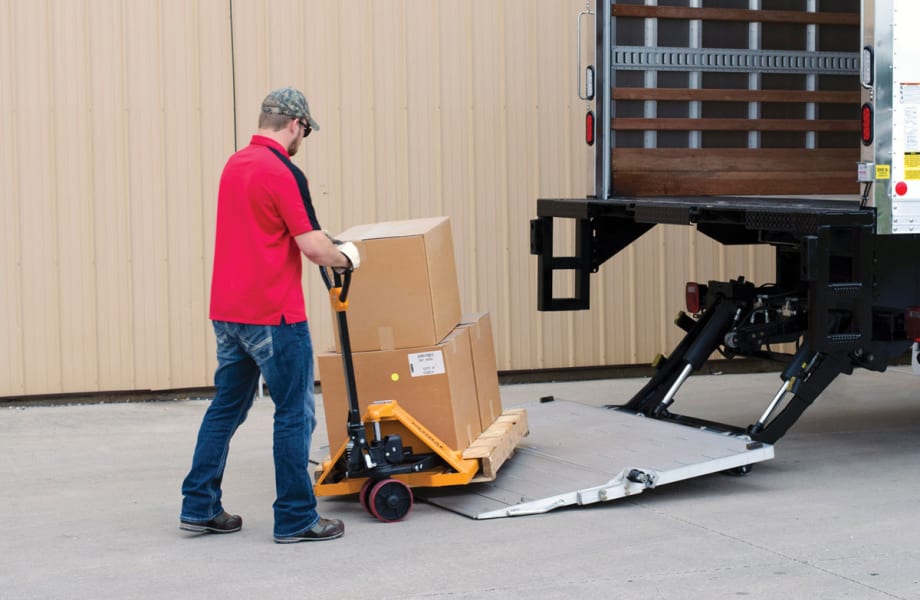
The last-mile delivery business is driving up demand for liftgates.
Photo: Anthony Liftgates
Unlike the shrink-wrapped pallets of freight you’ll find in most van trailers, last-mile delivery trucks carry everything from packages containing wireless earbuds or camping tents, all the way up to snowblowers and washing machines. If you can buy it online, somebody will have to deliver it.
But how does one de-truck a 400-pound snowblower and get it up a customer’s driveway? A liftgate would be helpful, perhaps one with cart-stops along the edge of the platform to prevent stuff from rolling off. A couple of securement-strap tie-down points might come in handy, too. But for all the safety trappings you can buy, if drivers find them cumbersome and difficult to use, they will just rust away on the back of the truck.
The home-delivery business is driving up demand for liftgates, and manufacturers are rising to the challenge with smaller units that can fit onto more chassis with more options. Liftgate choices will be narrowed by what final-mile truck chassis and body are selected, and which liftgates are designed to fit that application, says Terry Eyink, engineer for Thieman Tailgates, which offers a broad range of products.
“From there, it comes down to choosing the liftgate model that best fits the application and optioning that liftgate to move the product to be delivered. For example, in-cab shut-off switches that cut power to the liftgate are good options for residential deliveries, so unintended usage of the liftgate doesn’t occur.”
In-cab shut-off switches indeed. Curious children just love pressing buttons.
Liftgates can really tax the batteries, and on smaller trucks doing long delivery routes, there’s never enough time to fully recharge them. There are an increasing number of charging options available for liftgate power management, including some that use solar panels.
John Houweling, president of Coral International Truck Equipment in Langley, British Columbia, a distributor and installer of Dhollandia liftgates, says it’s common practice in Europe (but not so much here) to power the device with two isolated 6-volt batteries located close to the liftgate rather than a single 12-volt battery.
“A pair of 6-volt batteries will hold their voltage better than a single 12-volt battery,” he says. “You can run the liftgate batteries right down with no risk to the starting batteries. It’s not a cheap option, but it’s very cost-effective over the life of the truck. Just ask anyone who has had a battery let them down midway through a route.”
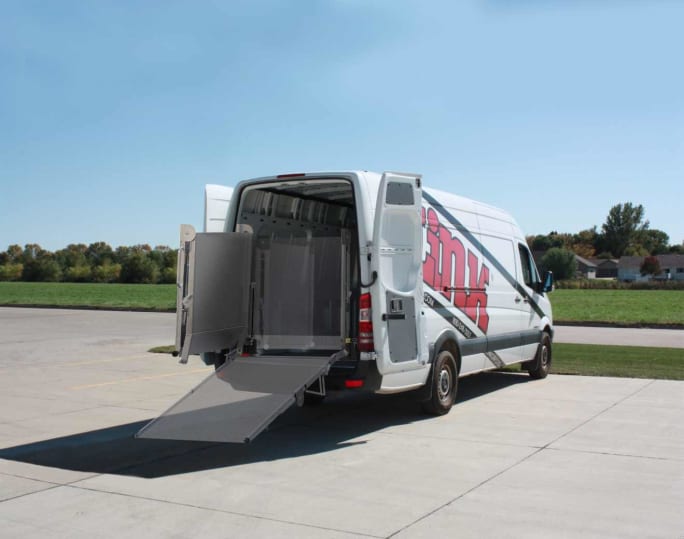
Cargo ramps are an alternative (or addition) to liftgates.
Photo: Link Mfg.
And it’s not just big or heavy cargo that gives drivers heartburn. Getting even a couple of boxes weighing 50 pounds or so off the truck and up to the house is a real chore. (If you don’t think that’s a chore, try doing it 30 or 40 times a day. Can you say repetitive strain injury?)
Ramps are a low-cost, low-maintenance alternative to liftgates for drivers in this situation. Link’s Cargo Management Products Division makes swivel, spring-assist, bi-fold, tri-fold, and customized loading ramps for rear and side-mount applications and from a variety of deck heights.
And unlike liftgates that can be slow to deploy, a ramp can be opened and in use within seconds – and can be stowed just as quickly. That can be a big concern with heavy delivery schedules.
More Equipment

How Volvo Updated Its D13 for EPA 2027 [Watch]
Volvo’s updated D13 promises lower emissions without sacrificing performance or fuel economy. Take a closer look at what changed inside the engine in this HDT Spotlight video.
Read More →
Michelin Tire Improves Efficiency and Durability for Regional Fleets
The Michelin X Multi Energy D2 is a regional haul drive tire engineered to help fleets improve fuel efficiency, durability and traction in demanding stop-and-go operations.
Read More →
ZF Expands Commercial Vehicle Push in North America
ZF is expanding its North American commercial-vehicle presence with new transmission applications, electrification, trailer technology and autonomous-driving systems.
Read More →
Tesla Wants a Self-Driving Semi. Are Cameras Enough?
Could Tesla’s camera-only autonomous driving technology work on an 80,000-pound Semi? In this commentary, HDT's Deborah Lockridge takes a look at Tesla, Cybercab, and how autonomous trucks see the road.
Read More →
Kodiak: Driverless Long-Haul Truck Launch on Track for 2026
Kodiak AI says its driverless long-haul safety case is 93% complete and it remains on track to begin commercial operations by year-end 2026.
Read More →
What DOT’s Automated Vehicle Strategy Means for Trucking
The U.S. Department of Transportation issued a new automated-vehicle strategy that outlines plans for driverless-truck regulations, cross-state freight corridors, and federal safety standards.
Read More →
East Coast Port Launches $45M Electric Truck Push
The Port Authority of New York and New Jersey announced millions in incentives for zero-emission drayage trucks, yard tractors, and new charging hubs near the port.
Read More →
PlusAI Going Public to Fund Autonomous Truck Launch
A SPAC deal could provide PlusAI with up to $300 million as it works toward a 2027 commercial launch of factory-built autonomous trucks.
Read More →
NHTSA Moves to Rewrite Truck Fuel-Economy Rules
The National Highway Traffic Safety Administration says it lacks authority to regulate medium- and heavy-duty truck engines separately from complete vehicles, but the existing standards have not yet been eliminated.
Read More →
Detroit Opens Orders for EPA 2027 Engines
Detroit isn’t starting from scratch to meet EPA 2027 diesel emissions standards. Its Gen 6 DD13 and DD15 engines keep much of today’s platform while updating the fuel and aftertreatment systems.
Read More →