




Huttig Building Products Is Seeing Green
"Go Green" is a program Huttig Building Products uses to motivate its drivers to improve performance and increase fuel efficiency
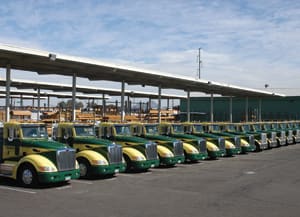
Huttig monitors drivers' mpg, idling and rpm using the PacTrac telematics system, available on the Peterbilt trucks it leases. (Photo by Huttig)
"Go Green" is a program Huttig Building Products uses to motivate its drivers to improve performance and increase fuel efficiency.
Every month, Erik Nagli, general manager at the company's Phoenix distribution center, posts a spreadsheet, showing the performance of its nine drivers in a color-coded matrix. Drivers are in the green if they get their fuel economy above 6 mpg. Yellow indicates mpg between 5.5 and 5.9, while red shows anything below 5.5 mpg.
If you look at the matrix from January 2010, there are almost no fields that aren't green. Drivers can earn a bonus for good performance, based on a points system. Green, for example, is worth two points, while yellow gets a driver one point. Drivers get paid an additional $100 for every 16 points they earn.
Huttig is able to keep on top of drivers' mpg, idling and rpm through the PacTrac system, a telematics system powered by PeopleNet. The Phoenix center leases eight Class 8 Peterbilts and one straight truck through a local PacLease franchise, Rush Enterprises. PacTrac is the unit inside the truck, which sends data to the PeopleNet system so the company can create these reports.
Before, the company was achieving 4.89 mpg; now the fleet averages 6.2 mpg. In January, the company saved 1,457 gallons of fuel. When the company was running 18 trucks before, the fleet was using 400 gallons of "long-idle" fuel in one month. In January, the fleet of nine trucks used 0.16 gallons of fuel from long idling (any idling longer than five minutes).
Switching over to the new system weeded out the bad drivers and reduced the center's operating expenses by 20 percent. "The savings are staggering," Nagli says. "It is such a no-brainer."
Nagli says the report helps drivers recognize how their driving habits compare to company expectations. It offers him a way to reward drivers who achieve the best results and to encourage improvement from drivers who don't perform as well.
"You have to engage your drivers to be part of the solution."
From the August 2010 issue of Heavy Duty Trucking.
More Fuel Smarts

How Volvo Updated Its D13 for EPA 2027 [Watch]
Volvo’s updated D13 promises lower emissions without sacrificing performance or fuel economy. Take a closer look at what changed inside the engine in this HDT Spotlight video.
Read More →
Diesel Price Spike Shortens Payback for Natural Gas Trucks, Report Says
Energy Vision estimates fleets could recover the higher purchase price of an RNG-fueled Class 8 tractor in 1.3 to 2.8 years under current fuel-price scenarios.
Read More →
Calstart Becomes Catalyst Mobility, Reflecting Broader Focus
Calstart is now Catalyst Mobility, reflecting the nonprofit’s growing national role in clean transportation, including zero-emission trucks, infrastructure and incentive programs.
Read More →

Record Diesel Prices Squeeze Trucking Fleets
Average U.S. diesel prices have climbed to nearly $6 a gallon, surpassing the 2022 record as tight refinery capacity and Middle East disruptions keep fuel costs elevated.
Read More →
How Fuel Delivery Shapes Engine Performance
Fuel delivery depends on more than what happens at the injector. For fleet, maintenance and technical professionals, looking at the full path from pump to injector can provide useful context for understanding engine performance.
Read More →
East Coast Port Launches $45M Electric Truck Push
The Port Authority of New York and New Jersey announced millions in incentives for zero-emission drayage trucks, yard tractors, and new charging hubs near the port.
Read More →
California Bill Could Shed Light on Electric Truck Prices
Why do battery-electric Class 8 trucks remain so expensive? A California bill headed to Gov. Gavin Newsom would give fleets and state agencies more visibility into what manufacturers charge.
Read More →
Detroit Opens Orders for EPA 2027 Engines
Detroit isn’t starting from scratch to meet EPA 2027 diesel emissions standards. Its Gen 6 DD13 and DD15 engines keep much of today’s platform while updating the fuel and aftertreatment systems.
Read More →
Zero-Emission Truck Corridor Planned for West Coast
California, Oregon, Washington, British Columbia and Baja California are coordinating plans for truck charging and hydrogen fueling from Canada to Mexico.
Read More →
A Closer Look at Kenworth’s Electric T880E Vocational Truck [Video]
Learn more about Kenworth's T880E battery-electric vocational truck at the Paccar Technical Center, including its range, applications, upfitting considerations, and PTO options, in this HDT Spotlight video.
Read More →