




How to Simplify CO2 Emissions Reporting
Fleets looking for a standard way to calculate CO2 emissions should consider using a method that accounts for vehicle type, fuel use, and direct emissions by route, Trimble Maps officials said.

A “tank-to-wheel” approach of calculating CO2 emissions combines both the European Norm 16258 and the SmartWay Truck Carrier Tool as key indicators.
Photo: Gettyimages.com/NicoElNino
Greenhouse gases contribute to the global climate change problem and cause air pollution to spike to crisis levels in some urban areas.
Carbon dioxide emissions are a major source of greenhouse gases around the world, and a significant portion of those come from transportation. In the U.S., for instance, 28% of CO2 emissions are produced by the transportation sector. In the UK, the transportation industry accounts for more than a third of CO2 emissions – and road vehicles contribute the most CO2 emissions in transportation sector activities.
These greenhouse gases build up over time in the atmosphere, creating a cumulative effect. The cumulative nature is what makes tracking emissions crucial — we have to understand how much CO2 is being released to know where we stand. But we can’t effectively track emissions without a standard, simplified approach to reporting.
The Disconnect Between Regional Government and Business CO2 Tracking Standards
Air pollution last year was reduced by lockdowns imposed as a response to the pandemic, but because greenhouse gases build up over time, a temporary reduction in emissions doesn’t solve the long-term problem.
Governments and businesses have policies in place to make transportation more sustainable (and this will be a major push under the new Biden administration). A key part of the effort is tracking emissions.
The problem is that while the fight against climate change has to be waged globally, there’s no universal standard that every organization uses to calculate emissions. There’s a disconnect because of the variety of calculation methods.
The disconnect is especially pronounced when global transportation companies use local methods to calculate emissions. There’s significant pressure on companies to commit to reducing their carbon footprint. In some regions, government regulations are increasing. This highlights why it’s so important to find a standard way to calculate emissions for effective tracking.
Combining Regional Standards for a Better CO2 Tracking Methodology
In Europe, most transportation companies use the European Norm 16258 to calculate greenhouse gas emissions. In North America, many shippers use the SmartWay Truck Carrier Tool to calculate total emissions. The use of these different standards makes it difficult to monitor the global effect of emissions.
A “tank-to-wheel” approach combines both the European Norm 16258 and the SmartWay Truck Carrier Tool as key indicators. Transportation companies that are looking for a standard way to calculate emissions should consider using a method that accounts for vehicle type, fuel use, and direct emissions by route, since that approach includes static and individual standards.
The key to accurate calculations is to find a simple way to update vehicle setup and develop trip-based calculations via a web service. With this solution in place, the company can access detailed projections of planned route factors and create estimates for each leg of the trip and total expenses per trip. Ideally, the estimate would provide fuel and labor costs in addition to greenhouse gas emissions per route, providing a complete picture.
A True Picture of Greenhouse Gas Costs
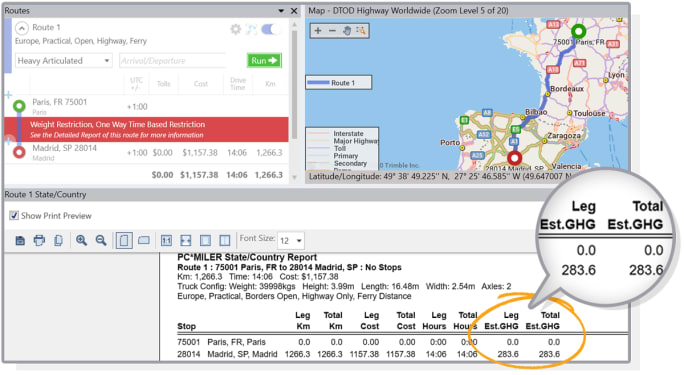
Fleets looking for a standard approach to emissions monitoring should look for a web-based solution that allows them to customize calculation methodologies to meet their needs.
Graphic: Trimble Maps
Companies that have a standard calculation approach delivered via a web service can track greenhouse gas emissions in their operations worldwide. A method that combines regional standards enables a direct comparison between operating units located in different countries.
And when fuel and labor costs are also calculated in a web service solution, companies can get higher quality reports with more detail about those aspects of operations in addition to greenhouse gas emissions, all in one place. Centralized reporting and dashboards can provide a clearer picture.
Having a standard way to calculate emissions is critical because it allows the company to monitor emissions and track reduction program progress over time. It gives companies the complete picture they need to make the best decisions about purchasing or replacing fleet vehicles and investing in energy savings at levels that work best for their business.
A standard approach also enables transportation companies to comply with regulations and legal requirements for emissions tracking. And as new regulations are enacted and customers put new greenhouse gas policies into effect, a standard approach simplifies compliance every step of the way.
Companies that are looking for a standard approach to emissions monitoring should look for a web-based solution that allows them to customize calculation methodologies to meet their needs — by supporting the European Norm 16258, SmartWay and also the Handbook of Emission Factors for Road Transport (version 3.2). A flexible solution that simplifies reporting makes compliance easier and helps companies reduce greenhouse gases to fight climate change.
Abigail Obano leads product marketing in the EMEA (Europe, Middle East and Africa) region for Trimble Maps, which offers the kind of tracking mentioned in this article through its PC Miler solutions. This article was authored under the guidance and editorial standards of HDT’s editors to provide useful information to our readers. Opinions may not reflect those of HDT.
More Fuel Smarts

How Volvo Updated Its D13 for EPA 2027 [Watch]
Volvo’s updated D13 promises lower emissions without sacrificing performance or fuel economy. Take a closer look at what changed inside the engine in this HDT Spotlight video.
Read More →
Diesel Price Spike Shortens Payback for Natural Gas Trucks, Report Says
Energy Vision estimates fleets could recover the higher purchase price of an RNG-fueled Class 8 tractor in 1.3 to 2.8 years under current fuel-price scenarios.
Read More →
Calstart Becomes Catalyst Mobility, Reflecting Broader Focus
Calstart is now Catalyst Mobility, reflecting the nonprofit’s growing national role in clean transportation, including zero-emission trucks, infrastructure and incentive programs.
Read More →

Record Diesel Prices Squeeze Trucking Fleets
Average U.S. diesel prices have climbed to nearly $6 a gallon, surpassing the 2022 record as tight refinery capacity and Middle East disruptions keep fuel costs elevated.
Read More →
How Fuel Delivery Shapes Engine Performance
Fuel delivery depends on more than what happens at the injector. For fleet, maintenance and technical professionals, looking at the full path from pump to injector can provide useful context for understanding engine performance.
Read More →
East Coast Port Launches $45M Electric Truck Push
The Port Authority of New York and New Jersey announced millions in incentives for zero-emission drayage trucks, yard tractors, and new charging hubs near the port.
Read More →
California Bill Could Shed Light on Electric Truck Prices
Why do battery-electric Class 8 trucks remain so expensive? A California bill headed to Gov. Gavin Newsom would give fleets and state agencies more visibility into what manufacturers charge.
Read More →
Detroit Opens Orders for EPA 2027 Engines
Detroit isn’t starting from scratch to meet EPA 2027 diesel emissions standards. Its Gen 6 DD13 and DD15 engines keep much of today’s platform while updating the fuel and aftertreatment systems.
Read More →
Zero-Emission Truck Corridor Planned for West Coast
California, Oregon, Washington, British Columbia and Baja California are coordinating plans for truck charging and hydrogen fueling from Canada to Mexico.
Read More →
A Closer Look at Kenworth’s Electric T880E Vocational Truck [Video]
Learn more about Kenworth's T880E battery-electric vocational truck at the Paccar Technical Center, including its range, applications, upfitting considerations, and PTO options, in this HDT Spotlight video.
Read More →