




How Simulators Can Help Save Fuel
From the November Issue of HDT - Driving simulators aren't just for new drivers or safety training, they can be used to teach drivers how to improve fuel economy by breaking bad habits.

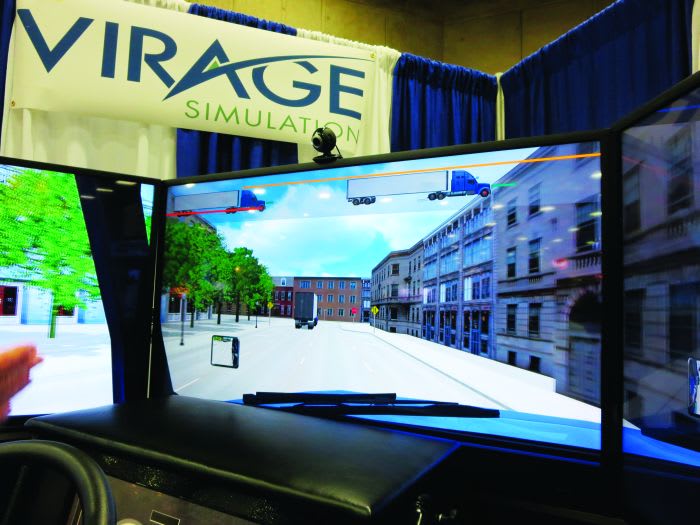
In this Eco-Drive challenge program, you can see the driver accelerating gradually while the non-fuel-saving-truck on the left has raced ahead to the next light. Look at the red arrow below the truck graphic on the left that indicates the energy being wasted in hard braking.
In this Eco-Drive challenge program, you can see the driver accelerating gradually while the non-fuel-saving-truck on the left has raced ahead to the next light. Look at the red arrow below the truck graphic on the left that indicates the energy being wasted in hard braking.
When the City of Waterloo in Ontario conducted a four-month trial of a fuel-efficient driver training program, it was able to improve the score among the 20 test vehicles by 17%. A simulator program from Virage Simulation taught drivers to reduce harsh acceleration and harsh braking.
During the initial phase of the project, which set a baseline via a telematics system, vehicle operators exhibited hard accelerating events 8% of the time they accelerated and hard braking events 15% of the time they stopped. After their eco-driver training experience, these metrics improved to only 5% and 9%, respectively.
According to the Environmental Protection Agency’s SmartWay Transport Partnership, a driver training program that improves fuel economy by 5% could save over $3,000 in fuel costs and eliminate 8 metric tons of greenhouse gas emissions per truck each year.
But you may not have the extra capacity to be able to offer on-the-road training. And while classroom training is valuable, driving simulators offer another, more interactive level of training.
Training that targets fuel efficiency can help drivers recognize and change driving habits that waste fuel. For example, driving 65 mph instead of 55 mph can use up to 20% more fuel, and driving with the engine rpm too high can waste several gallons of fuel each hour. Other common habits that reduce fuel economy are frequent or improper shifting, too-rapid acceleration, too-frequent stops and starts from failing to anticipate traffic flow, and taking circuitous routes.
“Fuel-efficient shifting techniques are best taught with a simulator,” says Greg Collins, contracts/marketing manager for Doron Precision Systems. “You won’t waste any fuel or grind up any clutches in a simulation lab!”
Simulators help drivers learn proper shifting techniques without the fear of damaging equipment, points out Mike Speers, manager of business development for DriveWise Canada. “Proper shifting and acceleration can lead to greater fuel efficiency. We also have an interface that provides a graphic representation of a driver’s fuel consumption and correlates it to his/her driving habits. For example, improper use of eye lead time results in hard braking, and rapid acceleration is often the follow on reaction. Our interface shows the correlation of these behaviors and fuel consumption.”
In addition to being able to teach fuel-efficient driving techniques in the simulator, doing simulator training saves fuel in and of itself compared to using the real truck, Collins points out.
“One can train up to four drivers at the same time in a simulation system, which is impossible on the road. That’s a serious cut in fuel consumption.”
Virage says research using its Eco-Drive Pro program found that it can improve driver fuel efficiency between 4-24% after training.
“The program is designed for drivers with years, even decades, of experience behind the wheel,” explains Virage President Remi Quimper. “We don’t tell the drivers what to do, but help them understand the physics behind fuel consumption. Instead of telling you what to do, we make you aware of what your fuel consumption is, and why is your truck or vehicle consuming fuel.
“The simulator is the only way we can see these forces in real time and how they interact with each other.”
Virage’s chief software architect, Danny Grenier, demonstrated the Eco-Drive simulation at the American Trucking Associations’ recent Management Conference and Exhibition. He emphasizes that it is “based on the physics of the vehicle, and not someone’s opinion of how we save fuel,” he said.
The simulation graphically illustrates the forces acting upon the vehicle that affect its fuel use — gravity, acceleration, aerodynamics, the engine, braking, and rolling resistance.
In a challenge mode in a city driving situation, the trainee competes against a computer-generated typical driver who jackrabbits off from stoplights and races ahead to the next, wasting fuel all the way. Grenier, however, accelerates and brakes gently and gradually, and tries to maintain his speed in a way as to avoid having to stop at the next light.
“You adapt your speed to the traffic around you, the lights in front of you,” he explains.
By the end of the short test route, he’s achieved 5.4 mpg compared to the other driver’s 2.4 mpg — using nearly 57% less fuel. A summary readout highlights how much fuel was consumed by the various physical factors mentioned. Acceleration, braking and engine performance were all significantly better.
When training a driver, the simulator program starts with a pre-evaluation of the driver’s eco-driving skills. After training, a final evaluation will measure the improvement in fuel consumption.
“Say a driver can use these techniques at 10% of stoplights,” Grenier says. “At the end of the day that adds up to significant fuel savings for a fleet.”
More Fuel Smarts

How Volvo Updated Its D13 for EPA 2027 [Watch]
Volvo’s updated D13 promises lower emissions without sacrificing performance or fuel economy. Take a closer look at what changed inside the engine in this HDT Spotlight video.
Read More →
Diesel Price Spike Shortens Payback for Natural Gas Trucks, Report Says
Energy Vision estimates fleets could recover the higher purchase price of an RNG-fueled Class 8 tractor in 1.3 to 2.8 years under current fuel-price scenarios.
Read More →
Calstart Becomes Catalyst Mobility, Reflecting Broader Focus
Calstart is now Catalyst Mobility, reflecting the nonprofit’s growing national role in clean transportation, including zero-emission trucks, infrastructure and incentive programs.
Read More →

Record Diesel Prices Squeeze Trucking Fleets
Average U.S. diesel prices have climbed to nearly $6 a gallon, surpassing the 2022 record as tight refinery capacity and Middle East disruptions keep fuel costs elevated.
Read More →
How Fuel Delivery Shapes Engine Performance
Fuel delivery depends on more than what happens at the injector. For fleet, maintenance and technical professionals, looking at the full path from pump to injector can provide useful context for understanding engine performance.
Read More →
East Coast Port Launches $45M Electric Truck Push
The Port Authority of New York and New Jersey announced millions in incentives for zero-emission drayage trucks, yard tractors, and new charging hubs near the port.
Read More →
California Bill Could Shed Light on Electric Truck Prices
Why do battery-electric Class 8 trucks remain so expensive? A California bill headed to Gov. Gavin Newsom would give fleets and state agencies more visibility into what manufacturers charge.
Read More →
Detroit Opens Orders for EPA 2027 Engines
Detroit isn’t starting from scratch to meet EPA 2027 diesel emissions standards. Its Gen 6 DD13 and DD15 engines keep much of today’s platform while updating the fuel and aftertreatment systems.
Read More →
Zero-Emission Truck Corridor Planned for West Coast
California, Oregon, Washington, British Columbia and Baja California are coordinating plans for truck charging and hydrogen fueling from Canada to Mexico.
Read More →
A Closer Look at Kenworth’s Electric T880E Vocational Truck [Video]
Learn more about Kenworth's T880E battery-electric vocational truck at the Paccar Technical Center, including its range, applications, upfitting considerations, and PTO options, in this HDT Spotlight video.
Read More →