HDT Fact Book 2022: Trucking Fleets Focus on Preventive Maintenance
Recent maintenance data suggests trucking fleets are paying more attention to preventive maintenance, which is good considering repair costs are increasing. Here's what you need to know.
Continued supply chain disruptions, scarce capacity, surging customer demand and the continued growth of e-commerce has driven freight rates higher, but also has pushed shippers to depend more on third-party logistics companies and develop private or dedicated fleets.
Ad Loading...
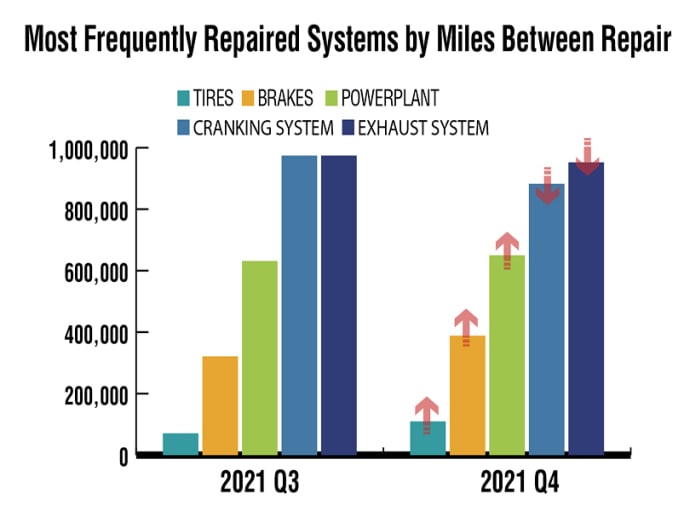
The average fleet participating in the ATA’s Technology & Maintenance Council and FleetNet America Vertical Benchmarking Program operated 42,459 miles between unscheduled repairs in the fourth quarter of 2021, which is highest it has been in the past two years. The increase in miles signifies fleets are paying more attention to preventive maintenance, according to the report.
This could spell good news for fleets, because while average repair and maintenance costs declined in 2020 to the lowest level since 2013, maintenance costs will likely continue to rise as more traffic returns to the road.
Ad Loading...
The top five most frequently repaired systems in the graph accounted for nearly 67% of all reported roadside repairs. Miles between roadside repair of tires improved nearly 55%, the greatest gain.
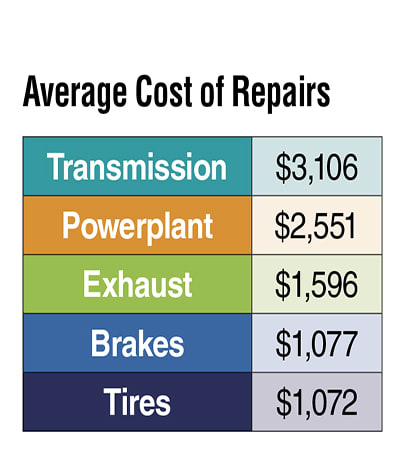
The Decisiv SRM Ecosystem tracks service and repair events for more than 7 million assets, recording the average costs of parts and labor for repair of systems linked to the Vehicle Maintenance Reporting Standards. Transmission repairs were by far the most expensive in terms of parts ($2,039) and labor ($1,067).
Source: TMC/Decisiv VMRS System Service Data, Q1 2021
The average age of trucks on the road has continued to rise as demand for new equipment outpaces supply. As carriers struggle to manage these aging fleets and a shortage of technicians, costs will likely increase as fleet managers pay more in maintenance and repairs because they either cannot or choose not to purchase new trucks.
Average repair and maintenance costs declined slightly in 2020 to 14.8 cents per mile, the lowest level since 2013. This decrease may partly result from decreases in engine rebuilds and other maintenance activities typically associated with higher milage, or form increased truck and trailer purchase costs (which also increased a greater rate in 2020.) 2020 is the most current data available.
Source: American Transportation Research Institute, “An Analysis of the Operational Cost of Trucking 2021"
Repair and Maintenance Cost by Sector
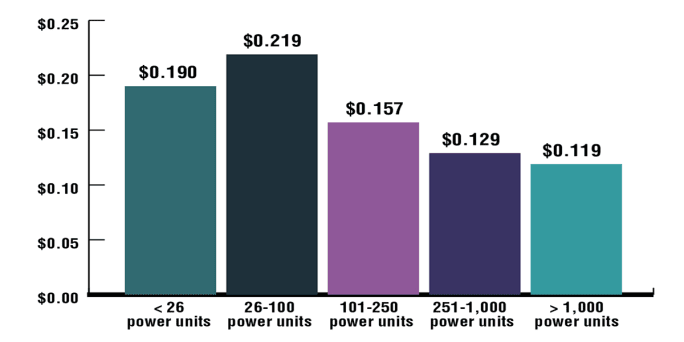
Specialized carriers pay more in repair and maintenance per mile at nearly every fleet size. In the specialized sectors, fleets with 26 to 100 power units have the highest maintenance costs. In the truckload sector, fleets with 5 to 25 power units have the highest maintenance cost.
Source: American Transportation Research Institute, “An Analysis of the Operational Cost of Trucking 2021"
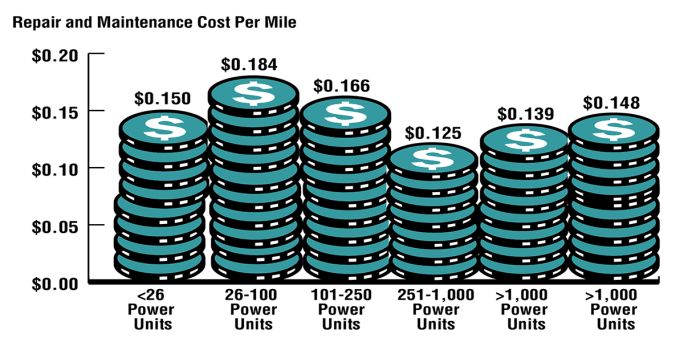
Repair and Maintenance Cost Per Mile By Fleet Size
Sector had less of an impact on maintenance costs than fleet size. In both truckload and specialized sectors, large carries have the lowest repair and maintenance costs, while mid-sized carriers encountered diseconomies of scale: costs that are higher in proportion to fleet size. These parallel cost curves indicate that carriers must outlay disproportionally more funds toward repair and maintenance before benefiting from economies of scale.
Source: American Transportation Research Institute, “An Analysis of the Operational Cost of Trucking 2021"
Even those who do get newer trucks in 2022 or 2023 won’t be immune to rising costs.
While it may seem as though newer trucks would decrease maintenance costs by lowering maintenance frequency and parts costs, historical data by the American Transportation Research Institute shows that newer trucks are still expensive to maintain and repair as costs increase for diagnostics, parts and diesel technician labor costs.
“Some experts believe that the diesel technician shortage may ultimately surpass the truck driver shortage over time — particularly when autonomous and advance safety technologies become pervasive,” ATRI officials wrote in its 2021 Operational Cost of Trucking report.
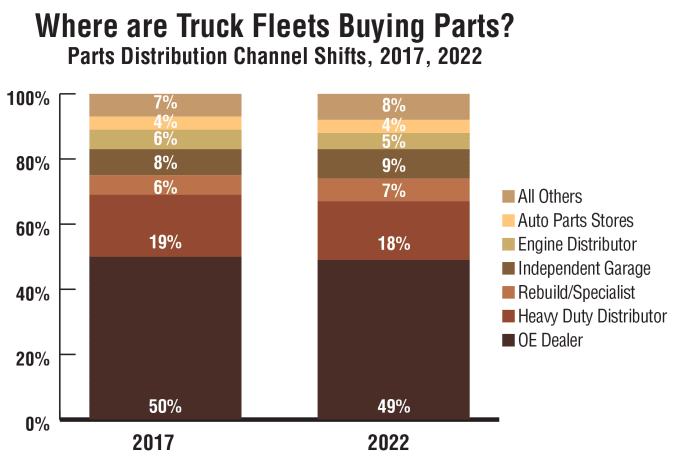
In total, aftermarket demand for medium and heavy-duty vehicles (Class 6-8), trailers and container chassis has grown 44% in the last five years. The growth is attributed primarily to price increases along with increasing populations and greater fleet utilization. The OE dealer, heavy-duty distributor and engine distributor each lost one share point over this period, resulting in slight gains in the independent garage, specialists and “other” channels.
Source: MacKay & Company
This data and analysis first appeared in the August 2022 special Fact Book issue of Heavy Duty Trucking.
2022 Fact Book
The Trucking Industry Numbers Impacting the Bottom Line
Heavy Duty Trucking’s annual Fact Book is designed to provide a snapshot of the current state of the industry, where it’s been, and where it’s going. 2022 is the eighth year for the HDT Fact Book. Dive into the other topics: (Coming Soon...)
For fleet managers and collision repair professionals keeping heavy-duty trucks on the road, getting the color right the first time isn't just about appearance — it's about efficiency, turnaround time, and bottom-line results. Discover how today's digital color tools are transforming the repair process from guesswork to precision.
DTNA is recalling more than 2,400 trucks that received an incompatible software fix instead of the hardware repair required to address brake valve corrosion.
Fleets have more visibility into truck health, safety events, and driver activity than ever. The next challenge is turning all that information into useful guidance for the person who has to decide what to do next.
Making it through August isn’t the same as being ready for the next several months of operation. Find out what systems may have suffered from summer heat and need to be checked out before fall.
With freight improving but costs still climbing, fleet maintenance executives explain how they're balancing price, quality, and supplier relationships.
The new API PC-12 heavy-duty engine oil category reflects the changing demands of modern diesel engines. But fleets like Foodliner are looking to getting their own data before making decisions on adopting the new oils and questions such as extending oil drain intervals.
The joint venture will operate MCT's network of Carrier Transicold dealerships and mobile service locations, with the companies promising greater service capacity and uptime for refrigerated fleets.