





The Dodge Big Horn Only Lasted for 3 Years -- and Became an American Icon Anyway
Great American Trucks: The Mack B Series
World War II was over. The American economy was booming. Mack Trucks needed a workhorse truck fleets could rely on to do any number of jobs. What they delivered became an icon.
April 24, 2024

The Mack B Series was tough and versatile -- a perfect fit for the rapidly expanding and evolving American trucking industry in the 1950s.
Photo: Jim Park
5 min to read
World War II was over. The American economy was white-hot and getting hotter. Construction and manufacturing were booming. And the first truck fleets were experimenting with a business model that would, in time, evolve into the coast-to-coast, long-haul trucking sector we know today.
As one of the oldest truck OEMs in the country, Mack Trucks knew it needed a new truck to meet the new era.
There are times that cry out for fresh, bold, new takes in automotive design. But this was not one of those moments. What Mack needed was a versatile, rugged and capable truck that could easily be slotted into any trucking application — some of which were just being invented.
Mack needed a workhorse. And with the introduction of its B Series trucks in 1953, that’s exactly what it got.
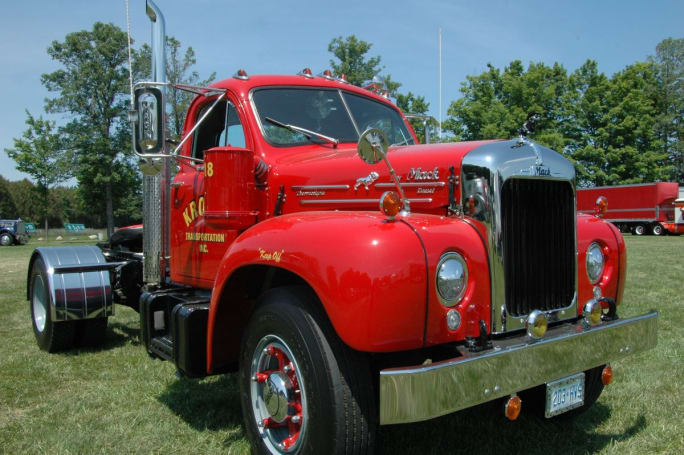
The Mack B Series featured a large, prominent chrome grill combined with bold, sweeping front fenders.
Photo: Jim Park
Mack B-Series Design
Appearance-wise, the Mack B Series was something of a throwback design. At a glance, the truck relied heavily on styling cues that American truck designers settled on in the late 1930s.
The truck featured a large, prominent chrome grill combined with bold, sweeping front fenders, and running boards. A high-mounted, two-piece hood opened from either side of the truck. The nose of the truck protruded outward a smallish-looking cab with a large, sloped, two-piece windscreen.
But, in a nod to what would eventually become iconic 1950s automotive styling, the B-Series’ angles were smoothed out. Large headlamps were now fully integrated into the truck’s fenders, instead of mounted externally atop them. And while the cab seemed disproportionate compared to the wide, stout, lower truck body, it featured a decidedly low-profile, aerodynamic design.
It was an updated look on a classic design that would eventually bridge the design gap between the 1930s and conventional style trucks that began to appear in the 1970s.
A Bulletproof Design
All in all, the B Series was exactly the right truck for Mack at exactly the right time. The North American trucking industry was undergoing rapid growth and change. New applications were appearing constantly. And the B Series was offered in a variety of configurations that allowed fleets to get exactly the truck they needed for the jobs they wanted to do.
The B Series could be spec’d as a straight truck, tractor, with a cowled chassis or as a fire truck. A contour cab proved to be popular with East Coast fleets, as it allowed a closer tractor-trailer coupling that worked well in crowded cities and narrow roads. There was also an integrated sleeper option that played into the just-developing long-haul market segment.
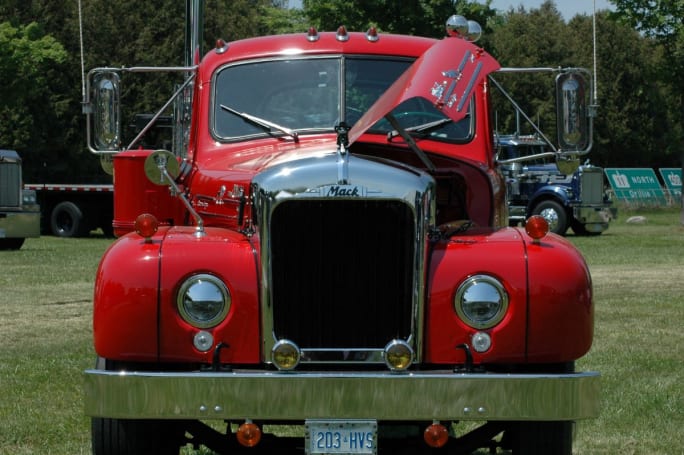
The B Series' hinged, two-peice hood was one of many throwback design features held over from 1930s truck styling.
Photo: Jim Park
And it was also the very first Mack truck offered with a standard diesel engine.
This was the introduction of the famous Mack Thermodyne inline, six-cylinder engine. In a foreshadowing of the future, Mack engineers collaborated with Scania in Sweden on the development of the new, direct-injection diesels engines, which would become extremely popular with fleets in coming years. Eventually, around 80% of all B Series trucks built would have some Thermodyne engine variant under the hood.
The Mack Magnadyne gasoline engine was still offered as standard equipment on the B-42 model and as optional equipment for other variants. All told, there were 10 different gasoline engines available for B Series trucks, ranging from a 4.8-liter, 107 horsepower engine in the B-20 model, up to the 11.6-liter, 232-horsepower engine offered in the B-70 model.
Other engine options, including the 14-liter Cummins NTC335 rated at 335 horsepower, were also available.
Transmission Options Included Twin-Stick and More
One problem with diesel engines of the period, however, was the narrow band between maximum power and peak torque. And Thermodyne engines weren't immune to this problem.
To deal with this issue, Mack engineers opted for deep-reduction final drive gearing and a multitude of transmissions options. These included the two-stick, 20-speed Quadruplex, 15-speed Triplex and one-stick, 10-speed Unishift gearboxes.
The Right Truck for the Times
Spartan beyond belief by today’s standards, the B-Series cab interior was reasonably comfortable for its day.
Power steering was a distant dream for truckers of the time. So, the driver’s station was dominated by a massive, three-spoke steering wheel needed to turn the truck at low speeds.
The large steering wheel was also useful for drivers who had to hook an elbow through it to simultaneously shift both transmission levers on the dual-shift gearboxes. Luckily the shifters were located close at hand on the driver’s right side — although many drivers bent the sticks inward to allow easier access and even one-handed shifts.
Safety belts were not a thing at the time. So, there wasn’t going to be anything stopping drivers from slamming violently into the steering wheel or the flat, all-metal, chromatic green painted dashboard behind it in the event of an accident.
But at least all the important gauges and control switches were large, easy to read, easy to reach and centered directly in front of the driver.
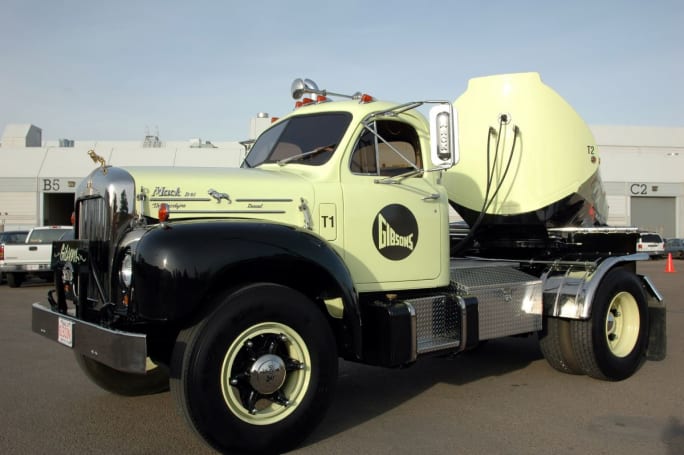
The B Series was the first Mack truck to be offered with a diesel engine as the standard spec.
Photo: Jim Park
The cab was incredibly loud, of course; that was normal in the 1950s. But views to the front and sides were very good for the day. Large mirrors mounted on the A-pillars gave good views rearward, as well. And the trucks handled reasonably well at highway speeds.
In terms of safety, conform and convenience, the B Series was perfectly in tune with other trucks of the time.
How the Mack B Series Became a Trucking Icon
It was apparent almost at once that Mack had a hit on its hands with the B Series. Nine different chassis versions were offered. The OEM would eventually build a total of 126,745 units before retiring the B Series in 1966.
But the B Series was so tough and capable, it wasn’t unusual to see them still working hard for fleets 50 years after their production run ended.
Today, the trucks are mostly found in the hands of collectors, who treasure them for their iconic looks and a reputation that has transcended trucking to become a part of American culture. Ask any layman to describe a 1950s American truck, and odds are they’ll point to the Mack B Series as the make and model that defined that decade.
Just as it had done 40 years earlier with its AC Series trucks, Mack once again set the standard for what Americans trucks would be at a moment when the trucking industry was going through great changes. Both trucks became famous for their looks and earned unparalleled reputations for toughness and reliability — and became American icons in the process.
Subscribe to Our Newsletter
More Equipment

How Volvo Updated Its D13 for EPA 2027 [Watch]
Volvo’s updated D13 promises lower emissions without sacrificing performance or fuel economy. Take a closer look at what changed inside the engine in this HDT Spotlight video.
Read More →
Michelin Tire Improves Efficiency and Durability for Regional Fleets
The Michelin X Multi Energy D2 is a regional haul drive tire engineered to help fleets improve fuel efficiency, durability and traction in demanding stop-and-go operations.
Read More →
ZF Expands Commercial Vehicle Push in North America
ZF is expanding its North American commercial-vehicle presence with new transmission applications, electrification, trailer technology and autonomous-driving systems.
Read More →
Tesla Wants a Self-Driving Semi. Are Cameras Enough?
Could Tesla’s camera-only autonomous driving technology work on an 80,000-pound Semi? In this commentary, HDT's Deborah Lockridge takes a look at Tesla, Cybercab, and how autonomous trucks see the road.
Read More →
Kodiak: Driverless Long-Haul Truck Launch on Track for 2026
Kodiak AI says its driverless long-haul safety case is 93% complete and it remains on track to begin commercial operations by year-end 2026.
Read More →
What DOT’s Automated Vehicle Strategy Means for Trucking
The U.S. Department of Transportation issued a new automated-vehicle strategy that outlines plans for driverless-truck regulations, cross-state freight corridors, and federal safety standards.
Read More →
East Coast Port Launches $45M Electric Truck Push
The Port Authority of New York and New Jersey announced millions in incentives for zero-emission drayage trucks, yard tractors, and new charging hubs near the port.
Read More →
PlusAI Going Public to Fund Autonomous Truck Launch
A SPAC deal could provide PlusAI with up to $300 million as it works toward a 2027 commercial launch of factory-built autonomous trucks.
Read More →
NHTSA Moves to Rewrite Truck Fuel-Economy Rules
The National Highway Traffic Safety Administration says it lacks authority to regulate medium- and heavy-duty truck engines separately from complete vehicles, but the existing standards have not yet been eliminated.
Read More →
Detroit Opens Orders for EPA 2027 Engines
Detroit isn’t starting from scratch to meet EPA 2027 diesel emissions standards. Its Gen 6 DD13 and DD15 engines keep much of today’s platform while updating the fuel and aftertreatment systems.
Read More →