Sometimes small changes can have the biggest impact on a fleet’s operations.
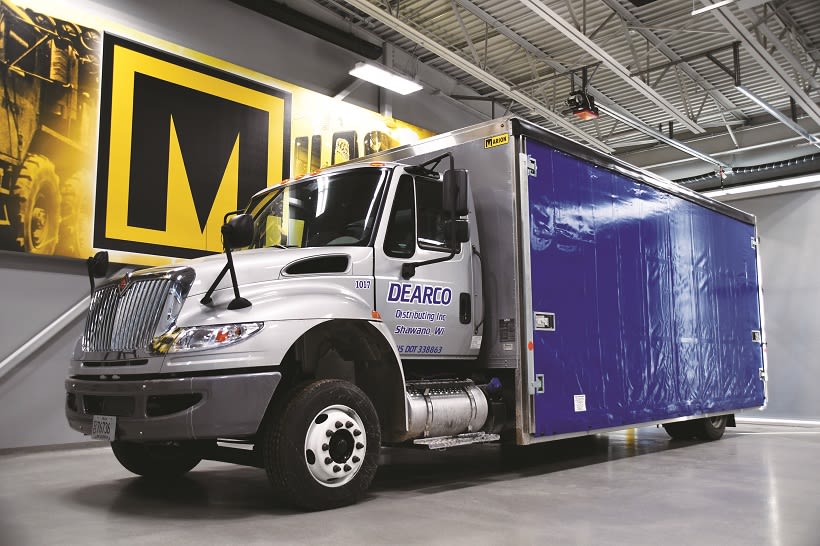
Wisconsin-based Dearco Glass Paint & Decorating has a fleet of 10 trucks with custom bodies designed to haul large flat pieces of glass to manufacturers, glass shops, furniture shops fabricators, and other customers around the upper Midwest. The trucks are fitted with a custom body designed by Marion Body Works, which has worked with its longtime customer to make small changes to Dearco’s trucks over the years to meet the company’s needs.
“We’ve been tweaking the Marion body and we kind of got it where we like it,” says Dearco President Jeff Knope. But they found one more way to improve it.
Some of Dearco’s trucks were fitted with a strap-and-buckle curtain system, mostly to protect the glass during bad weather. In the winter months especially, salt on the roads and ice and snow could make delivering a clean sheet of glass a hassle. But the curtains weren’t perfect. In a day when a driver might make 30 stops along a 300-mile route, just unbuckling the straps and keeping them clean of road gunk became its own problem.
Knope says he wasn’t going to live with the old curtain system forever because it slowed his drivers too much. Some of his trucks are uncovered anyway, so he had decided he was either going to go without it, or switch to new sliding curtains he had seen on other trucks.
“The previous curtain worked, but it was just too much monkeying around,” he says. “I see these sliders everywhere, so I knew there was something else out there, and Marion came through.”
Cargo-control product maker Kinedyne had recently introduced a new sliding curtain system called the Kin-Slider. Sliding curtain systems are in frequent use in Europe, and Kinedyne felt that there was an untapped market in the United States. The company partnered with a European provider to bring it here. Longtime Kinedyne customer Marion Body Works knew Dearco was looking for a sliding curtain for its trucks.
The Kin-Slider QR 30-second Curtain Side Vehicle Access opens at either end with a latch release mechanism located on the front and back that can be moved with ease and quickness that the old multi-strap curtains couldn’t match. Kinedyne tailors the curtains to fit any size trailer or truck body, from medium-duty trucks up to 53-foot trailers.
The curtains are made of a PVC-coated vinyl able to withstand a wide range of temperatures. They slide on rollers located on top and bottom rails, creating a watertight wall with no need for tensioning, according to Kinedyne.
Right away, Dearco’s drivers could be more efficient with their deliveries, no longer having to bend down to unbuckle several straps to load and unload glass.
Eric Smitsdorff, product manager for Kinedyne, says the system is useful for any fleet making large deliveries with multiple stops. The sliders can be fitted to box trucks, beverage trucks, and may see applications in the burgeoning last-mile delivery segment.
“We saw some other sliders out there, but Marion recommended this one and this is the way to go,” says Knope. Dearco has been using a truck with the Kin-Slider system for almost a year and plans to use this design for its trucks going forward.