




Fleets Answer the Question, 'How's Business?'
After enduring a bruising first quarter that saw falling profits at many fleets, it comes as no surprise that in a second quarter survey of business conditions fleet executives are feeling a bit down.

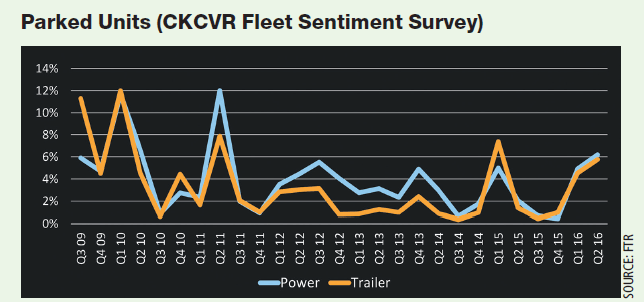
The percentage of fleets' parked trucks in the first quarter of 2016 is the highest in a year, but is only one of several signs of a slowing trucking business and overall economy.
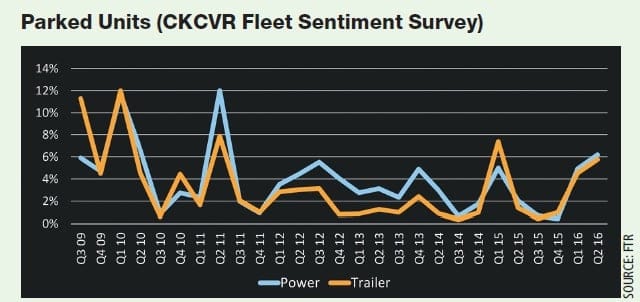
The percentage of fleets' parked trucks in the first quarter of 2016 is the highest in a year, but is only one of several signs of a slowing trucking business and overall economy.
After enduring a bruising first quarter that saw falling profits at many fleets, it comes as no surprise that in a second quarter survey of business conditions, responses show fleet executives are feeling a bit down.
Multiple fleet earnings reports described the first quarter freight environment as “challenging,” with a slowdown in the overall economy getting much of the blame. The first estimate of GDP for the quarter showed the economy growing at an annual rate of just 0.5%, the slowest expansion in the nation’s gross domestic product since the first quarter of 2014.
Hearing from Chris Kemmer, president of CK Commercial Vehicle Research and publisher of the Fleet Sentiment Survey Report, there’s little doubt this has led to a softening in overall operating metrics for trucking companies.
It’s not a fall-off-the-cliff scenario, but utilization is down, parked vehicles are up, and the overall “how’s business” rating in the survey has fallen for the first time in more than a year, to 3.9 on a 5.0 scale. While better than the 3.2 seen during the throes of the Great Recession, that’s down from the 4.2 reported in the second quarters of 2015 and 2014.
Out of all the measures Kemmer presented from the survey in a webinar last month, the most interesting and the one she described as a “major concern” is a spike in the number of parked trucks, which she called “very reflective of the market.”
According to the survey, the percentage of fleets’ parked vehicles continues heading upward, now above 6.2% for power units and 5.8% for trailers. Both measures were below 2% in the second quarter of 2015.
Interestingly, in the first quarter of 2015, when there were more freight movements and rates were better, the percentage of parked trucks and trailers was even higher.
“I think the difference is last year, [fleets] had vehicles parked because they didn’t have drivers. They had freight, plenty of freight last year, but they were short on drivers,” Kemmer said. This year’s second quarter survey results reflect an attitude more of, “I don’t need the trucks that bad, so it’s okay that they are parked,” she explained.
Why is the increase in parked vehicles a concern? Equipment utilization is also softening for both power units and trailers. It’s still above 85% for trucks and higher than 80% for trailers among survey respondents, Kemmer said, which is in a “decent range but it’s not growing.” Some fleets are continuing to add capacity, but the percentage of fleets doing so is down from a year earlier.
One large truckload carrier reported it “needed more freight” to fill current capacity.
“That is likely to trickle down to smaller fleets,” Kemmer said in an interview. “And while I don’t track shipping rates, I would assume excess capacity ultimately reduces spot rates fleets can charge. Also, if freight continues to soften, or doesn’t strengthen significantly, fewer trucks and trailers will be ordered.”
All this translates into a softening trajectory for trucking, but Kemmer stressed it’s also “not doom and gloom.” However, with recent forecasts lowering expectations for overall economic growth this year, fleets may find they have to withstand some more bruises.
More Fleet Management

Color Match Smarter: Tools That Restore & Perform
For fleet managers and collision repair professionals keeping heavy-duty trucks on the road, getting the color right the first time isn't just about appearance — it's about efficiency, turnaround time, and bottom-line results. Discover how today's digital color tools are transforming the repair process from guesswork to precision.
Read More →
FMCSA Pauses Biennial-Update Enforcement Amid Motus Transition
Carriers whose updates were due on or after June 1 have more time, while FMCSA works to stabilize its new registration system and warns of phishing sites impersonating its new carrier registration system, Motus.
Read More →
2026 Blueprint for Countering Smarter Supply Chain Theft
Cargo theft is no longer just the cost of doing business. It's a multi-billion-dollar criminal enterprise exploiting vulnerabilities across your fleet, drivers, and supply chain.
Read More →


How Telematics Improves Visibility, Control, and Performance in Refrigerated Fleets
Explore how telematics help refrigerated fleets improve visibility, uptime, efficiency, compliance, and cargo protection across connected cold chain operations.
Read More →
What the U.S.-Canada Trade War Means for Trucking
Escalating U.S.-Canada tariffs could disrupt cross-border freight, reduce truck volumes, raise costs, and create new uncertainty for carriers on both sides of the border.
Read More →
What Are Trucking’s Top Concerns for 2026?
The American Transportation Research Institute wants to know what's worrying trucking fleet managers, drivers, and other stakeholders in its annual Industry Issues survey.
Read More →
American Trucking Associations Looks for a New Leader
ATA President and CEO Chris Spear abruptly left his job at the association on August 21, at a pivotal time for the trucking industry.
Read More →
Public Wi-Fi Cybersecurity Risks: How Truck Drivers and Fleets Can Protect Their Data
Public Wi-Fi can expose truck drivers and fleets to credential theft, malware, and other cyber threats. Here’s how to reduce the risk on the road.
Read More →
For Nicky Cupp, Fleet Innovation Starts With Frustration
HDT Truck Fleet Innovator Nicky Cupp turns everyday pain points at Fraley & Schilling into opportunities for better technology and smarter processes.
Read More →
Adam Buttgenbach’s Approach to Electric Trucks: Start With Where They Fit
HDT Truck Fleet Innovator Adam Buttgenbach helped PepsiCo build one of North America’s largest EV fleets by focusing on where electric trucks make operational sense.
Read More →