




Failure to Communicate
How can you expect to maintain a good relationship if you never talk with your partner? This is where a marriage has something in common with your relationship with your drivers and owner-operators

How can you expect to maintain a good relationship if you never talk with your partner? This is where a marriage has something in common with your relationship with your drivers and owner-operators.
Both partners in any committed relationship have wants and needs, and if those aren't communicated effectively - that is, spoken by one and understood by the other - the partnership will fail.
This occurs with frustrating frequency in the carrier/owner-operator world.
A carrier I once worked for claimed to have an open-door policy. The trouble was, that door led into a broom closet. It's one thing to sell your company using platitudes about open doors and open communication, but you have to follow through.
One of my biggest complaints at the time was the mileage policy. The carrier claimed it used such-and-such a mileage/routing program. Yet my actual mileage, the mileage I got from a pirated version of that same program, and the mileage I was paid were always different - usually in the carrier's favor. I wasn't alone. Most of the other owner-operators were getting skinned as well. Twenty miles here, 30 miles there; it wasn't much, but it added up over 30 days times the 80-odd trucks in the fleet.
A group of us figured out one day that the carrier was skimming enough from our settlements to make the payment on two company trucks. The carrier, naturally, was shocked by the suggestion, but discontinued the practice when threatened with a mass exodus. We eventually established a list of standard mileages based on averages of actual miles run on popular lanes.
Unfortunately, it wasn't honest and open communication that precipitated the change. It came down to a threat.
Trent Dye, director of Paramount Freight Systems, a growing company of about 200 owner-operator trucks - twice named a Top Fleet to Drive For by TCA - told me he opened up lines of communication in his fleet by establishing an owner-operator committee that meets quarterly. He also uses Survey Monkey to poll his drivers on various issues. His most recent survey revealed that about 80% of his owner-operators listed fair treatment as their top concern.
Just what constitutes fair treatment is open to interpretation, but it surely includes not blaming short miles on the routing software, listening to legitimate concerns and complaints and trying honestly to resolve them.
I believe fair treatment begins with openness: transparent pay packages that don't require an engineering degree to decipher, clear lines of communication with a mechanism to acknowledge concerns and regular meetings with open, two-way dialog.
Folks who drive trucks have lots of time to stew over a problem, and that almost always makes the problem worse - at least in their minds. Some minor altercation or disagreement that may have been over in 30 seconds and forgotten about by a dispatcher can linger unresolved in the driver's mind for hours. If he or she lost the altercation, the resentment will build as time goes by. Before you know it, the driver is throwing his or her bills on the desk and walking out the door.
By then, it's too late for committees and surveys.
If that dispatcher had reported the problem to a manager and the manager made a follow-up call to the driver, the problem would probably evaporate. At the very least, you'd turn the stewing down to a simmer.
You wouldn't ignore your spouse if he or she had a serious issue to deal with. How could you expect any better outcome by ignoring the other partners in your life?
From the April 2012 issue of HDT.
More Fleet Management

How Telematics Improves Visibility, Control, and Performance in Refrigerated Fleets
Explore how telematics help refrigerated fleets improve visibility, uptime, efficiency, compliance, and cargo protection across connected cold chain operations.
Read More →
What the U.S.-Canada Trade War Means for Trucking
Escalating U.S.-Canada tariffs could disrupt cross-border freight, reduce truck volumes, raise costs, and create new uncertainty for carriers on both sides of the border.
Read More →
What Are Trucking’s Top Concerns for 2026?
The American Transportation Research Institute wants to know what's worrying trucking fleet managers, drivers, and other stakeholders in its annual Industry Issues survey.
Read More →

American Trucking Associations Looks for a New Leader
ATA President and CEO Chris Spear abruptly left his job at the association on August 21, at a pivotal time for the trucking industry.
Read More →
Public Wi-Fi Cybersecurity Risks: How Truck Drivers and Fleets Can Protect Their Data
Public Wi-Fi can expose truck drivers and fleets to credential theft, malware, and other cyber threats. Here’s how to reduce the risk on the road.
Read More →
For Nicky Cupp, Fleet Innovation Starts With Frustration
HDT Truck Fleet Innovator Nicky Cupp turns everyday pain points at Fraley & Schilling into opportunities for better technology and smarter processes.
Read More →
Adam Buttgenbach’s Approach to Electric Trucks: Start With Where They Fit
HDT Truck Fleet Innovator Adam Buttgenbach helped PepsiCo build one of North America’s largest EV fleets by focusing on where electric trucks make operational sense.
Read More →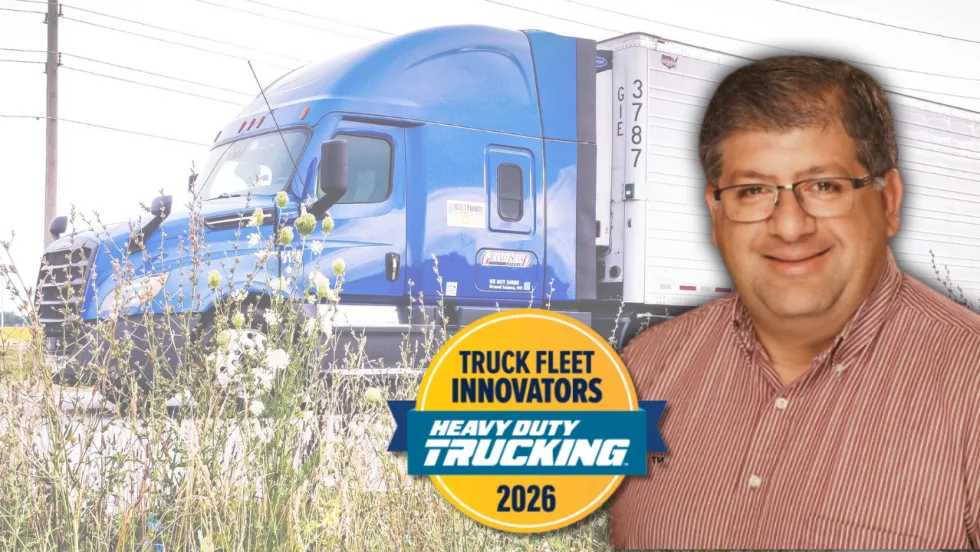
Deen Albert: Let Automation Do the Math, People Make the Decisions
HDT Truck Fleet Innovator Deen Albert makes sure people are still at the heart of operations at Grand Island Express, even while adopting artificial intelligence tools. AI-assisted dispatch helped boost revenue 25% with the same number of trucks.
Read More →
Trimble’s New AI Agent Takes Aim at Fleet Back-Office Busywork
Arc Agent works across Trimble TMS products to automate repetitive tasks such as freight orders, maintenance, invoices, fuel costs and more.
Read More →
How HDT’s 2026 Truck Fleet Innovators Are Rethinking Fleet Operations
Meet five trucking leaders who are challenging assumptions, solving operational problems, and putting innovative ideas to work.
Read More →