





Related: Veterans in the Driver's Seat
Ex-Military Trucks Find Duties with Civilian Operators
Bob Eggar, who runs The Pumpkin Patch, a produce farm on an island in the Columbia River, operates three 6x6s to get through mud.
May 12, 2016

Workers at The Pumpkin Patch in Oregon load the orange orbs aboard a M923 5-ton truck. All-wheel drive works well in mud. Photos: Bob Eggar
4 min to read

Workers at The Pumpkin Patch in Oregon load the orange orbs aboard a M923 5-ton truck. All-wheel drive works well in mud. Photos: Bob Eggar
Need a stout go-anywhere truck for off-road work, and for not a lot of money? An ex-military 6x6 might be just the ticket. It is for Bob Eggar, who runs The Pumpkin Patch, a produce farm on an island in the Columbia River, near Portland, Oregon. Here, mud is an enemy.
That complicates the task of getting crops out of the fields, but a team of former U.S. Army vehicles can handle it. Two were purchased through the GovPlanet arm of IronPlanet, the worldwide auction service, for under $5,000 apiece. An older a 2-1/2-ton cargo truck – a Vietnam-era “deuce and a half” -- cost Eggar only $2,500.
“They offered me another one for the same price,” he said of that dealer, “and to this day I wish I had taken it.” His latest trucks came from Joint Base Lewis-McChord (formerly the Army’s Fort Lewis and McChord Air Force Base, near Tacoma, Washington).
“We farm 55 acres, and have a lot of equipment. My son just turned 18, he likes equipment, and he found the web site,” Eggers said, explaining how he happened to buy the 5-tonners through GovPlanet.com.
In war zones, like Iraq and Afghanistan, soldiers ran these trucks day and night and they got ragged, so were often scrapped. However, trucks kept Stateside usually see light duty, and though they’ve been kept for 20 years or more, they have low miles and hours by the time the military decides to replace them.
IronPlanet executives say they recently heard that many were to be scrapped, and convinced the Pentagon to auction them instead. Then they set up GovPlanet. Civilians have bought hundreds of trucks and much construction equipment, like motor graders and bulldozers, at a fraction of new-equipment prices.
Eggar said he bought the deuce-and-a-half, an M35A1, 20 years ago; it has a turbocharged multi-fuel engine with 5-speed synchromesh manual transmission and a 2-speed transfer case.
He acquired a pair of 5-tonners, a truck and a tractor in the M939 series, in the last two years. The ‘939s originally had heavy, naturally aspirated Cummins NHC-240 diesels with similar manual transmissions and TCs, but the Army upgraded them in the early 1990s with Cummins turbocharged ISC-240 diesels and Allison automatics.

A harvestor conveys produce into bins tied to a flatbed trailer pulled by a 5-ton 6x6 tractor, an M931.
“They work well for us because we can harvest our winter crops,” he said. “Sometimes the weather can get kind of sour on us, but they go well through mud” with their all-wheel-drive setups. “We’ve had no problems whatsoever -- no grief yet. We did put a clutch in the deuce-and-a-half.
"They don’t do road trips because they’re so heavy, and we can’t get enough produce on to make it worthwhile.” For road work The Pumpkin Patch has commercial-style trucks.
A 2-1/2-ton cargo truck’s empty weight is about 13,000 pounds, according to Wikipedia. The stated capacity of American military trucks is for off-road operation; on roads a 2-1/2-ton truck can carry 5 tons. Its top speed is about 50 mph, though GIs have driven them faster (says this ex-soldier).
The M939 series includes sub-models for various duties: A straight cargo truck like Eggar’s is designated M923, and weighs 21,600 pounds, and an M931 tractor weighs 22,089 pounds. The tractor’s on-road fifth-wheel rating is 15,000 pounds and it can pull a semitrailer weighing up to 37,000 pounds.
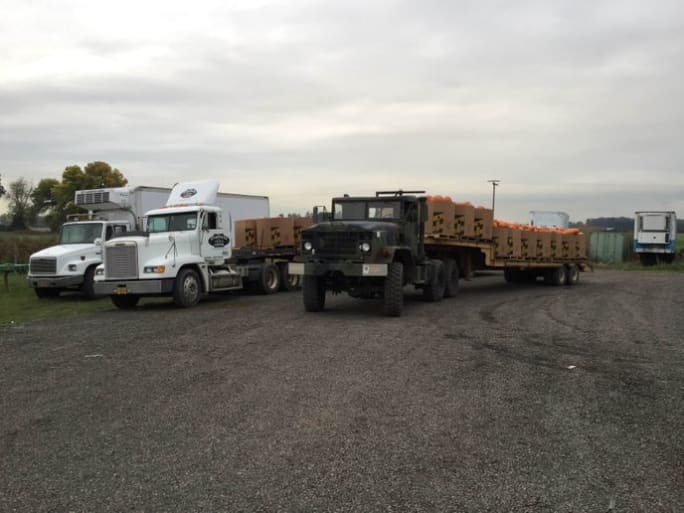
The farm uses lighter-weight commercial-style trucks, like these Freightliners, to carry products to market. When weather's wet, the military trucks get the crops from the fields.
Though Eggar’s trucks don’t have them, Eaton central tire inflation systems went on some of the upgraded M939s. (CTIS is now made by Dana Spicer, which continues to sell it mostly for military use, but some have gone on civilian concrete mixer trucks.) Upgraded M35-series 2.5-ton trucks got Caterpillar 3116 diesels with Allison automatics.
All trucks retained their air-over-hydraulic drum brakes during the upgrading. Because of stability problems with the 5-tonners, the Army had limited road speed to 40 mph, and some got anti-lock braking systems as a remedy. Some trucks had power steering, and with the automatic transmissions were rather easy to drive.
Aside from GovPlanet, “trader” publications carry listings for ex-military trucks like these, with asking prices from $3,500 to $7,500 and more. That’s because the government has been selling obsolete and no-longer-needed vehicles for many years. “Army surplus” became part of our language after World War II, and older folks recall cranes, excavators and water tanks mounted on deuce-and-a-half chassis.
Frugal commercial operators like Bob Eggar and private enthusiasts who often belong to the Military Vehicle Preservation Association (www.mvpa.org) buy such trucks singularly and in groups. Parts are readily available from specialists who run print and on-line ads. Maybe it’s time to “join up.”
Subscribe to Our Newsletter
More Equipment

How Volvo Updated Its D13 for EPA 2027 [Watch]
Volvo’s updated D13 promises lower emissions without sacrificing performance or fuel economy. Take a closer look at what changed inside the engine in this HDT Spotlight video.
Read More →
Michelin Tire Improves Efficiency and Durability for Regional Fleets
The Michelin X Multi Energy D2 is a regional haul drive tire engineered to help fleets improve fuel efficiency, durability and traction in demanding stop-and-go operations.
Read More →
ZF Expands Commercial Vehicle Push in North America
ZF is expanding its North American commercial-vehicle presence with new transmission applications, electrification, trailer technology and autonomous-driving systems.
Read More →
Tesla Wants a Self-Driving Semi. Are Cameras Enough?
Could Tesla’s camera-only autonomous driving technology work on an 80,000-pound Semi? In this commentary, HDT's Deborah Lockridge takes a look at Tesla, Cybercab, and how autonomous trucks see the road.
Read More →
Kodiak: Driverless Long-Haul Truck Launch on Track for 2026
Kodiak AI says its driverless long-haul safety case is 93% complete and it remains on track to begin commercial operations by year-end 2026.
Read More →
What DOT’s Automated Vehicle Strategy Means for Trucking
The U.S. Department of Transportation issued a new automated-vehicle strategy that outlines plans for driverless-truck regulations, cross-state freight corridors, and federal safety standards.
Read More →
East Coast Port Launches $45M Electric Truck Push
The Port Authority of New York and New Jersey announced millions in incentives for zero-emission drayage trucks, yard tractors, and new charging hubs near the port.
Read More →
PlusAI Going Public to Fund Autonomous Truck Launch
A SPAC deal could provide PlusAI with up to $300 million as it works toward a 2027 commercial launch of factory-built autonomous trucks.
Read More →
NHTSA Moves to Rewrite Truck Fuel-Economy Rules
The National Highway Traffic Safety Administration says it lacks authority to regulate medium- and heavy-duty truck engines separately from complete vehicles, but the existing standards have not yet been eliminated.
Read More →
Detroit Opens Orders for EPA 2027 Engines
Detroit isn’t starting from scratch to meet EPA 2027 diesel emissions standards. Its Gen 6 DD13 and DD15 engines keep much of today’s platform while updating the fuel and aftertreatment systems.
Read More →