




Veterans in the Driver's Seat
In the past two years, 34 states have adopted laws that allow motor vehicle departments to waive the CDL skills test for qualified military veterans, the Obama administration says in a new report. Nine more states plus the District of Columbia are considering legislation to do the same thing.

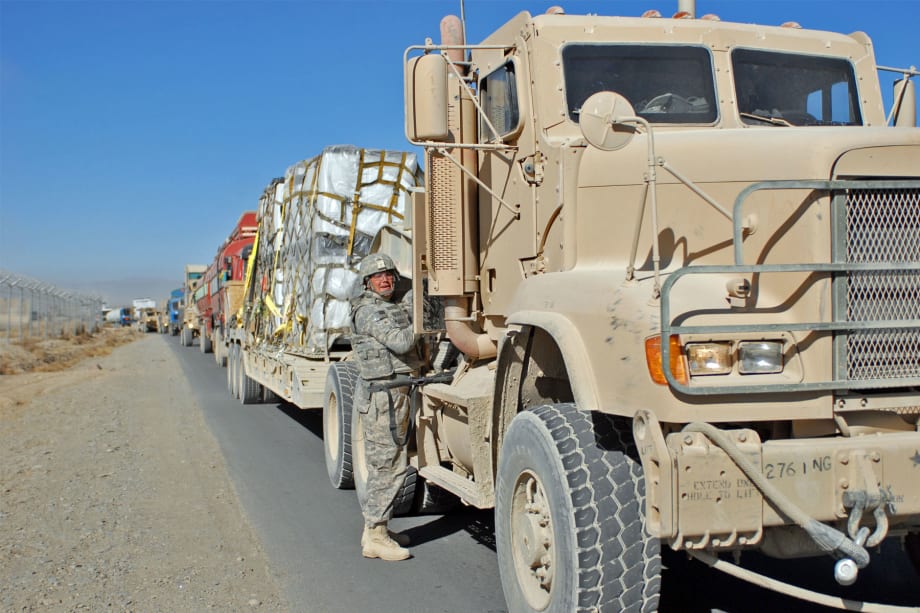
The Army National Guard's "Drive the Guard" program is putting soldiers behind the wheel while they are in uniform and helping them to qualify for fulltime civilian employment as a truck driver.
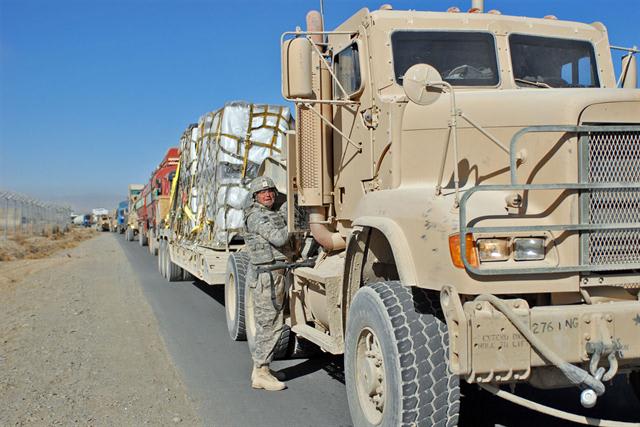
The Army National Guard's "Drive the Guard" program is putting soldiers behind the wheel while they are in uniform and helping them to qualify for fulltime civilian employment as a truck driver.
In the past two years, 34 states have adopted laws that allow motor vehicle departments to waive the CDL skills test for qualified military veterans, the Obama administration says in a new report.
Nine more states plus the District of Columbia are considering legislation to do the same thing. And under a new law, states may issue commercial licenses to military personnel who live in another state.
These are among several initiatives currently under way that could help relieve a driver shortage in the truckload industry that apparently is growing worse.
“The truckload industry has long suffered from a driver shortage. However, its severity level is now acute,” says John Larkin of the Stifel Transportation & Logistics Research Group in a recent report.
Larkin, citing an analysis by Gordon Klemp, president of the National Transportation Institute, says the problem is partly demographic: Only 17% of drivers and owner-operators are 34 years old or younger.
Economic conditions conspire to make the matter worse, with the growing strength of the construction sector siphoning away would-be drivers, he says.
And while some owner-operators are seeing mileage-rate increases, pay for company drivers appears likely to remain where it is.
Military drivers could help lessen the pain
According to the White House report, “The Fast Track to Civilian Employment,” there are more than 22,000 active-duty drivers in the military and nearly 10,000 became civilians last year.
Military service can instill skills that are desirable for truck drivers, discipline not the least of them, but clearly not all of those driving specialists are interested in commercial trucking.
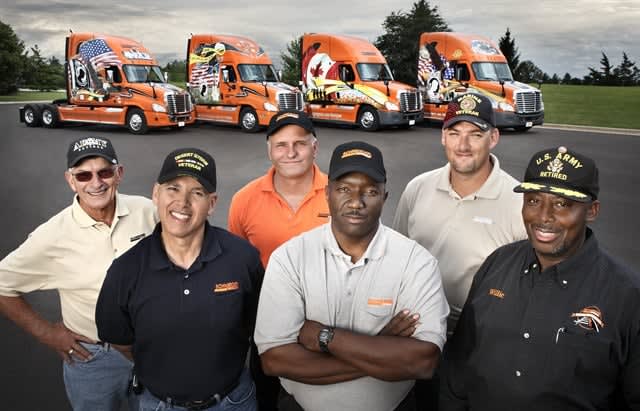
Schneider National has had active programs recruiting former military drivers like these for years. In the background are its Ride of Pride trucks, special veteran-themed trucks built by Freightliner to participate in the Rolling Thunder Ride of Pride on Memorial Day as well as in other events.
There are no exact numbers on how many do want to work for a fleet or own their own truck, so it's hard to say how big a dent these veterans can put in the shortage of drivers, says Boyd Stephenson, director of hazmat and licensing policy at the American Trucking Associations.
And the hands-on driving skills that service members learn do not necessarily transfer directly to civilian trucking. The military, for example, does not train to Federal Motor Carrier Safety Administration regulations, Stephenson says.
Nor are military drivers exposed to commercial-style equipment, according to Cindy Atwood, deputy director of the Commercial Vehicle Training Association, which represents private truck driver training schools.
“You can't take someone directly out of the military and put him in an 18-wheeler,” she says. “About 80% of commercial trucks have manual transmissions, while 98% of military trucks have automatics.”
And more than 95% of military trucks qualify only as Class B trucks, Stephen-son notes.
All of that said, the federal-state effort to ease the path between military and commercial trucking is useful, he says. The skills test waiver, for example, makes it possible for a safe military driver who meets several conditions to skip the CDL driving test.
Stephenson also underscores the usefulness of allowing states to exempt military personnel from restrictions on issuing a CDL to someone whose legal residence is in another state.
Procedures for this exemption may vary from state to state, but the overall effect will be to make CDLs more accessible to military drivers, the White House report says.
The report also touches on what Stephenson describes as the most effective initiative of all, Virginia's Troops to Trucks Program.
The partnership links military bases such as the Marine Corps’ Quan-tico and the Army's Fort Lee with local community colleges, the Virginia Department of Motor Vehicles and the Virginia Trucking Association. The DMV supplies a mobile CDL unit and the trucking association supplies tractor-trailers that visit the bases so military drivers can get experience on Class A equipment. This, Stephenson says, makes the skills test waiver more useful.
“Those guys and girls are going to end up getting Class A CDLs, which makes them far more employable than someone with a Class B license.”
A bigger driver pool through immigration reform?
The immigration reform bill in Congress could ease the truck driver shortage by giving undocumented immigrants a path to legal status and, potentially, the ability to obtain a Commercial Driver's License.
President Obama is making immigration reform a major goal for his second term. In the wake of the 2012 presidential election, many Republicans are saying the time has come to reconsider their party's hardline stance.
The bill introduced by the bipartisan “Gang of Eight” senators will make major changes in the immigration system, including creating a way for the 11 million illegal immigrants now in the country to come out from the shadows and work legally.
The bill also would reform the visa system to accommodate more workers in the category that may include truck drivers.
These changes would be tied to toughened border security to keep out illegals, including a $3 billion program for beefed-up surveillance and patrolling.
The process of moving from the undocumented shadow-land to legal status will not be easy.
The bill would create a Registered Provisional Immigrant Status, under which a person could work for any employer.
To win that status, the person would have to pay a $500 penalty and assessed taxes, as well as application fees. Anyone convicted of a felony or three or more misdemeanors, or who has voted illegally, would not be eligible.
The provisional status would last for six years, renewable upon payment of another $500 penalty.
After 10 years in provisional status, a person could apply for Lawful Permanent Resident Status through the Green Card application method, which requires payment of all taxes, regular work and the ability to speak English.
The visa reform would create a new category for lower-skilled workers, possibly including truck drivers, who will work for registered employers.
The decision about how many such W-Visa workers could be admitted in any given year would be made by a new independent agency in the Department of Homeland Security.The number would be capped at 20,000 in 2015 and range up to 75,000 by 2019. After that, the agency would make a determination on a yearly basis.
Employers would have to apply to participate in this program.They also would be required to phase in the E-Verify system, which includes biometric identification of non-citizens.
It is too soon to know how this bill will fare in Congress. It has many supporters but will face stiff opposition from those who consider any path to citizenship an “amnesty” program.
American Trucking Associations is paying close attention. If it passes, the program could significantly increase the number of potential truck drivers, although they would have to meet U.S. requirements for a CDL.
Driver demographics are changing and truckfleets are asking where they'll find the next group of qualified drivers, said Dave Osiecki, senior vice president of policy and regulatory affairs.
“ATA is watching the development of immigration reform with a view toward the impact it might have on the driver shortage,” he said. “It's one of a number of solutions, including the veterans programs.”
More Fleet Management

Color Match Smarter: Tools That Restore & Perform
For fleet managers and collision repair professionals keeping heavy-duty trucks on the road, getting the color right the first time isn't just about appearance — it's about efficiency, turnaround time, and bottom-line results. Discover how today's digital color tools are transforming the repair process from guesswork to precision.
Read More →
FMCSA Pauses Biennial-Update Enforcement Amid Motus Transition
Carriers whose updates were due on or after June 1 have more time, while FMCSA works to stabilize its new registration system and warns of phishing sites impersonating its new carrier registration system, Motus.
Read More →
2026 Blueprint for Countering Smarter Supply Chain Theft
Cargo theft is no longer just the cost of doing business. It's a multi-billion-dollar criminal enterprise exploiting vulnerabilities across your fleet, drivers, and supply chain.
Read More →


How Telematics Improves Visibility, Control, and Performance in Refrigerated Fleets
Explore how telematics help refrigerated fleets improve visibility, uptime, efficiency, compliance, and cargo protection across connected cold chain operations.
Read More →
What the U.S.-Canada Trade War Means for Trucking
Escalating U.S.-Canada tariffs could disrupt cross-border freight, reduce truck volumes, raise costs, and create new uncertainty for carriers on both sides of the border.
Read More →
What Are Trucking’s Top Concerns for 2026?
The American Transportation Research Institute wants to know what's worrying trucking fleet managers, drivers, and other stakeholders in its annual Industry Issues survey.
Read More →
American Trucking Associations Looks for a New Leader
ATA President and CEO Chris Spear abruptly left his job at the association on August 21, at a pivotal time for the trucking industry.
Read More →
Public Wi-Fi Cybersecurity Risks: How Truck Drivers and Fleets Can Protect Their Data
Public Wi-Fi can expose truck drivers and fleets to credential theft, malware, and other cyber threats. Here’s how to reduce the risk on the road.
Read More →
For Nicky Cupp, Fleet Innovation Starts With Frustration
HDT Truck Fleet Innovator Nicky Cupp turns everyday pain points at Fraley & Schilling into opportunities for better technology and smarter processes.
Read More →
Adam Buttgenbach’s Approach to Electric Trucks: Start With Where They Fit
HDT Truck Fleet Innovator Adam Buttgenbach helped PepsiCo build one of North America’s largest EV fleets by focusing on where electric trucks make operational sense.
Read More →