




Engine Smarts: SCR vs. EGR - Curiouser and Curiouser
A recent request for help with understanding different emissions technologies to reach the Tier 4 Interim and Final off-highway emissions rules reopened the cooled EGR vs. SCR debate for me
A recent request for help with understanding different emissions technologies to reach the Tier 4 Interim and Final off-highway emissions rules reopened the cooled EGR vs. SCR debate for me.
Cooled exhaust gas recirculation, or EGR, is going to be the route most off-highway engine manufacturers are going to take when the rule hits a big chunk of the off-highway market in January 2011.
It's interesting, but not surprising, because several have already developed the systems to reach the earlier Tier 3 rules. And Tier 4 Interim is nowhere near as demanding as EPA 2010 on-highway regulations. They're more like the Tier 4 Final, which is due in 2015, by which time most off-highway engines will run similar combinations of EGR and selective catalytic reduction (SCR) as the on-highway counterparts and any issues with either technology or their combination will have been ironed out.
But for the looming Tier 4 Interim, one equipment manufacturer, Case, is going down both routes simultaneously, using EGR and SCR individually according to application, duty cycle and so on. That way, Case customers will get either the operator simplicity of EGR or the economy benefits of SCR according to how the construction or agricultural equipment is used. However, customers don't get to chose: Case will make the evaluation and select the technology it thinks will work best.
In the technology transfer from on-highway to off-highway emissions, it would be easy to think of Volvo Construction and the equipment manufacturers using Cummins power as the big winners because those companies have already taken engines to close-to-Tier 4 for their highway products. But Case has that advantage, too, as it is part of the mighty Fiat empire and has access to Fiat Powertrain Technologies (a company that commercialized the common-rail diesel engine), and has lots of on-highway experience through the commercial vehicle Iveco brand that is big in southern Europe and elsewhere around the world.
So far, there appears to be little being said about reaching Tier 4 Final. Interestingly, John Deere Power is looking at a different approach altogether, perhaps even using an electric drive and a diesel engine running at a constant speed generating the electrical power. That's an interesting approach, allowing for a single speed optimization of the engine and none of the transients to deal with that give the on-highway guys such heartburn.
That brings us to Navistar's latest announcement that it will certify the MaxxForce at 0.2 g NOx (currently it is at the 0.5 g level, with emissions credits closing the gap). But the plan is to not sell that engine immediately, but soldier on with the current 0.5 g calibrations.
The thought here is that, as Navistar has claimed all along, 0.2 g is doable will all-EGR, but it may bring some fuel economy compromises that the market cannot live with. By delaying the commercial launch of the cleaner engine, Navistar engineers have more time to work out the technological solutions to deliver low engine-out NOx and fuel economy at the same time.
Speculation has it that to get down to 0.2 g, there will have to be some sort of add-on technology, similar to the concept proposed by Deere. But that may be a little too radical for truckers at the moment.
Far more likely will be an SCR solution that is not urea in solution, if you'll pardon the pun. No messing with a new fluid on the truck, but using ammonia nevertheless.
This could be through on-board generation from the diesel fuel, a technology that exists but currently is very expensve. Or it could be from a solid storage medium that has a cartridge that is renewed at oil-change intervals. Navistar has the technology in the Danish company Amminex, which it invested in at the end of last year. This contains the ammonia in a solid salt matrix and gives it up when the cartridge is heated. The big question here is whether the technology which works on smaller diesel engines is scalable to the big-bore truck engine and the duty cycles it sees.
Or maybe there's another ace just waiting up the Navistar sleeve.
More Equipment

ZF Expands Commercial Vehicle Push in North America
ZF is expanding its North American commercial-vehicle presence with new transmission applications, electrification, trailer technology and autonomous-driving systems.
Read More →
Tesla Wants a Self-Driving Semi. Are Cameras Enough?
Could Tesla’s camera-only autonomous driving technology work on an 80,000-pound Semi? In this commentary, HDT's Deborah Lockridge takes a look at Tesla, Cybercab, and how autonomous trucks see the road.
Read More →
Kodiak: Driverless Long-Haul Truck Launch on Track for 2026
Kodiak AI says its driverless long-haul safety case is 93% complete and it remains on track to begin commercial operations by year-end 2026.
Read More →
What DOT’s Automated Vehicle Strategy Means for Trucking
The U.S. Department of Transportation issued a new automated-vehicle strategy that outlines plans for driverless-truck regulations, cross-state freight corridors, and federal safety standards.
Read More →
East Coast Port Launches $45M Electric Truck Push
The Port Authority of New York and New Jersey announced millions in incentives for zero-emission drayage trucks, yard tractors, and new charging hubs near the port.
Read More →
PlusAI Going Public to Fund Autonomous Truck Launch
A SPAC deal could provide PlusAI with up to $300 million as it works toward a 2027 commercial launch of factory-built autonomous trucks.
Read More →
NHTSA Moves to Rewrite Truck Fuel-Economy Rules
The National Highway Traffic Safety Administration says it lacks authority to regulate medium- and heavy-duty truck engines separately from complete vehicles, but the existing standards have not yet been eliminated.
Read More →
Detroit Opens Orders for EPA 2027 Engines
Detroit isn’t starting from scratch to meet EPA 2027 diesel emissions standards. Its Gen 6 DD13 and DD15 engines keep much of today’s platform while updating the fuel and aftertreatment systems.
Read More →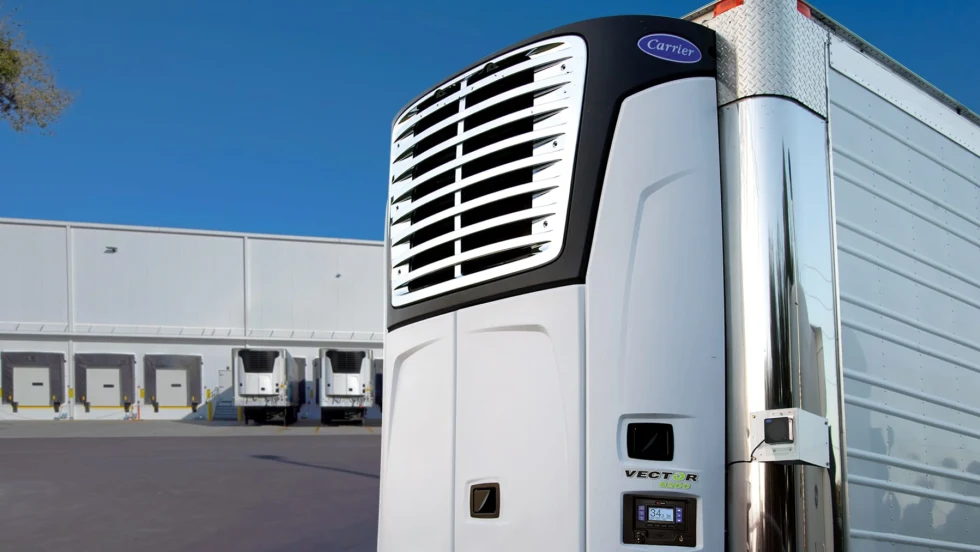
Carrier Transicold Adds All-Electric TRU for Stationary Cold Storage
Carrier Transicold’s new Vector 8200 all-electric transport refrigeration unit gives fleets a diesel-free option for temporary refrigerated and frozen trailer storage.
Read More →
A Closer Look at Kenworth’s Electric T880E Vocational Truck [Video]
Learn more about Kenworth's T880E battery-electric vocational truck at the Paccar Technical Center, including its range, applications, upfitting considerations, and PTO options, in this HDT Spotlight video.
Read More →