




Engine Smarts: A Carbon-Free Fuel?
On a recent visit to Woodland Park, Colo., -based Sturman Industries, I was privileged to view the first beginnings of Eddie Sturman's crank-free internal combustion engine
On a recent visit to Woodland Park, Colo., -based Sturman Industries, I was privileged to view the first beginnings of Eddie Sturman's crank-free internal combustion engine.
Sturman is a hydraulics inventor and creator of the Sturman Digital Valve, which has him both in the Aerospace Hall of Fame and the man who makes the Navistar International HEUI fuel system possible. His injectors are in the straight six-cylinder engines that have earned all those emissions credits for Navistar over the last few years.
Sturman's latest concept is, of course, hydraulics-based. It uses a free floating piston that has a hydraulic connecting rod that positions the piston in the bores - in the case of the prototype being assembled, a custom-made piston in a single International cylinder liner.
Other hydraulic cylinders under the piston, together with the positioning cylinder, convey the force generated in combustion to hydraulic pressure. This, instead of rotary motion of a crankshaft, becomes the energy output from the power unit.
Conventional poppet valves, also controlled hydraulically, manage the flow of air through the combustion chamber. So at a stroke, Sturman has control of air, fuel and piston position completely independently. He can change compression ratio, displacement, injection timing, valve opening and closing, completely independently of piston position. This engine can even idle cylinders with pistons not moving, saving the pumping losses associated with more conventional cylinder cut-out configurations. Or, alternatively, make some cylinders air pumps to supercharge the engine. The possibilities are endless.
But the most important may be the fact that the engine can run on almost any fuel. "How about a completely carbon-free fuel?" asked company president Carol Sturman over lunch.
I was a little taken aback.
I had not thought of the mechanism before, but what burns in an internal combustion engine is the hydrogen that is associated with the carbon in a conventional fossil fuel. You can squirt hydrogen into an engine and it'll run quite well with only water as the combustion product - as in a fuel cell, for instance - but hydrogen is a difficult fuel to manage. But combine that hydrogen with nitrogen in ammonia, and the NH3 molecule becomes a perfect carrier for the hydrogen.
An ammonia fuel?
Why not? In WWII, buses in Belgium were run on ammonia. Various demonstration projects have shown it is a viable fuel, though engines have to be converted to run on it as it is fairly difficult to light off. But Sturman's concept engine, with its infinitely controllable combustion, is a perfect candidate.
Think about an ammonia-fuel economy. Ammonia is already the second largest manufactured chemical in use today. Farming pours billions of tons of ammonia onto crops every year. It is made today from natural gas, but it can be produced electrolytically from water and air.
We wouldn't have to drill for it in sensitive environments or suffer the consequences of spills. We wouldn't have to obtain fuel supplies from politically unstable areas of the world where currently we spend billions of dollars a day supporting America's declared enemies.
Then we got on to the dangers of electromagnetic fields and high-voltage transmission lines. Not that I am necessarily a subscriber to that notion. But if you can use the current ammonia distribution infrastructure and generate electricity locally using ammonia-burning internal combustion engines, you have addressed the whole electrical distribution and power-grid issue.
Spend an afternoon with the Sturmans and you come away shaking your head. It's a humbling experience.
More Equipment

ZF Expands Commercial Vehicle Push in North America
ZF is expanding its North American commercial-vehicle presence with new transmission applications, electrification, trailer technology and autonomous-driving systems.
Read More →
Tesla Wants a Self-Driving Semi. Are Cameras Enough?
Could Tesla’s camera-only autonomous driving technology work on an 80,000-pound Semi? In this commentary, HDT's Deborah Lockridge takes a look at Tesla, Cybercab, and how autonomous trucks see the road.
Read More →
Kodiak: Driverless Long-Haul Truck Launch on Track for 2026
Kodiak AI says its driverless long-haul safety case is 93% complete and it remains on track to begin commercial operations by year-end 2026.
Read More →
What DOT’s Automated Vehicle Strategy Means for Trucking
The U.S. Department of Transportation issued a new automated-vehicle strategy that outlines plans for driverless-truck regulations, cross-state freight corridors, and federal safety standards.
Read More →
East Coast Port Launches $45M Electric Truck Push
The Port Authority of New York and New Jersey announced millions in incentives for zero-emission drayage trucks, yard tractors, and new charging hubs near the port.
Read More →
PlusAI Going Public to Fund Autonomous Truck Launch
A SPAC deal could provide PlusAI with up to $300 million as it works toward a 2027 commercial launch of factory-built autonomous trucks.
Read More →
NHTSA Moves to Rewrite Truck Fuel-Economy Rules
The National Highway Traffic Safety Administration says it lacks authority to regulate medium- and heavy-duty truck engines separately from complete vehicles, but the existing standards have not yet been eliminated.
Read More →
Detroit Opens Orders for EPA 2027 Engines
Detroit isn’t starting from scratch to meet EPA 2027 diesel emissions standards. Its Gen 6 DD13 and DD15 engines keep much of today’s platform while updating the fuel and aftertreatment systems.
Read More →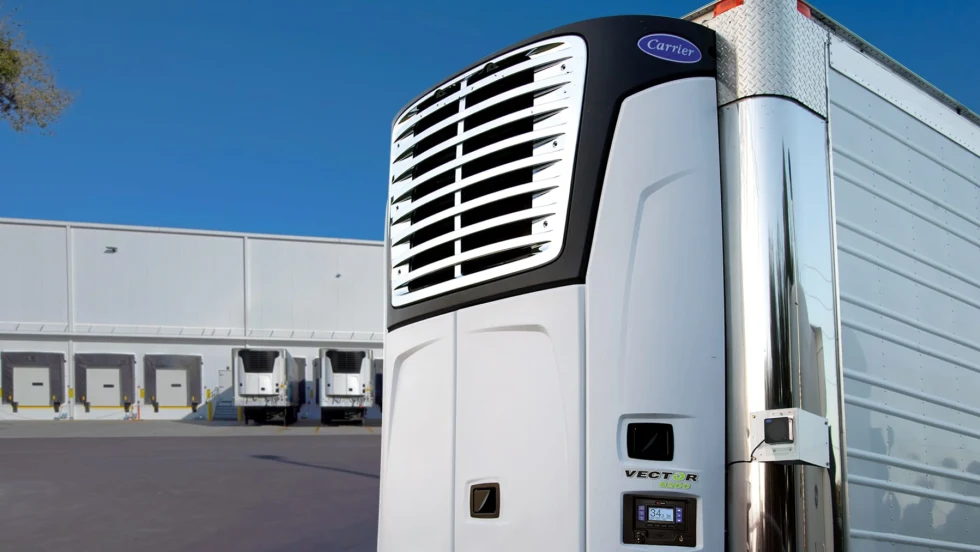
Carrier Transicold Adds All-Electric TRU for Stationary Cold Storage
Carrier Transicold’s new Vector 8200 all-electric transport refrigeration unit gives fleets a diesel-free option for temporary refrigerated and frozen trailer storage.
Read More →
A Closer Look at Kenworth’s Electric T880E Vocational Truck [Video]
Learn more about Kenworth's T880E battery-electric vocational truck at the Paccar Technical Center, including its range, applications, upfitting considerations, and PTO options, in this HDT Spotlight video.
Read More →