




Electricity Gives Trucking Industry a Power Boost
As truck owners look for ways to deal with $4 to $5 diesel, some fleets are finding that electricity is helping them plug into savings, through all-electric vehicles, plug-in hybrids, idle reduction or electric refrigeration units
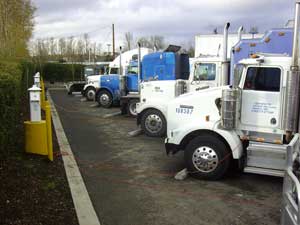
Above, trucks hook up to shore power via heavy-duty extension cords. Plugging in this way costs $1 an hour through Shorepower Technologies.
As truck owners look for ways to deal with $4 to $5 diesel, some fleets are finding that electricity is helping them plug into savings, through all-electric vehicles, plug-in hybrids, idle reduction or electric refrigeration units.
We've seen the introduction of light-duty hybrid and electric vehicles, such as Ford's Transit Connect EV and Via Motors' new extended-range electric pickup truck. Larger all-electric trucks are working their way into the market. Fleets such as FedEx and Frito-Lay are already using electric delivery vans such as the Navistar eStar, Smith Electric Vehicles' Newton Van, and a walk-in step van developed by Enova and Freightliner Custom Chassis. Other, lesser-known electric-truck entrants include EVI USA, Boulder Electric and Electrorides' ZeroTruck.
Most of these trucks can go no more than 100-150 miles on a single charge, making them best suited for daily delivery operations where they come back to home base at night to charge.
An EV costs two to three times as much as a diesel-powered truck of the same size, so prices for light- to medium-duty electric trucks range from $60,000 to more than $200,000. Potential buyers also are wary of the cost of replacing battery packs, whose life spans are somewhat unknown. Although battery prices are coming down, a single pack will cost many thousands of dollars. However, maintenance costs are significantly lower, and vehicle life is much longer - not to mention the money saved on fuel.
A program from Enova/Freightliner Chassis, Green for Free, lets fleets buy all-electric vehicles for the cost of a diesel-powered one. The savings from reduced maintenance and fuel savings is then used over a period of time to cover the higher purchase price.
Government incentives and programs also can make electricity a more attractive transport alternative.
The Shorepower Truck Electrification Project is one program that is working to increase the number of electric charging stations and electrified parking spaces at truckstops. A California program, the Hybrid Truck and Bus Voucher Incentive Program, offers vouchers ranging from $10,000 to $30,000 for the purchase of eligible new hybrids or electric trucks or buses.
Smith Electric Vehicles is working with other states to help them follow California's lead. The company identified federal dollars already going to states, called CMAQ funds (for carbon mitigation and air quality). With help from Smith, the state of New York allocated $10 million of those funds to support the adoption of EVs.
In addition to price, the charging infrastructure is another barrier. According to Frost & Sullivan, in 2011, there were just 7,500 charging stations in the U.S., a meager number considering all the existing highway gas stations and truckstops.
"Carrying enough energy to run an over-the-road truck is the challenge," says Smith Electric co-founder and CEO Bryan Hansel. "Energy density in batteries doesn't allow you to put enough fuel in the tank, so to speak, to go 300-400 miles between fills."
Also, he says, charging a battery is a slow process. "It typically takes five to six hours to refill. Obviously, that doesn't work in an over-the-road scenario where you pull in, need to refuel and move on."
Rapid charging technology does exist, Hansel says, and although all-electric vehicles aren't practical for over-the-road trucking today, he's not ruling it out for the future.
"As rapid charging continues to develop, as battery technology continues to advance, I think there are some compelling reasons why it's worth working toward."
For the electric infrastructure to grow, there has to be demand. Ultimately, demand for EVs will be the result of increasing fuel prices, says Sandeep Kar, global director of commercial vehicle research with Frost & Sullivan. "Fuel prices are trending toward reaching $5 a gallon," Kar says. "If that were to happen, that psychological barrier could lead a lot of fleets to choosing these vehicles. I believe it's the market demand that will bring in charging infrastructure and not vice versa. Everything depends on oil prices."
A viable option for fleets that want to electrify without the short range of all-electric vehicles is diesel-electric (or gasoline-electric) hybrid vehicles. "You don't have to rely on charging infrastructure, and that is the biggest thing going for hybrids," Kar says. Frost & Sullivan forecasts that by 2020, global penetration of hybrid and electric vehicles will be at 6.9%.
You don't have to own an electric truck or hybrid to take advantage of electricity and save on fuel costs. Truckstop electrification helps trucks avoid idling, which eats up fuel and is becoming increasingly regulated because of environmental concerns. Currently, 29 states have anti-idling laws for trucks.
Right now, there are two basic options on the market: single-system electrification and dual-system electrification or "shore power."
Single-system involves using off-board equipment hooked up to a cab's window to heat or cool a truck, with other amenities such as Internet and cable usually available as well.
The best-known provider is IdleAir, which charges $2.09 per hour ($1.49 per hour after 10 hours). This option is convenient for drivers who don't have the onboard equipment to hook up to the grid or drivers who want to avoid running an auxiliary power unit.
The second option, shore power, requires onboard and off-board equipment - thus the "dual-system" moniker. Drivers need a heavy-duty extension cord and an appliance or electrical device for a truck cab that uses 110-volt alternating current. This could be a heater, AC unit, microwave, coffee maker, TV, etc. Many APUs today can run off shore power as well, giving drivers more options.
Shore power is nothing new. Boats at marinas and motor homes at campgrounds have been plugging in for years. Even planes plug in to an electricity source while at a gate, instead of idling on jet fuel.
"It's a natural progression of the technology that trucks, which are required by law to rest, would have access to this type of power," says Alan Bates, vice president of marketing for Shorepower Technologies, probably the largest provider of shore power systems for trucking.
If these other industries have been plugging in for years, why is trucking lagging behind? Infrastructure.
"It's counterintuitive to ask a driver to stop driving before he gets to his maximum 11 hours," says David Hancock, CEO of Hodyon, maker of the Dynasys APU. "If they're 10.5 hours into an 11-hour drive and pass by one of these locations, they could pull over and have a more comfortable night, but if they stop, they just lost 4.5% of their revenue for that day."
The infrastructure is growing, with some help from government programs and incentives, including the above-mentioned STEP program.
The STEP project provides $22.2 million for the development of about 1,250 electrified truck parking spaces at 50 locations on major freight corridors in the U.S., to be up and running by Sept. 1. Introduced in 2009 by the Department of Energy with funds from the American Recovery and Reinvestment Act, it's administered by Cascade Sierra Solutions.
Shorepower Technologies installs and operates the pedestals. The company charges a $1 startup fee for each use and $1 per hour.
The program also offers an equipment purchase rebate program, with incentives of up to 20% of the installed price for equipment that can hook up to the power grid or operate on battery power to eliminate engine idling. Free adapter kits are available at a number of truckstops for drivers who ask for them. The driver only pays for the cost of installation, which takes about an hour and a half.
Currently, according to the Department of Energy, there are more than 60 TSE (truckstop electrification) locations. That includes both si
More Fuel Smarts

How Volvo Updated Its D13 for EPA 2027 [Watch]
Volvo’s updated D13 promises lower emissions without sacrificing performance or fuel economy. Take a closer look at what changed inside the engine in this HDT Spotlight video.
Read More →
Diesel Price Spike Shortens Payback for Natural Gas Trucks, Report Says
Energy Vision estimates fleets could recover the higher purchase price of an RNG-fueled Class 8 tractor in 1.3 to 2.8 years under current fuel-price scenarios.
Read More →
Calstart Becomes Catalyst Mobility, Reflecting Broader Focus
Calstart is now Catalyst Mobility, reflecting the nonprofit’s growing national role in clean transportation, including zero-emission trucks, infrastructure and incentive programs.
Read More →

Record Diesel Prices Squeeze Trucking Fleets
Average U.S. diesel prices have climbed to nearly $6 a gallon, surpassing the 2022 record as tight refinery capacity and Middle East disruptions keep fuel costs elevated.
Read More →
How Fuel Delivery Shapes Engine Performance
Fuel delivery depends on more than what happens at the injector. For fleet, maintenance and technical professionals, looking at the full path from pump to injector can provide useful context for understanding engine performance.
Read More →
East Coast Port Launches $45M Electric Truck Push
The Port Authority of New York and New Jersey announced millions in incentives for zero-emission drayage trucks, yard tractors, and new charging hubs near the port.
Read More →
California Bill Could Shed Light on Electric Truck Prices
Why do battery-electric Class 8 trucks remain so expensive? A California bill headed to Gov. Gavin Newsom would give fleets and state agencies more visibility into what manufacturers charge.
Read More →
Detroit Opens Orders for EPA 2027 Engines
Detroit isn’t starting from scratch to meet EPA 2027 diesel emissions standards. Its Gen 6 DD13 and DD15 engines keep much of today’s platform while updating the fuel and aftertreatment systems.
Read More →
Zero-Emission Truck Corridor Planned for West Coast
California, Oregon, Washington, British Columbia and Baja California are coordinating plans for truck charging and hydrogen fueling from Canada to Mexico.
Read More →
A Closer Look at Kenworth’s Electric T880E Vocational Truck [Video]
Learn more about Kenworth's T880E battery-electric vocational truck at the Paccar Technical Center, including its range, applications, upfitting considerations, and PTO options, in this HDT Spotlight video.
Read More →