




ELD Mandate: Don’t Rest Easy If You’re Grandfathered with AOBRDs
The roughly two-year grace period for grandfathered users of AOBRDs buys time, but it risks complicating things for trucking fleets in the future.

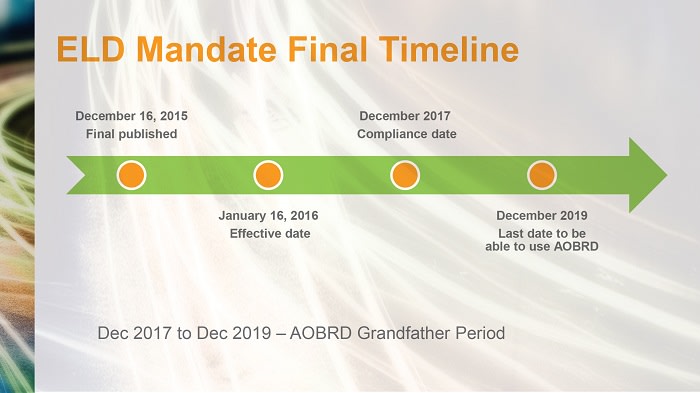
Grandfather clause in the ELD rule excuses carriers and drivers from complying so long as they are already using automatic onboard recording devices. But it’s only a temporary fix — the clause expires in less than two years.
Grandfather clause in the ELD rule excuses carriers and drivers from complying so long as they are already using automatic onboard recording devices. But it’s only a temporary fix — the clause expires in less than two years.
Being “grandfathered” may have a warm and cozy ring to it. But when that term applies to the electronic logging device mandate, don’t let a vision of idly playing checkers across a cracker barrel while swigging back a cold root beer draw your eye away from the calendar.
To be grandfathered means to meet certain conditions that allow one to remain under the provisions of a given law or regulation after a newer measure has taken legal precedence for all other affected parties.
The grandfather clause in the electronic logging device rule excuses carriers and drivers from complying with the ELD rule so long as they are already using previously compliant automatic onboard recorder devices to track driver hours of service. To be perfectly clear, a grandfathered AOBRD is an e-log device that a motor carrier installed and required its drivers to use before the ELD rule’s actual Dec. 18, 2017, compliance date.
But it’s only a temporary fix. The clause expires in less than two years, on Dec. 16, 2019. At that point, all AOBRDs will have to be replaced by ELDs.
The reason AOBRDs will be phased out is they do not meet the technical specifications that the Federal Motor Carrier Safety Administration has required for ELDs. A carrier may not recognize much difference between an AOBRD and an ELD, according to Joe DeLorenzo, director of FMCSA’s Office of Enforcement and Compliance. And in some cases, a vendor may be able to convert existing AOBRDs to ELDs with very few visible differences.
One of the biggest difference between the types of logging devices is that the ELD specification incorporates what FMCSA calls “edits and annotations,” which allows drivers to insert notes as to why their record of duty status needed to be corrected or edited and retains the original entries. “It’s good accountability for the driver and the carrier if they have to make an adjustment in the driver’s hours,” says DeLorenzo.
But the two-year extension is not a blanket rule. That’s because it does not allow for the net addition of AOBRDs during that borrowed time. That is, if an AOBRD needs to be replaced — any time after Dec. 18, 2017 — that device must be replaced by an ELD, according to Mark Schedler, senior editor, transport management, for J.J. Keller & Associates. The only exception to the replacement provision is that an AOBRD in use before Dec. 18, 2017, may be taken out of a truck that’s leaving the fleet and be installed in a replacement truck.
According to Kam Roshan, Omnitracs senior product manager, if you downsize your fleet, any AOBRDs that are removed can be kept and reused during the grandfather period if you add trucks back in to your fleet. However, the total number of vehicles cannot exceed your AOBRD number as of Dec. 18, 2017. “Once you exceed that number, vehicles are considered ‘net new’ and require ELDs.”
She also points out that, according to the FMCSA website, “during the grandfather period, a defective AOBRD under warranty can be replaced with another AOBRD from the same vendor. Similarly, you can upgrade your AOBRD to a newer version, provided it is replacing an AOBRD installed in an existing vehicle.”
What about owner-operators? “For owner-operators with AOBRD units already installed, FMCSA guidance has been that the owner-operator may continue to use the AOBRD unit, even when working with carriers that have already transitioned to ELDs,” says Rashan. “However, there is a caveat that carriers can require all drivers to use ELDs.”
Perhaps the biggest bugaboo to holding onto AOBRDs until nearly the bitter end of next December is that fleet operations personnel will have to stay on top of how those devices work while — at some point, presumably — starting to learn about ELDs before the grace period evaporates. What’s more, growing the fleet by just one truck any time from now until late 2019 will mean having to work with two different systems at the same time, creating what some are calling a “blended fleet.”
“It’s difficult for some back-office systems to ‘commingle’ AOBRD and ELD data and/or to present it in a usable fashion,” says Keller’s Schedler. “In some cases, the back-office system will be split, requiring users to go back and forth between the systems.”
On top of that, the system display may be different for each type of devices. The data may be presented in such a way that the AOBRD data may appear incomplete and/or the ELD data cannot be fully displayed to make it match the AOBRD data.
Drivers who were using AOBRDs but who get assigned ELDs will need to be trained on several key differences, including what will be required of the driver during a roadside inspection; how to make and/or approve edits; the speed threshold at which the ELD automatically moves into “driving” status (which can be as low as 5 mph), and how to use the special driving categories correctly.
“If the driver is using an ELD, the driver must be able to ‘send’ the records directly to an officer using either telematics or local transfer,” says Tom Bray, J.J. Keller industry consultant – Transportation. “But if using an AOBRD, the driver needs to be able to explain that the device is an AOBRD and that he/she can have the records to the officer within 48 hours.”
Eric Witty, vice president of product for PeopleNet, says “riding both sides of the fence of AOBRD and ELD” can be challenging, both on the back end and for the driver. He suggests that fleets using AOBRDs consider a terminal-by-terminal or site-by-site ELD conversion once they reach a certain number of trucks with ELDs. Fortunately, with many AOBRD devices, switching them to ELDs will require only a software upgrade, which a vendor might do at no extra charge.
More Safety & Compliance

From One Generation to the Next: How Mentorship Builds Safer Truck Drivers
After three decades in trucking, Harold Perry shares what he's learned about driver safety, mentorship, and helping the next generation build confidence behind the wheel.
Read More →
FMCSA Pauses Biennial-Update Enforcement Amid Motus Transition
Carriers whose updates were due on or after June 1 have more time, while FMCSA works to stabilize its new registration system and warns of phishing sites impersonating its new carrier registration system, Motus.
Read More →
ZF Expands Commercial Vehicle Push in North America
ZF is expanding its North American commercial-vehicle presence with new transmission applications, electrification, trailer technology and autonomous-driving systems.
Read More →
Truck Drivers Need More Than Another Alert
Fleets have more visibility into truck health, safety events, and driver activity than ever. The next challenge is turning all that information into useful guidance for the person who has to decide what to do next.
Read More →
Tesla Wants a Self-Driving Semi. Are Cameras Enough?
Could Tesla’s camera-only autonomous driving technology work on an 80,000-pound Semi? In this commentary, HDT's Deborah Lockridge takes a look at Tesla, Cybercab, and how autonomous trucks see the road.
Read More →
What DOT’s Automated Vehicle Strategy Means for Trucking
The U.S. Department of Transportation issued a new automated-vehicle strategy that outlines plans for driverless-truck regulations, cross-state freight corridors, and federal safety standards.
Read More →
NYC Expands Speed, Pedestrian Safety Tech Across Fleet
New York City is expanding intelligent speed assistance and pedestrian-alert systems across its municipal fleet, moving the technologies from pilot programs into vehicle procurement and retrofit requirements.
Read More →
FMCSA Removes 110 Truck Driver Training Schools from Certified ELDT List
Federal regulators also are targeting more than 160 additional training providers and launching a nationwide audit of third-party CDL skills testers as part of a broader crackdown on trucking fraud.
Read More →
Beyond DOT Compliance: What Makes a Trucking Fleet Truly Safe?
A trucking fleet can follow every rule and still make unsafe decisions. The real test comes when safety conflicts with freight, productivity, or cost.
Read More →
Hours of Service Pilot Programs: FMCSA Readies for 2027 Rollout
Two pilot programs could eventually reshape hours-of-service rules, giving truck drivers options to pause their 14-hour clock or use longer split sleeper rest periods.
Read More →