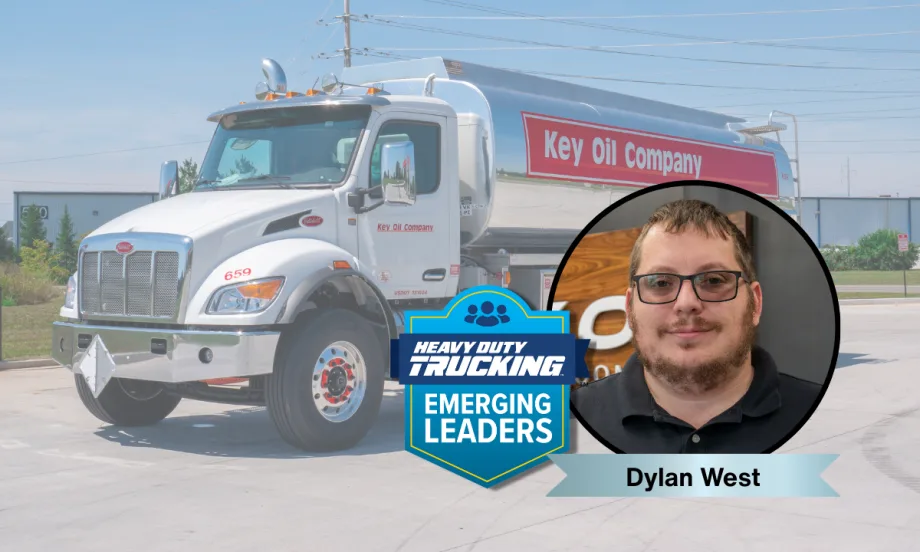
Dylan West Pushes Driver Training and Retention Forward With Custom Technology
HDT 2025 Emerging Leader Dylan West built his own driver simulator, created data-driven scorecards, and developed tools that transformed safety culture and retention at Key Oil.
Dylan West had no formal background in safety and compliance, but he had been a driver, a dispatcher, and other roles.
Credit:
HDT Graphic/Key Oil photos
5 min to read
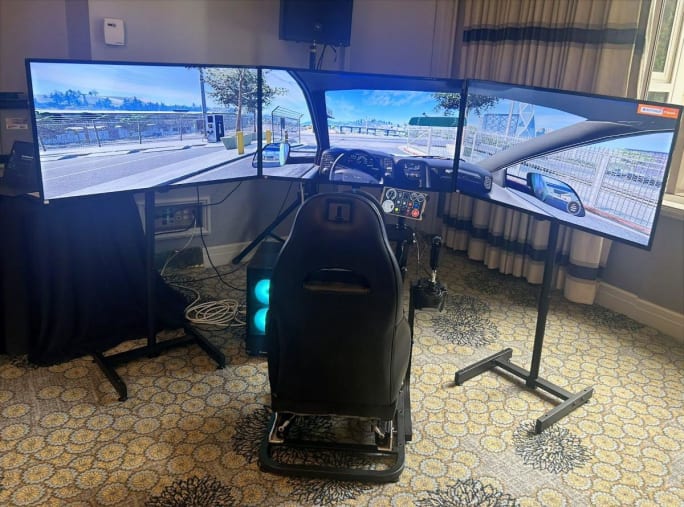
Dylan West and his boss believed a truck driver training simulator would help take their driver safety program to the next level for Key Oil. The problem? The price tag.
Ad Loading...
“So I got to work on building my own,” says the 2025 HDT Emerging Leader, who’s the safety training manager at the Kentucky-based fuel-hauler.
West has been a key part of the safety department for about four years, working under Director of Safety David Murphy, a 2025 HDT Truck Fleet Innovator.
Ad Loading...
West is a big believer in hiring younger drivers and works closely with the local community college’s CDL driver training school. The driver simulator plays a part in that.
“It's much easier to train you to do things the right way than to eliminate a bad habit you come in here with,” he explains.
“I've got the tools. I've got the information. I've got the knowledge. And I've got the trainers to help train that guy to be a driver.”
Turning a Cost Problem Into a Safety Innovation
His simulator is one of those tools. Both new hires and veteran drivers are put through their paces on the homegrown system, which West uses for pre-employment evaluations, ongoing coaching, and risk analysis.
The simulator program even features AI-generated traffic.
Ad Loading...
“It's always fun when you're driving through the simulator, doing an analysis with somebody, and all of a sudden there's two cars wrecked in front of you,” West says. “Like, why is there a bumper in the middle of the road?”
He’s still tinkering. A recent project uses machine vision and artificial intelligence to track eye movements in the simulator, identifying where drivers are looking.
Both new hires and veteran drivers are put through their paces on the homegrown driver simulator, which West uses for pre-employment evaluations, ongoing coaching, and risk analysis.
Photo: Key Oil
Transforming Telematics and Camera Data Into Practical Coaching Tools
But the simulator is only part of the picture.
“There's so much technology out there,” he says. “I talk to other fleets all the time, and they have all this data, they have all this information, and they're using none of it.”
Erika Nolan, corporate safety quality assurance manager, Werner Enterprises
Chelsea Seger, shift maintenance supervisor, Waste Management
Dylan West, safety training and compliance manager, Key Oil (part of Keystops LLC)
Technology, he says, can make it easier for fleets to manage that data.
Ad Loading...
West has used the simulator and all the data generated by the fleet’s telematics and in-cab cameras to create a driver scorecard.
“We've got 18 locations across three states with 150 drivers and 350 employees,” West says. “We can't see everything. And we were tracking performance on an Excel spreadsheet.
“If you try to have 25 people modify an Excel spreadsheet, things just don’t work.”
So he developed driver scorecard tracking software that can be accessed on a phone, laptop, desktop, or tablet.
Managers across the company can add performance feedback, while telematics and camera data feed automatically into the system.
Ad Loading...
“We can get a good picture of who our top-performing drivers are, and who our underperforming drivers are who need a little bit of help.”
Making Compliance Easier Through Smarter Tools and Processes
The driver simulator is just one of the ways West has been using technology to improve safety and simplify compliance.
One of the most annoying pieces of paperwork I deal with on a regular basis is annual inspections.”
He’s building a system where inspectors can scan a VIN barcode and complete the inspection on the phone, then put a sticker on the truck certifying it’s been inspected. All the records are automatically stored digitally.
“I just like to make things easier,” he says. It may take an investment in his time to create these tools, but in the long run, it’s worth it.
Ad Loading...
Sharing Safety Insights With Trucking Fleets Across the Industry
West had no formal background in safety and compliance. He ran a mobile mechanic business, drove a tow truck for a friend with a towing business, and then moved into fuel hauling as a driver.
He often stopped by the safety office at Key Oil to chat. When the previous safety training manager moved on, West decided to give it a shot.
“I'd been in management roles, I’d been a dispatcher, I’d been training drivers, but I’d never been in an actual safety role,” he says. “It seemed like something I could do.
“That was about four years ago. I’ve been having a whole lot of fun doing it ever since. And my shelf over here says I'm not too bad at it,” he says, nodding toward the safety awards lining it for both him and the company.
From Mobile Mechanic to Safety Innovator and Industry Speaker
Today, West is a frequent conference speaker, sharing what he and Murphy have learned on their safety-culture journey.
Ad Loading...
“When I took this job, I was not good at public speaking at all,” he admits. “I had to quickly overcome that obstacle.”
A common question: What is Key Oil doing differently?
One answer: Being proactive.
“Don't try to respond to an accident after it's happened,” he says. “Look at where your issues are and train drivers before the accident happens.
“That's where that scorecard comes in. So we can identify those weaker drivers and help to improve them.”
Ad Loading...
A Coaching-First Approach That Helps Drivers Improve and Stay
Part of Key Oil’s approach is what West calls a “train to retain mentality.”
“We don't need to write every driver up every time they make a mistake,” he says. Instead of putting a write-up they need to sign, “we can get the same message across by having a simple conversation.
“We can still document it on our side. It serves the exact same purpose. But to the driver, it's a whole different perspective.”
If a driver does get involved in a collision, West says, the company can present a stack of driver training documentation and data to insurance companies and attorneys.
Turning a High-Turnover Fleet Into a Company Drivers Choose to Stay With
When West first joined Key Oil as a driver, it had a reputation of being the company to work for just long enough to get the experience needed to move on to a better carrier.
Ad Loading...
Today, he says, Key Oil is the better company that drivers want to work for — and stay with. Improved retention has cut the fleet’s driver hiring in half.
“I've got drivers who on a regular basis walk through my door, and they know that if they come in here and tell me they have a problem, that we're going to work to fix it,” West says.
“They understand that we're here just to help them, make them successful, allow them to make as much money as they can. Cause that's how the business keeps running.
“Then they want to stick around longer, because they feel like they're more a part of that team.”
Carriers whose updates were due on or after June 1 have more time, while FMCSA works to stabilize its new registration system and warns of phishing sites impersonating its new carrier registration system, Motus.
ZF is expanding its North American commercial-vehicle presence with new transmission applications, electrification, trailer technology and autonomous-driving systems.
Fleets have more visibility into truck health, safety events, and driver activity than ever. The next challenge is turning all that information into useful guidance for the person who has to decide what to do next.
Could Tesla’s camera-only autonomous driving technology work on an 80,000-pound Semi? In this commentary, HDT's Deborah Lockridge takes a look at Tesla, Cybercab, and how autonomous trucks see the road.
The U.S. Department of Transportation issued a new automated-vehicle strategy that outlines plans for driverless-truck regulations, cross-state freight corridors, and federal safety standards.
New York City is expanding intelligent speed assistance and pedestrian-alert systems across its municipal fleet, moving the technologies from pilot programs into vehicle procurement and retrofit requirements.
Federal regulators also are targeting more than 160 additional training providers and launching a nationwide audit of third-party CDL skills testers as part of a broader crackdown on trucking fraud.
Two pilot programs could eventually reshape hours-of-service rules, giving truck drivers options to pause their 14-hour clock or use longer split sleeper rest periods.
Hundreds of thousands of pets travel in truck cabs. A new safety guide from Volvo Trucks and the Center for Pet Safety offers practical advice for truck drivers who bring dogs and cats along for the ride.