




Dual-fuel conversion saves big money every day, supplier-trucker says
A band wagon powered by natural gas seems to have begun rolling, but most of those aboard talk about brand-new heavy trucks with special gas-burning engines. Why not convert existing trucks and engines to use cheap and clean-burning gas
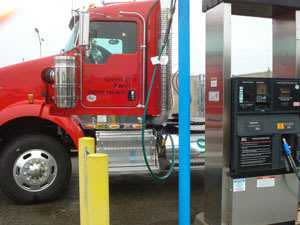
One trucking company had so much success with dual-fuel conversions it's now selling them to other fleets.
A band wagon powered by natural gas seems to have begun rolling, but most of those aboard talk about brand-new heavy trucks with special gas-burning engines. Why not convert existing trucks and engines to use cheap and clean-burning gas?
That's the message delivered by several suppliers in a session during the Alternative Clean Fuels Expo, held last month in Long Beach, Calif. One is a trucker who is saving so much money with a conversion that he now makes and sells the device himself.
Michael Kilbourne, who runs a small fleet out of South Carolina, said he struggled for years with the high cost of diesel fuel and tried to figure out how he could bring that down. Cheap natural gas was the answer, he thought, but "I couldn't afford a dedicated system" in a new truck.
He looked closely at the idea of injecting gas along with diesel in his existing truck engines, a process known as fumigation and now commonly called dual fuel, and concluded that it was the easiest way.
He found partners with the technical know-how to develop and assemble a system, and began installing it on his tractors. The results were astounding to him, and he offered an example.
On a regular 1,375-mile run from Albermarle, N.C., to Laredo, Texas, one of his rigs usually averages 5.5 mpg on diesel. On a recent trip his dual-fuel system ran the tractor's engine on 65% natural gas, and calculations showed that the total fuel bill was $593.75, or $406.29 less than with diesel alone.
Those kinds of savings are seen on every tractor he's equipped with the system, Kilbourne said.
A questioner wanted to know what the combined gas-and-diesel mpg number was, but Kilbourne and others on the panel advised listeners not to worry about it. A combined mpg number is a little complicated to calculate, and it will be lower because gas has less energy than diesel. So concentrate on the cost of the two fuels, especially gas, they said.
Dual-fuel systems usually displace diesel at the rate of 40% to 60%, with the amount depending on load factor, terrain and other variables in an operation, said the supplier representatives on the panel.
This means that $4-a-gallon diesel is replaced by gas that costs less than $2 per equivalent gallon, and that can save hundreds of dollars per day for each truck, as Kilbourne's example shows.
"We use it every day, and it's been refined, tested and approved" by the federal Environmental Protection Agency, Kilbourne said of his system, called Green Fuel Pro. "It's been successful for four years, and now I'm ready to share it with others."
It's been so successful that Kilbourne now calls his trucking company Green Pro. Information on his transportation services and the dual-fuel product are at www.greenprofuels.com.
Lower fuel costs help pay for a conversion, and its comparatively low cost makes it even more attractive. For about $30,000 to $35,000, a good truck or tractor can be set up to run on compressed or liquefied natural gas - CNG and LNG, respectively - plus diesel, which is what the Green Fuel Pro and other kits do.
That includes gas fuel lines, an injector near the turbocharger, and replacing one diesel saddle tank with a gas tank. The truck's other diesel tank is retained.
A new heavy truck equipped to burn natural gas costs $165,000 or more. Government grants can pay part of the "incremental" (additional) cost of a new natural gas truck, but a dual-fuel conversion is so reasonable that it makes sense on its own, the presenters said.
Also, dual-fuel systems mean operators needn't worry about running out of gas somewhere out on the road. If the gas tank is empty, the truck switches back to all-diesel and continues on its way.
An important development occurred last year, when the EPA eased its rules for certification of aftermarket. This has allowed suppliers of the systems to take approved products to market. But the panelists complained that the California Air Resources Board requires very expensive certification of aftermarket conversions, making them financially impractical.
Three other presenters in the ACT Expo session also talked about success with dual-fuel conversions, and a fourth described a process that converts diesels to spark-ignition to burn straight natural gas. We'll write about them in future Fuel Smarts articles.
More Equipment

How Volvo Updated Its D13 for EPA 2027 [Watch]
Volvo’s updated D13 promises lower emissions without sacrificing performance or fuel economy. Take a closer look at what changed inside the engine in this HDT Spotlight video.
Read More →
Michelin Tire Improves Efficiency and Durability for Regional Fleets
The Michelin X Multi Energy D2 is a regional haul drive tire engineered to help fleets improve fuel efficiency, durability and traction in demanding stop-and-go operations.
Read More →
ZF Expands Commercial Vehicle Push in North America
ZF is expanding its North American commercial-vehicle presence with new transmission applications, electrification, trailer technology and autonomous-driving systems.
Read More →
Tesla Wants a Self-Driving Semi. Are Cameras Enough?
Could Tesla’s camera-only autonomous driving technology work on an 80,000-pound Semi? In this commentary, HDT's Deborah Lockridge takes a look at Tesla, Cybercab, and how autonomous trucks see the road.
Read More →
Kodiak: Driverless Long-Haul Truck Launch on Track for 2026
Kodiak AI says its driverless long-haul safety case is 93% complete and it remains on track to begin commercial operations by year-end 2026.
Read More →
What DOT’s Automated Vehicle Strategy Means for Trucking
The U.S. Department of Transportation issued a new automated-vehicle strategy that outlines plans for driverless-truck regulations, cross-state freight corridors, and federal safety standards.
Read More →
East Coast Port Launches $45M Electric Truck Push
The Port Authority of New York and New Jersey announced millions in incentives for zero-emission drayage trucks, yard tractors, and new charging hubs near the port.
Read More →
PlusAI Going Public to Fund Autonomous Truck Launch
A SPAC deal could provide PlusAI with up to $300 million as it works toward a 2027 commercial launch of factory-built autonomous trucks.
Read More →
NHTSA Moves to Rewrite Truck Fuel-Economy Rules
The National Highway Traffic Safety Administration says it lacks authority to regulate medium- and heavy-duty truck engines separately from complete vehicles, but the existing standards have not yet been eliminated.
Read More →
Detroit Opens Orders for EPA 2027 Engines
Detroit isn’t starting from scratch to meet EPA 2027 diesel emissions standards. Its Gen 6 DD13 and DD15 engines keep much of today’s platform while updating the fuel and aftertreatment systems.
Read More →