





Expert Advice on Reducing Truck Out-of-Service Violations [Video]
Don’t Fear the Blitz: How Truckers Can Own CVSA’s International Roadcheck
Preparation is the key for trucking companies to not only surviving CVSA's annual 72-hour inspection blitz, but turning those inspections to their advantage.
May 4, 2025
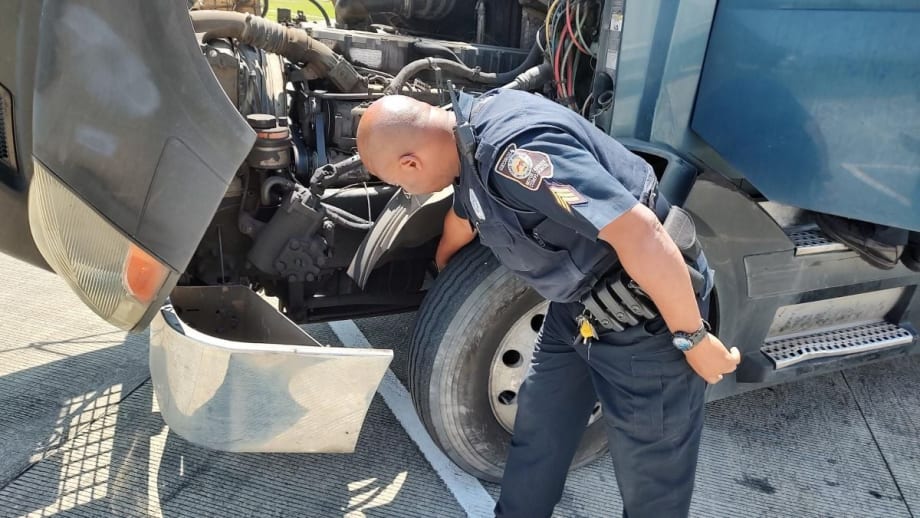
Close to 50,000 truck inspections were done across North America in last year's International Roadcheck.
Photo: Wayne Parham
7 min to read
Every spring, the trucking industry braces for CVSA’s International Roadcheck — a 72-hour inspection blitz that sends state troopers and DOT-trained inspectors to weigh stations, rest stops, and roadside shoulders across North America.
Some drivers see it as the perfect week to take a vacation. But for well-prepared fleets, it can be an opportunity.
“If you're prepared for the blitz, why hide from more inspections if those inspections can reduce your score?” says John Seidl, a former DOT officer and FMCSA investigator who now consults on safety and insurance. “All you have to do is make sure they're clean.
“If you know there’s an increase in the inspections, prepare for it. Be ready for it. Embrace it.”
This year’s Roadcheck takes place May 13–15.
Tires and driver logs are the official “focus” of this year’s inspection blitz — but that certainly doesn’t mean inspectors aren’t still looking at the lights and the brakes and everything else.
Here's how two safety experts say trucking fleets can turn Roadcheck into a positive rather than a compliance headache.
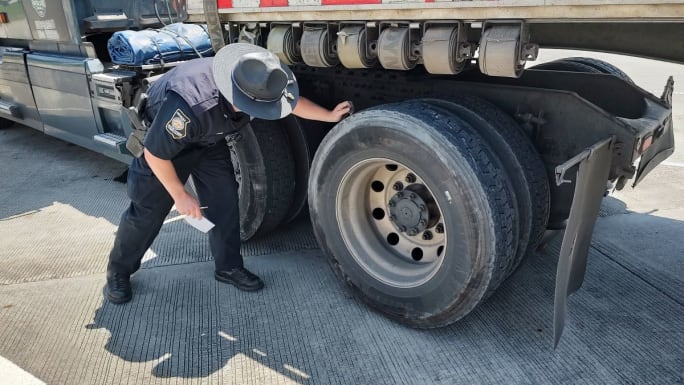
One of the focus areas of this year’s Roadcheck is tires. Tire tread that's too worn or tires that are underinflated can lead to citations.
Photo: Wayne Parham
What is the International Roadcheck Inspection Blitz?
International Roadcheck is an annual 72-hour inspection blitz coordinated by the Commercial Vehicle Safety Alliance (CVSA) in partnership with the Federal Motor Carrier Safety Administration and law enforcement across North America.
Tens of thousands of commercial motor vehicle inspections are conducted at weigh stations, inspection sites, and roadside. All DOT-certified officers — even those who typically work in offices or other duties — are tasked to conduct roadside inspections.
“It’s all hands on deck,” says Seidl. “You get way more inspections than you ever would at any other time in the year, because they pull MCSAP-trained officers from under the rocks and under the tables to get them out there.”
“A lot of those inspectors, they only do inspections during the blitz.”
Why it matters:
Violations can lead to fines and downtime.
Violations can lead to a higher (worse) CSA (Compliance, Safety, Accountability) score, often called a DOT score or a safety score.
A clean inspection improves a carrier’s CSA numbers.
The good news is that with Roadcheck dates published months in advance, fleets have a chance to prepare.
More Inspections = More Opportunity
While CVSA announces an annual focus — this year, tires and driver hours of service records — the reality is broader.
“You can get violations for a broken windshield or a tail light and anything, even if the focus is tires,” Seidl says.
A CVSA Level 1 inspection, also known as the North American Standard Inspection, includes 37 inspection steps. covering both the driver and the vehicle.
“The focus items just mean inspectors may take a closer look at them,” explains Isaac Harmon, director of safety for CPC Logistics. “But they still look at everything.”
CPC Logistics manages more than 2,000 drivers who operate equipment for safety-focused private fleets.
Strategic Use of Roadcheck to Lower CSA Scores
Here’s where it gets interesting: Clean inspections during Roadcheck can actually improve your CSA scores, where lower is better.
“Clean, relevant inspections can reduce your score,” Seidl explains. With the right preparation, a fleet could take advantage of this.
“So if you have a vehicle maintenance CSA score that's high, a clean Level 2 will reduce your score,” he says. “If you have hours of service that’s in the alert and your CSA score is high, a clean Level 3 or Level 2 will reduce your hours of service score.”
Say your scores are a little high in hours of service and maintenance, Seidl says.
“The blitz is coming. Everybody needs to make sure your logbook is perfect. Everybody needs to get an annual DOT inspection done on your truck and trailer the day before the blitz.
“Then you should want all your drivers to go out there with clean log books and clean, perfect trucks and get as many inspections as they can, because then you add the number of relevant inspections to your CSA score and you can actually use the blitz to drive down your score.”
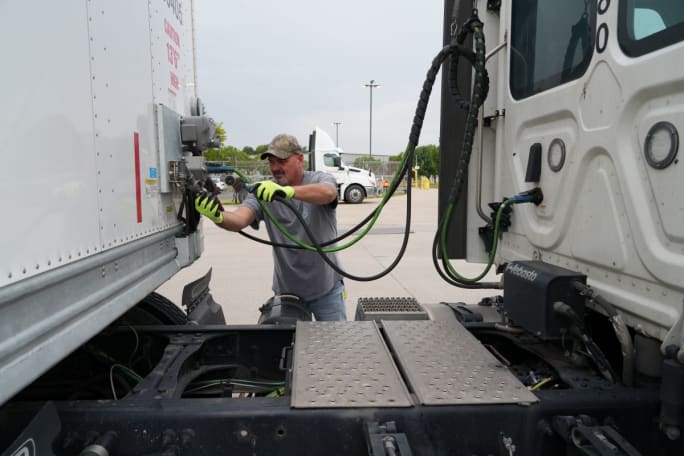
Lights are one of the most commonly overlooked items caught in an inspection. There could be a short between the tractor and trailer that would mean a light would be working when a driver did his or her pretrip inspection but quit working between then and a roadside inspection.
Photo: CPC Logistics
The Importance of Driver Vehicle Inspections
Key to passing inspections during Roadcheck or any time of the year is the driver pre-trip and post-trip vehicle inspection.
“The best thing they can do for equipment issues is really be meticulous about your equipment,” Harmon says, “doing extra thorough pre-trips…. not skimping on anything, and getting that stuff written up. And if it needs to be repaired, getting it to the shop as soon as possible.”
CPC Logistics uses a “safety lane check” to keep drivers on their toes regarding pre- and post-trip inspections, no matter what time of year. Driver inspections are especially important leading up to Roadcheck.
For major accounts, he explains, “we'll do random safety blitzes, random safety lane checks. When the drivers return or when the drivers get ready to dispatch, we'll be out there on the yard and we'll put them kind of through a mini [inspection.]
“Not the full-blown inspection, but we'll have them walk us through a pre-trip. We check to make sure they have their license, all their ERODS (electronic records of duty status) are up to date, all their logs are certified, hours of service is in compliance, that they have all of their insurance and everything that needs to be in the truck.
“And we'll do a quick walk around the truck and make sure everything is hooked up correctly, all lights are properly working, checking tires, no audible leaks in brake lines or anything like that.”
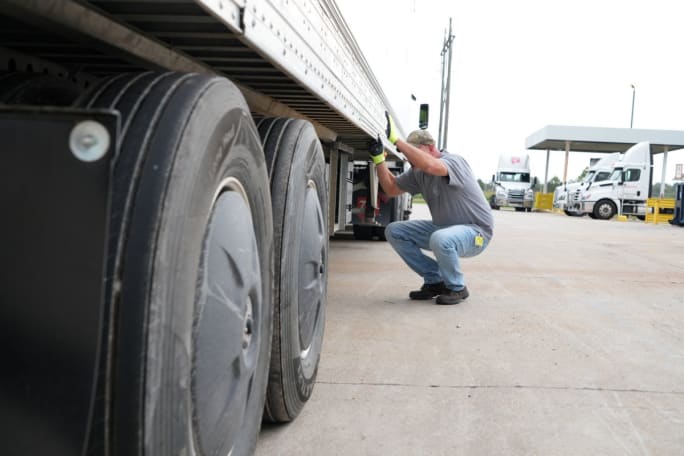
CPC Logistics conducts random "safety lane" events at its clients' yards to prepare truck drivers for roadside inspections.
Photo: CPC Logistics
Avoiding Equipment-Related Inspection Pitfalls in Truck Inspections
Both Harmon and Seidl point to common violations that fleets and drivers can easily overlook that get them in trouble during commercial vehicle inspections.
Some of the smaller lights, Harmon says, can easily be overlooked during a pre- or post-trip inspection.
“Lights are always one of the biggest things that you see [cited] in a roadside inspection," he says.
“Sometimes the pigtails … from the truck to the trailer, there may be a connection break in there somewhere So the lights may work when you leave and then they're not working when you get back.”
Harmon suggests that drivers, when they stop to get fuel or use the restroom or get a bite to eat, spend a few minutes to do a quick walkaround to make sure all the lights are still working, including the top lights.
“The big things are easy to catch. It’s just the little, minute things that sometimes can be overlooked because they can be taken for granted.”
Low tire tread or underinflation are also a common cause of citations — and this year they’re under the spotlight. (Story continues below video)
More from Isaac Harmon in this episode of HDT Talks Trucking:
How Little Things Can Get Truck Drivers in Hours of Service Trouble
In the other area of focus this year, driver logs, there also are a couple of common areas that can easily be overlooked by drivers, resulting in a citation.
Unassigned driving time can be a problem, especially in a slip-seating operation like CPC Logistics, Harmon says.
“If somebody moves the truck around a yard and a driver gets in, it’s always going to prompt them, were you the driver? Did you move this?" he explains. "And if it's not them, they can inadvertently accept somebody else’s drive time," which could cause them to go over their hours of service.
“So every day they get in, they should be reviewing their logs for accuracy and then certifying them,” Harmon says.
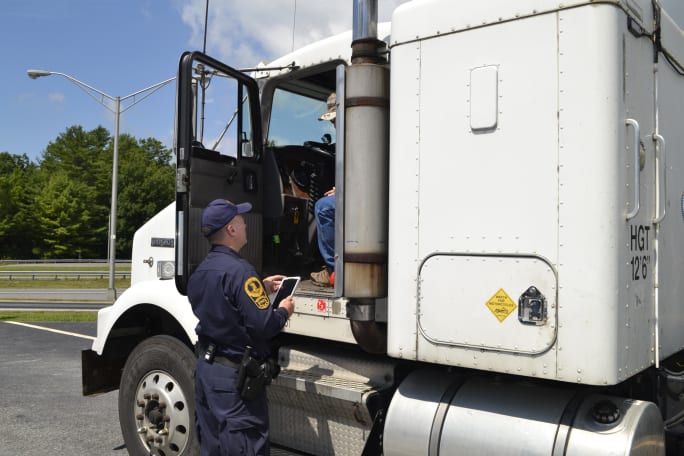
Truck drivers need to know how to transfer the hours-of-service data from their electronic logging devices to the inspecting officer — and they need to make sure they have the required instruction sheet available.
Photo: CVSA
Another common place drivers get caught on hours of service? Making sure they know how to transfer their electronic log records to law enforcement during a roadside inspection.
Exactly how that's done will vary depending on the particular ELD in the cab. But every truck is supposed to have an instruction sheet inside the cab to refer to during a roadside inspection for transferring the ERODs.
“That is kind of one of those little pitfalls," Harmon says. "A driver can get a violation if they don't have that.”
Drivers need to know that documentation is in the cab, know where it is, and make sure it's readily available to share with the officer when requested.
Don’t Hide from the Inspection Blitz
Roadcheck should not be feared — it should be leveraged. Because the inspection dates are published in advance, trucking fleets and truck drivers can and should prepare.
It’s like staging a home before a showing when you’re trying to sell it, Seidl says.
“Are you going to leave dishes in the sink, or are you going to vacuum? You know someone’s coming — be ready.”
Subscribe to Our Newsletter
More Safety & Compliance

FMCSA Pauses Biennial-Update Enforcement Amid Motus Transition
Carriers whose updates were due on or after June 1 have more time, while FMCSA works to stabilize its new registration system and warns of phishing sites impersonating its new carrier registration system, Motus.
Read More →
ZF Expands Commercial Vehicle Push in North America
ZF is expanding its North American commercial-vehicle presence with new transmission applications, electrification, trailer technology and autonomous-driving systems.
Read More →
Truck Drivers Need More Than Another Alert
Fleets have more visibility into truck health, safety events, and driver activity than ever. The next challenge is turning all that information into useful guidance for the person who has to decide what to do next.
Read More →
Tesla Wants a Self-Driving Semi. Are Cameras Enough?
Could Tesla’s camera-only autonomous driving technology work on an 80,000-pound Semi? In this commentary, HDT's Deborah Lockridge takes a look at Tesla, Cybercab, and how autonomous trucks see the road.
Read More →
What DOT’s Automated Vehicle Strategy Means for Trucking
The U.S. Department of Transportation issued a new automated-vehicle strategy that outlines plans for driverless-truck regulations, cross-state freight corridors, and federal safety standards.
Read More →
NYC Expands Speed, Pedestrian Safety Tech Across Fleet
New York City is expanding intelligent speed assistance and pedestrian-alert systems across its municipal fleet, moving the technologies from pilot programs into vehicle procurement and retrofit requirements.
Read More →
FMCSA Removes 110 Truck Driver Training Schools from Certified ELDT List
Federal regulators also are targeting more than 160 additional training providers and launching a nationwide audit of third-party CDL skills testers as part of a broader crackdown on trucking fraud.
Read More →
Beyond DOT Compliance: What Makes a Trucking Fleet Truly Safe?
A trucking fleet can follow every rule and still make unsafe decisions. The real test comes when safety conflicts with freight, productivity, or cost.
Read More →
Hours of Service Pilot Programs: FMCSA Readies for 2027 Rollout
Two pilot programs could eventually reshape hours-of-service rules, giving truck drivers options to pause their 14-hour clock or use longer split sleeper rest periods.
Read More →
New Guide Offers Pet Safety Tips for Truck Drivers
Hundreds of thousands of pets travel in truck cabs. A new safety guide from Volvo Trucks and the Center for Pet Safety offers practical advice for truck drivers who bring dogs and cats along for the ride.
Read More →