




Discussing DME with Oberon Fuels Co-Founder Elliot Hicks
At this year’s Green Fleet Conference Elliot Hicks of Oberon Fuels will be part of a panel called Looking Ahead: Emerging Alternative Fuels & Powertrains where he will discuss DME as a sustainable, clean and efficient alternative to diesel.

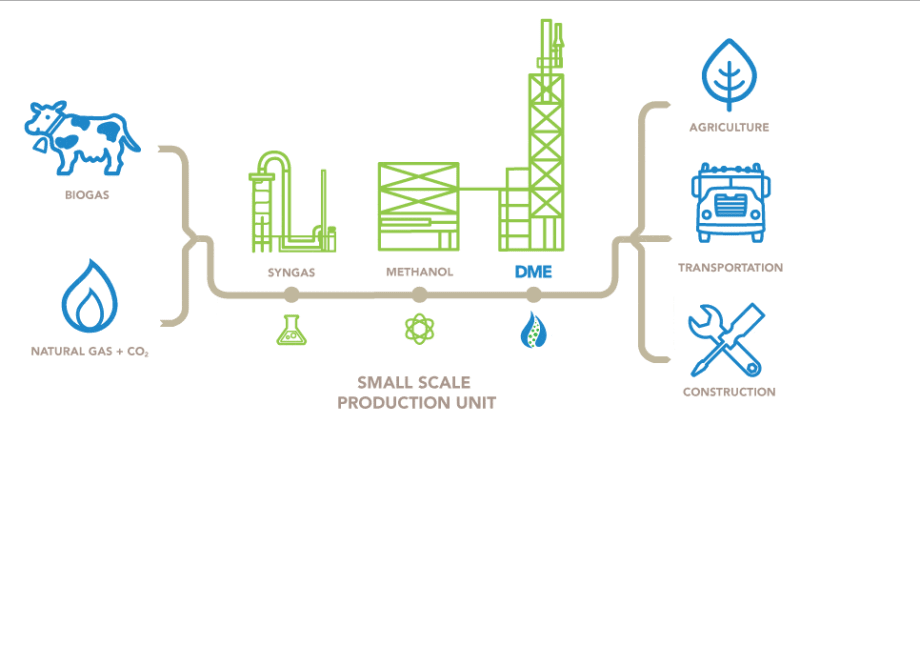
Graphic via Oberon.

Oberon Co-Founder Elliot Hicks:Photo via Oberon.
Elliot Hicks is one of the co-founders of Oberon Fuels, a company that is exploring the production and use of dimethyl ether, or DME, in heavy duty trucks. He has a background in mechanical engineering and is tasked with addressing the issues of bringing a new alternative fuel to market, focusing on regulatory compliance and customer acceptance.
At this year’s Green Fleet Conference running from Oct. 29-30 in Schaumburg, Ill., Hicks will be part of a panel called "Looking Ahead: Emerging Alternative Fuels & Powertrains," where he will discuss DME as a sustainable, clean and efficient alternative to diesel.
Heavy Duty Trucking: What is DME and what are its benefits to the trucking industry?
Elliot Hicks: DME is a simple fuel. It’s made out of any source of methane, natural gas being the easiest to reform.
It gets the same power performance in a combustion engine that diesel does, so you aren’t losing any torque or efficiency by going with DME. The structure of the molecule doesn’t have a carbon-carbon bond, so it doesn’t generate any particulate matter when it burns. There is no need for a diesel particulate trap or a filter on the trap, making it much easier to manage for NOx control.
It’s a simple fuel to produce and transport because its handling properties are essentially identical to propane. It is stored at moderate pressure, liquefied at moderate pressure, and all the dispensing equipment is the same as propane except for a few modifications to seals and gaskets for material compatibility. There are very minor changes.
HDT: Do any modifications have to be made to a diesel engine to be able to run DME?
Hicks: The fuel delivery system has to be modified for DME because it handles like propane. You need to modify the tank, the pump and the injectors to handle the fuel flow, and the engine controller needs to be tuned for DME.
It’s very much the same as converting a smaller gasoline engine to run on propane, and on a diesel engine, once DME is actually injected into the cylinder, it will combust very efficiently.
With the DME engines that Volvo is commercializing, they are doing some additional modifications to cylinder geometry and optimizing other parts but you don’t need to have those in-cylinder modifications in order to run DME in a diesel engine.
HDT: What is the efficiency of DME compared to diesel gas?
Hicks: Volvo’s getting about the same thermal efficiency from the engine that they do from their diesel engines. On a volume basis, you need 1.88 gallons of DME to have the same energy content as one gallon of diesel. It’s very similar to LNG in terms of energy density.
You might need a larger volume of fuel, but in terms of getting actual work out of the truck, you'll see the same converted mileage and the same efficiency.
HDT: DME is interesting because it can be pulled from sustainable sources. What level of production could you actually see from those sources?
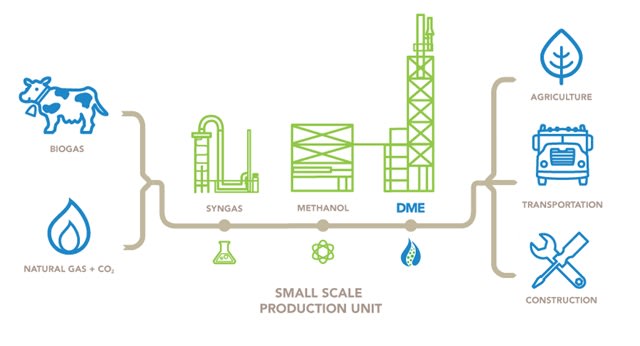
Graphic via Oberon.
Hicks: Landfills and other biogas sources are certainly where we are focused. Initially there will be quite a bit of production from fossil natural gas in order to maintain a stable supply of DME as the market launches, but there is tremendous opportunity to extract it from waste gasses.
We see a lot of room for development of sustainable DME as the market develops. Whether the biogas is from food waste or other organic waste, those waste streams still have a lot of development be done but there are a lot of opportunities for turning those sources into DME.
HDT: How is your pilot program with Volvo and Martin Energy Services going and what have you discovered?
Hicks: It’s performing quite well. Volvo had done all of their development work on DME in Sweden. When they brought over trucks to work with Martin, it was the first time they converted to a North American duty cycles and set up of the truck.
Naturally with any switch-over there are issues to iron out so it’s been very valuable in that it was the first effort to get the trucks over to North America and get them converted.
Overall it’s been very successful in that we’ve been getting good mileage out of the trucks and the drivers have been very happy with the performance of the trucks. The fuel that we’ve been producing has worked well with the vehicles.
We have a couple of years before commercialization is finalized but at this stage we’re quite happy with the performance of the tests.
HDT: Are there other companies producing DME at a production rate or is this still the early days?
This is still relatively early days. We have our plant in Southern California that we actually run in a batch process because at the moment there are only 4 demo trucks out in North America. There will be some additional ones coming in the next year in advance of the commercial trucks being available. That will start rolling out in 2017 or 2018.That’s where the real volume of fuel will be needed, in order to support the commercial trucks.
HDT: Thank you for your time, is there anything else you'd like to say?
I'm looking forward to the Green Fleet Conference, it should be fun to be there
For more information on the Green Fleet Conference click here.
More Fuel Smarts

How Volvo Updated Its D13 for EPA 2027 [Watch]
Volvo’s updated D13 promises lower emissions without sacrificing performance or fuel economy. Take a closer look at what changed inside the engine in this HDT Spotlight video.
Read More →
Diesel Price Spike Shortens Payback for Natural Gas Trucks, Report Says
Energy Vision estimates fleets could recover the higher purchase price of an RNG-fueled Class 8 tractor in 1.3 to 2.8 years under current fuel-price scenarios.
Read More →
Calstart Becomes Catalyst Mobility, Reflecting Broader Focus
Calstart is now Catalyst Mobility, reflecting the nonprofit’s growing national role in clean transportation, including zero-emission trucks, infrastructure and incentive programs.
Read More →

Record Diesel Prices Squeeze Trucking Fleets
Average U.S. diesel prices have climbed to nearly $6 a gallon, surpassing the 2022 record as tight refinery capacity and Middle East disruptions keep fuel costs elevated.
Read More →
How Fuel Delivery Shapes Engine Performance
Fuel delivery depends on more than what happens at the injector. For fleet, maintenance and technical professionals, looking at the full path from pump to injector can provide useful context for understanding engine performance.
Read More →
East Coast Port Launches $45M Electric Truck Push
The Port Authority of New York and New Jersey announced millions in incentives for zero-emission drayage trucks, yard tractors, and new charging hubs near the port.
Read More →
California Bill Could Shed Light on Electric Truck Prices
Why do battery-electric Class 8 trucks remain so expensive? A California bill headed to Gov. Gavin Newsom would give fleets and state agencies more visibility into what manufacturers charge.
Read More →
Detroit Opens Orders for EPA 2027 Engines
Detroit isn’t starting from scratch to meet EPA 2027 diesel emissions standards. Its Gen 6 DD13 and DD15 engines keep much of today’s platform while updating the fuel and aftertreatment systems.
Read More →
Zero-Emission Truck Corridor Planned for West Coast
California, Oregon, Washington, British Columbia and Baja California are coordinating plans for truck charging and hydrogen fueling from Canada to Mexico.
Read More →
A Closer Look at Kenworth’s Electric T880E Vocational Truck [Video]
Learn more about Kenworth's T880E battery-electric vocational truck at the Paccar Technical Center, including its range, applications, upfitting considerations, and PTO options, in this HDT Spotlight video.
Read More →