




Dairy Operation to Recycle Natural Waste of Cows into Fuel for Delivery Vehicles
Recycling waste is an integral part of sustainable living in both small-scale homes and large-scale industrial operations. Fair Oaks Farms, a dairy farm in northwestern Indiana, is taking this concept to a new level
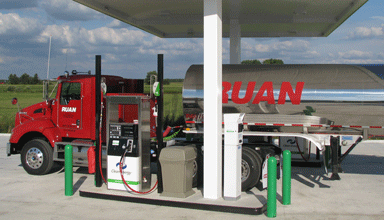
A milk delivery vehicle refuels at an on-site CNG station that will soon use manure-derived natural gas. Paclease has partnered with the Fair Oaks Farms to provide a full-service leasing agreement, and Ruan operates the trucks.
Recycling waste is an integral part of sustainable living in both small-scale homes and large-scale industrial operations. Fair Oaks Farms, a dairy farm in northwestern Indiana, is taking this concept to a new level.
They are implementing a plan to use cow manure to fuel the very trucks that deliver milk to processing plants throughout the Midwest.
The flammable potential of cow pies has been known to cattlemen in many cultures for centuries. Tibetans, for example, who live in the barren, treeless landscape of the Tibetan Plateau, sometimes burn cow and yak manure in place of wood for warmth.
The operation at Fair Oaks Farms is a bit more complex.
The farms, which comprise 10 dairy farms in a co-op, have around 30,000 dairy cows at any given moment. On average, a cow produces 16 gallons of manure per day, putting the total amount of daily defecation at 480,000 gallons. That's an Olympic-sized swimming pool three-quarters full of dung and an enormous waste management problem. Or, if you're Mark Stoermann, project manager at Fair Oaks Farms, an enormous opportunity.
"As long as everything runs right, it will be a win-win-win," said Stoermann. When fully implemented, "we should be very close to zero carbon footprint for operation of the trucks."
The other two wins, in addition to reduced carbon footprint, are money saved, and a significantly less stinky farm. Here's how it works:
Cows do their business in the specially designed stalls where they live. When the cows go off to be milked, vacuum trucks suck up the manure and deliver it to one of several "anaerobic digestion" stations in Fair Oaks Farms. The station designated for truck fuel production handles about 11,000 gallons per day, about a third of the total manure. Once inside, the manure is heated to around 100 degrees and mixed with bacteria inside the digester that helps break down the mess, releasing a gaseous mixture of 60% methane and 40% CO2.
From here, the gas will travel through a cleaning system that will separate the methane for use in 42 Kenworth T440 tractors running Cummins Westport ISL-G CNG engines. The gas cleanup station is in the process of being designed and built for Fair Oaks Farms by a contractor and will come online sometime next year. The 42 CNG tractors, however, are already running using utility gas.
After the gas extraction, the remains of the manure will be recycled back out to fertilize corn fields that feed the cows, completing a circle that's been central to farming since the middle ages.
Back to the third win in the trifecta: Processing manure in this way cuts down on odor by 90% or better. That may seem like an afterthought, but the farms are just off I-65 in Indiana. As a frequenter of that particular highway, I'm thankful.
When all is said and done, the cow-powered trucks are expected to deliver 53 of 60 daily milk loads to three regional processing plants. This will displace some 1.5 million gallons of diesel fuel annually, and since the trucks will consume the noxious cow flatulence, that takes methane, 25 times more powerful as a greenhouse gas than CO2, out of the atmosphere. That's why the trucks will be nearly carbon neutral when it comes to operations.
"This has never been done on this scale before," said Stoermann, who acknowledged the help of state funding get the program off the ground.
With a U.S. dairy cow population in the tens of millions, it may not be the last.
From the October 2011 issue of HDT.
More Fuel Smarts

How Volvo Updated Its D13 for EPA 2027 [Watch]
Volvo’s updated D13 promises lower emissions without sacrificing performance or fuel economy. Take a closer look at what changed inside the engine in this HDT Spotlight video.
Read More →
Diesel Price Spike Shortens Payback for Natural Gas Trucks, Report Says
Energy Vision estimates fleets could recover the higher purchase price of an RNG-fueled Class 8 tractor in 1.3 to 2.8 years under current fuel-price scenarios.
Read More →
Calstart Becomes Catalyst Mobility, Reflecting Broader Focus
Calstart is now Catalyst Mobility, reflecting the nonprofit’s growing national role in clean transportation, including zero-emission trucks, infrastructure and incentive programs.
Read More →

Record Diesel Prices Squeeze Trucking Fleets
Average U.S. diesel prices have climbed to nearly $6 a gallon, surpassing the 2022 record as tight refinery capacity and Middle East disruptions keep fuel costs elevated.
Read More →
How Fuel Delivery Shapes Engine Performance
Fuel delivery depends on more than what happens at the injector. For fleet, maintenance and technical professionals, looking at the full path from pump to injector can provide useful context for understanding engine performance.
Read More →
East Coast Port Launches $45M Electric Truck Push
The Port Authority of New York and New Jersey announced millions in incentives for zero-emission drayage trucks, yard tractors, and new charging hubs near the port.
Read More →
California Bill Could Shed Light on Electric Truck Prices
Why do battery-electric Class 8 trucks remain so expensive? A California bill headed to Gov. Gavin Newsom would give fleets and state agencies more visibility into what manufacturers charge.
Read More →
Detroit Opens Orders for EPA 2027 Engines
Detroit isn’t starting from scratch to meet EPA 2027 diesel emissions standards. Its Gen 6 DD13 and DD15 engines keep much of today’s platform while updating the fuel and aftertreatment systems.
Read More →
Zero-Emission Truck Corridor Planned for West Coast
California, Oregon, Washington, British Columbia and Baja California are coordinating plans for truck charging and hydrogen fueling from Canada to Mexico.
Read More →
A Closer Look at Kenworth’s Electric T880E Vocational Truck [Video]
Learn more about Kenworth's T880E battery-electric vocational truck at the Paccar Technical Center, including its range, applications, upfitting considerations, and PTO options, in this HDT Spotlight video.
Read More →