





Related: CNG: From an Idea to a Solution
Customers Make LNG ‘No-Brainer’ for Florida Fleet
The Jacksonville-based truckload carrier's transition to LNG was driven by three factors: addressing customers’ sustainability goals, contributing to U.S. energy independence, and lowering fuel costs for the 500-truck fleet.
October 7, 2015
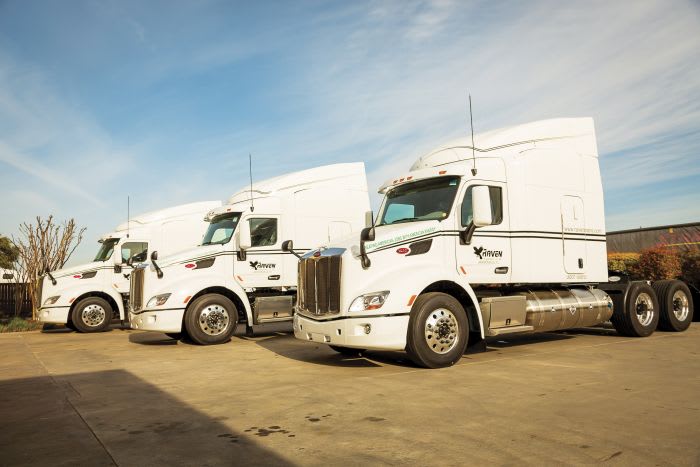
Photo: Raven Transport
2 min to read
Photo: Raven Transport
About two years ago, Raven Transport started switching its over-the-road tractor fleet to operate on liquefied natural gas. It expects to be running 100% on LNG by 2019.
Stephen Silverman, chief operating officer of the Jacksonville, Fla.-based truckload carrier, explains the transition was driven by three factors: addressing customers’ sustainability goals, contributing to U.S. energy independence, and lowering fuel costs for the 500-truck fleet.
“When we began buying LNG trucks in 2013,” he says, “we made the decision to go to LNG on day cabs as our first step. Then when [our customer] P&G included us in their sustainability program if we committed to LNG, it became a no-brainer.”
He points out that LNG power dovetails with Raven’s willingness to tailor its operations to the needs of customers. “Environmental stewardship and cost-effective logistics are central to the operating principles of our customers, which is why our investment in a natural gas fleet makes sense.”
In putting together its LNG truck fleet, Raven’s executives met with Clean Energy Fuels founder T. Boone Pickens. Silverman says they were impressed by his argument for the need to reduce the nation’s dependence on foreign oil by making more use of domestic natural gas.
The carrier was also intrigued by the potential per-gallon cost savings from running on LNG versus diesel. However, Silverman agrees that it’s difficult to quantify the effect on overall fuel costs today because of significantly lower oil and diesel prices. He also points out that it’s still “too early to tell about the impact on maintenance costs, since most of our historical maintenance costs escalate in the third and fourth years.”
The first order in the fall of 2013 was for day cabs, and earlier this year the fleet began to bring on LNG-fired sleeper trucks. Its natural-gas fleet now consists of 115 sleepers and 69 day cabs with 20 more on order. The fleet consists of Peterbilts powered by the Cummins Westport 12-liter engine, but Raven is looking at other tractor vendors as well.
The LNG day cabs can handle a 54,500-pound payload and have a range of around 670 miles, while the sleeper payload is 48,400 pounds and the range extends to just under 1,100 miles.
“The day cabs were purchased for our business partner MillerCoors and the sleepers with our long-term business partner P&G in mind, but we provide service with these trucks to other customers as well.”
About 98% of Raven’s LNG fueling is done at “truck-friendly” stations opened across the Southeast and in Texas, through a multi-year agreement the fleet signed with Clean Energy Fuels.
Subscribe to Our Newsletter
More Fuel Smarts

How Volvo Updated Its D13 for EPA 2027 [Watch]
Volvo’s updated D13 promises lower emissions without sacrificing performance or fuel economy. Take a closer look at what changed inside the engine in this HDT Spotlight video.
Read More →
Diesel Price Spike Shortens Payback for Natural Gas Trucks, Report Says
Energy Vision estimates fleets could recover the higher purchase price of an RNG-fueled Class 8 tractor in 1.3 to 2.8 years under current fuel-price scenarios.
Read More →
Calstart Becomes Catalyst Mobility, Reflecting Broader Focus
Calstart is now Catalyst Mobility, reflecting the nonprofit’s growing national role in clean transportation, including zero-emission trucks, infrastructure and incentive programs.
Read More →

Record Diesel Prices Squeeze Trucking Fleets
Average U.S. diesel prices have climbed to nearly $6 a gallon, surpassing the 2022 record as tight refinery capacity and Middle East disruptions keep fuel costs elevated.
Read More →
Sponsored•September 9, 2026
How Fuel Delivery Shapes Engine Performance
Fuel delivery depends on more than what happens at the injector. For fleet, maintenance and technical professionals, looking at the full path from pump to injector can provide useful context for understanding engine performance.
Read More →
East Coast Port Launches $45M Electric Truck Push
The Port Authority of New York and New Jersey announced millions in incentives for zero-emission drayage trucks, yard tractors, and new charging hubs near the port.
Read More →
California Bill Could Shed Light on Electric Truck Prices
Why do battery-electric Class 8 trucks remain so expensive? A California bill headed to Gov. Gavin Newsom would give fleets and state agencies more visibility into what manufacturers charge.
Read More →
Detroit Opens Orders for EPA 2027 Engines
Detroit isn’t starting from scratch to meet EPA 2027 diesel emissions standards. Its Gen 6 DD13 and DD15 engines keep much of today’s platform while updating the fuel and aftertreatment systems.
Read More →
Zero-Emission Truck Corridor Planned for West Coast
California, Oregon, Washington, British Columbia and Baja California are coordinating plans for truck charging and hydrogen fueling from Canada to Mexico.
Read More →
A Closer Look at Kenworth’s Electric T880E Vocational Truck [Video]
Learn more about Kenworth's T880E battery-electric vocational truck at the Paccar Technical Center, including its range, applications, upfitting considerations, and PTO options, in this HDT Spotlight video.
Read More →