




Commentary: Regulatory Drag and the Driver Shortage
Despite projections of an economic slowdown, upcoming regulations could still require fleets to find large numbers of new drivers.


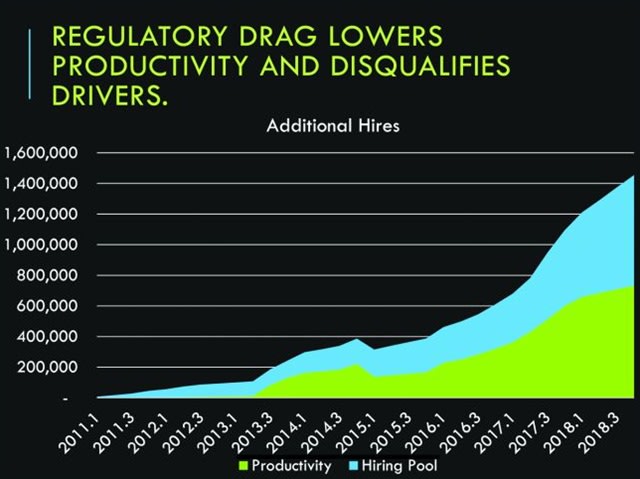
Electronic logs, speed limiters, a drug and alcohol testing database and other regulations will mean more drivers are needed, even if the economy slows. Graph: FTR
Electronic logs, speed limiters, a drug and alcohol testing database and other regulations will mean more drivers are needed, even if the economy slows.Graph: FTR
Could you find 50% more drivers for your fleet? You may have to in the not-too-distant future.
“Hold on, Evan. Last week you reported the economy is expected to slow by mid-2018. Why would I need that many more drivers?”
Yes, I said economist Noel Perry with freight forecasting firm FTR called the current economic recovery “a little stale,” explaining that as recoveries drag out they get weaker, especially for trucking.
A countervailing headwind, however, will come from a mountain of new regulations. Unless we are hit by a calamity like the Great Recession, the effect on the number of drivers needed by an economic slowdown will likely be outweighed by new rules from Uncle Sam that should blow in about the same time.
“The FMCSA is in the process of writing regulations that will hit the marketplace sometime between 2016 and 2018 and will affect it profoundly,” said Perry. We’re talking about around two dozen new or changed regulations, coving everything from electronic logging devices and training provisions to speed limiters and a database of driver drug and alcohol test results.
Hundreds of thousands of drivers or potential ones will be disqualified from trucking by 2018 due to new regulations, Perry says. On top of that, as you can see from the chart, regulations will chisel away at the productivity, meaning more drivers will be needed to haul the same amount of freight.
For example, as you’ll notice in the graph, when hours of service changes in mid-2013 limited use of the 34-hour restart, productivity dropped, requiring more drivers. Conversely, when the rule was relaxed at the end of 2015, productivity improved.
Productivity will gear down again when a requirement for speed limiters kicks in, expected in 2017 or 2018.
When these and many more regulations start hitting next year and beyond, additional hires needed, Perry says, will be more than 150,000 per quarter – and don’t expect Congress to swoop in and save us.
With a potential economic slowdown and a severe driver shortage buffeting fleets from all sides, fleets need to work on strategies to avoid being caught in the crosswinds.
More Drivers

FMCSA Removes 110 Truck Driver Training Schools from Certified ELDT List
Federal regulators also are targeting more than 160 additional training providers and launching a nationwide audit of third-party CDL skills testers as part of a broader crackdown on trucking fraud.
Read More →
Hours of Service Pilot Programs: FMCSA Readies for 2027 Rollout
Two pilot programs could eventually reshape hours-of-service rules, giving truck drivers options to pause their 14-hour clock or use longer split sleeper rest periods.
Read More →
Medical Cards, English Proficiency Reshape Roadcheck Violations
Medical-card violations jumped to the top of the driver out-of-service list during CVSA’s 2026 International Roadcheck, while English-language proficiency violations appeared among the leading violations for the first time.
Read More →
Driver Trust Can Make or Break the Success of Fleet Safety Technology
New Teletrac Navman research suggests that onboarding, transparency about driver data, and positive feedback can play a significant role in how commercial drivers respond to safety and coaching technology.
Read More →
EEOC Sues KLLM Over Alleged Sex Discrimination in Driver Training
KLLM is facing a federal sex-discrimination lawsuit over policies the EEOC alleges put female truck driver trainees at a disadvantage.
Read More →
FMCSA Moves to Codify English Language Requirements for Commercial Drivers
By changing regulations on English-language proficiency requirements for commercial drivers, rather than relying on a guidance memo, the FMCSA said future administrations won't be able to walk back the Trump administration's stricter enforcement with just a memo.
Read More →
Drivers Put Western Star Trucks to the Test at Star Nation Experience
Watch to get an inside look at the Western Star trucks, technology, and community behind the Star Nation Experience 2026!
Read More →
Trump Administration Looks to Put More Veterans Behind the Wheel
The Freedom Haulers program pulls together existing and expanded programs at several federal agencies to recruit veterans to drive commercial heavy-duty trucks and cut the red tape for them to get a CDL, training, and employment.
Read More →
Putting Mack’s Command Steer to the Test
A test drive of Mack’s Command Steer active steering system evaluates how it can make truck driving easier and less tiring.
Read More →
Competition Heating Up for Truck Drivers
New report reveals rising driver hiring costs, the return of sign-on bonuses, growing AI advantages, and the operational factors shaping driver retention.
Read More →