




Commentary: Need for Speed?
Trucks using speed limiters had a ratio of 1.6 crashes per 100 trucks per year, while those without had a ratio of 2.9.


Deborah Lockridge

Deborah Lockridge
It’s a matter of physics.
That’s what Mark Rosekind, administrator of the National Highway Traffic Safety Administration, said in announcing a proposal to mandate speed limiters in heavy trucks.
“Even small increases in speed have large effects on the force of impact,” Rosekind said in a statement “Setting the speed limit on heavy vehicles makes sense for safety and the environment.”
The proposal, announced Aug. 26 by NHTSA and the Federal Motor Carrier Safety Administration, doesn’t call for a specific speed limit. Instead, it outlines the estimated benefits of 60, 65 and 68 mph and asks for comments on the wisdom of those speeds — or what other speeds commenters believe would be best.
The concept of speed limiters on heavy trucks is supported by safety advocacy groups and the American Trucking Associations, although the preferred details differ.
On the other hand, the Owner-Operator Independent Drivers Association has long argued against speed limiters, on the grounds that differentials in speed “increase interactions between vehicles, which increases the likelihood of crashes.”
In reality, many trucks on the road today are speed-limited by their fleet owners for both fuel-saving and safety benefits. In its proposal, the agencies cite a 2012 FMCSA study of 15,000 crashes that analyzed 20 such fleets. Trucks using speed limiters had a ratio of 1.6 crashes per 100 trucks per year, while those without had a ratio of 2.9.
Speed limiters are already a reality in other parts of the world, including Ontario and Quebec (105 kilometers per hour, or about 65 mph), Japan (90 kph/56mph), Australia (100 kph/62 mph, lower for road trains) and the European Union (100 kph/62 mph).
I’ve been on highways in Germany, where the trucks are speed-limited but in many rural areas of the autobahn there’s no speed limit for cars. Plenty of opportunity for big speed differentials there. But trucks stay in the right lane, and cars don’t linger in the left lane unless they’re passing.
On the other hand, Great Britain restricted trucks to 40 mph on two-lane highways until 2014, while cars could travel 60 mph. But faster passenger cars crashing while trying to pass the slower trucks led to that being upped to 50 mph, according to the Christian Science Monitor.
You might see this as an argument supporting the idea that slower trucks are unsafe. But that was a 20-mph differential on two-lane roads. Though some states have upped speed limits to 80 (85 on some stretches in Texas), these are generally for rural Interstates, not two-lane highways where passing a slower truck could involve encountering oncoming traffic.
Another objection we’ve heard to mandatory speed limiters is that the majority of crashes are caused by the passenger vehicles, not by heavy trucks. This is a bit akin to a bigger brother arguing, “But he started it!” when parents punish him for fighting with his little brother. Doesn’t matter. You’re bigger, which means it’s not a fair match.
There’s no doubt a speed limiter rule will have repercussions. It will tighten capacity and exacerbate the driver shortage. The agencies acknowledge in their proposal that “in order to compensate for the increased travel time, trucking … companies would need to require current operators drive longer hours (within hours of service limits), hire additional operators, and use team-driving strategies in some cases.” Smaller companies and owner-operators will be the hardest hit. But the trucking companies already operating with speed limiters (and they’re not all mega-fleets) show it can be done successfully.
And most importantly, lives will be saved.
More Safety & Compliance

FMCSA Pauses Biennial-Update Enforcement Amid Motus Transition
Carriers whose updates were due on or after June 1 have more time, while FMCSA works to stabilize its new registration system and warns of phishing sites impersonating its new carrier registration system, Motus.
Read More →
ZF Expands Commercial Vehicle Push in North America
ZF is expanding its North American commercial-vehicle presence with new transmission applications, electrification, trailer technology and autonomous-driving systems.
Read More →
Truck Drivers Need More Than Another Alert
Fleets have more visibility into truck health, safety events, and driver activity than ever. The next challenge is turning all that information into useful guidance for the person who has to decide what to do next.
Read More →
Tesla Wants a Self-Driving Semi. Are Cameras Enough?
Could Tesla’s camera-only autonomous driving technology work on an 80,000-pound Semi? In this commentary, HDT's Deborah Lockridge takes a look at Tesla, Cybercab, and how autonomous trucks see the road.
Read More →
What DOT’s Automated Vehicle Strategy Means for Trucking
The U.S. Department of Transportation issued a new automated-vehicle strategy that outlines plans for driverless-truck regulations, cross-state freight corridors, and federal safety standards.
Read More →
NYC Expands Speed, Pedestrian Safety Tech Across Fleet
New York City is expanding intelligent speed assistance and pedestrian-alert systems across its municipal fleet, moving the technologies from pilot programs into vehicle procurement and retrofit requirements.
Read More →
FMCSA Removes 110 Truck Driver Training Schools from Certified ELDT List
Federal regulators also are targeting more than 160 additional training providers and launching a nationwide audit of third-party CDL skills testers as part of a broader crackdown on trucking fraud.
Read More →
Beyond DOT Compliance: What Makes a Trucking Fleet Truly Safe?
A trucking fleet can follow every rule and still make unsafe decisions. The real test comes when safety conflicts with freight, productivity, or cost.
Read More →
Hours of Service Pilot Programs: FMCSA Readies for 2027 Rollout
Two pilot programs could eventually reshape hours-of-service rules, giving truck drivers options to pause their 14-hour clock or use longer split sleeper rest periods.
Read More →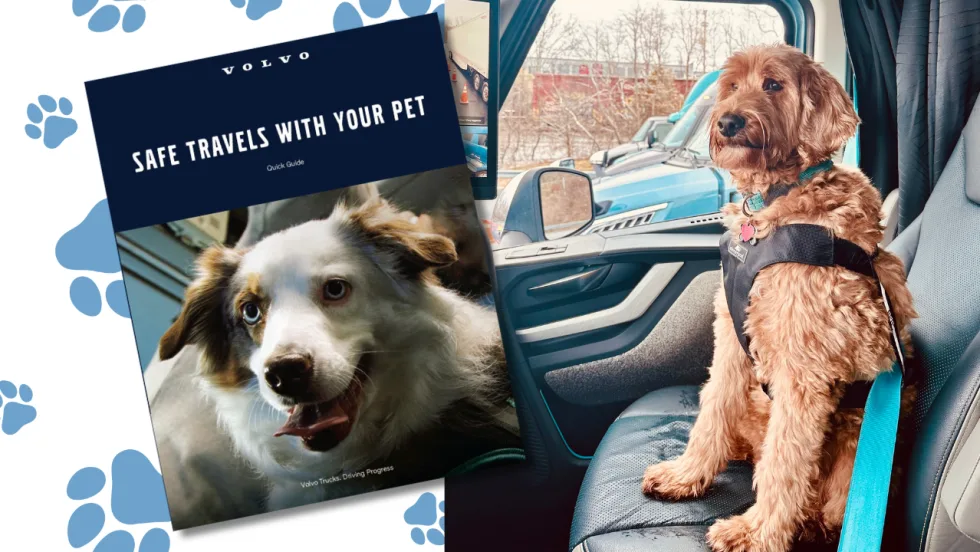
New Guide Offers Pet Safety Tips for Truck Drivers
Hundreds of thousands of pets travel in truck cabs. A new safety guide from Volvo Trucks and the Center for Pet Safety offers practical advice for truck drivers who bring dogs and cats along for the ride.
Read More →