




Related: What Economic Indicators Tell Us About Shifting Freight Trends
Commentary: It's Wait and See for Fleets in 2016
One transportation analyst described 2015 as disappointment on the heels of a strong 2014 and this year may end up being more of the same.

Evan Lockridge・Former Business Contributing Editor
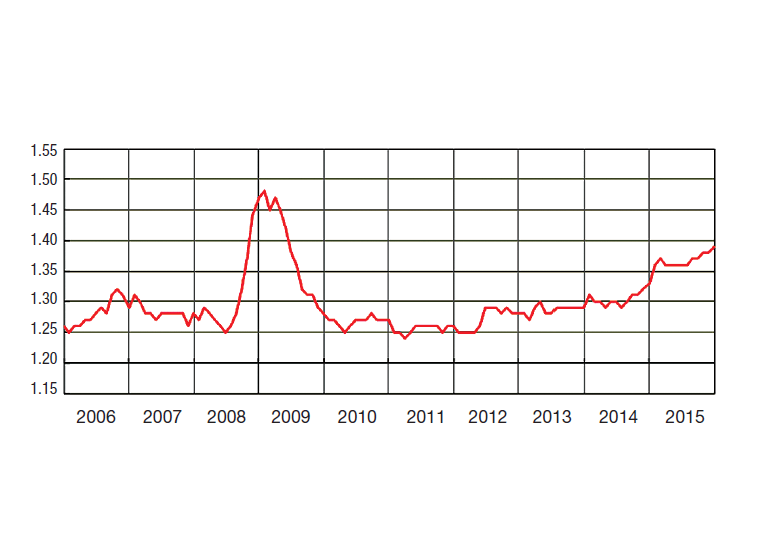
Source: U.S. Department of Commerce
3 min to read
After year-end financials for publicly traded trucking companies began rolling in last month, I decided to talk to an expert about 2015’s performance and what’s to come.
“2015 was probably characterized as disappointing on the heels of a very strong and robust 2014,” said John Larkin, managing director of equity research of transportation and logistics at the investment banking and financial services firm Stifel, though he admitted the results were kind of expected.
Larger economic influences were to blame. For instance, the strength of the U.S. dollar against foreign currencies, which makes U.S. goods more expensive overseas and foreign ones cheaper here at home, “pretty much killed off all export activity and encouraged a lot of import activity.” Plus low energy prices “put the kibosh on all incremental drilling activity.” And an inventory glut across many supply chains, which continues, slowed the level of manufacturing shipments, a situation that wasn’t helped by “mediocre consumer demand.”
It all added up to what Larkin called a “weak demand environment on the heels of a strong demand environment.”
But that’s not to say there weren’t any bright spots.
Fleets involved in dedicated trucking fared better. “Werner Enterprises, being sort of the poster child for that phenomenon,” is a prime example, with net income up 25% over 2014 (6% net of fuel surcharge). They are also managing their portfolio well, but certainly those companies that had dedicated exposure seem to be less volatile with respect to their earnings.”
Why was dedicated a bright spot? A lot of shippers are looking as much as three years ahead and are seeing an increasing number of trucking regulations coming down the pipeline that are expected to tighten capacity, Larkin said. These shippers want to avoid a repeat of the tight supply demand seen in 2014. Their goal is be a little less dependent on the spot market and the irregular route truckload business, so they can know their base load volume is going to be handled at a cost that has been predetermined.
On the downside, fleets with heavy spot market exposure seem to gotten hurt the worst, Larkin said. And those in the flatbed business hauling steel really “got slammed hard” because U.S. steel production took it on the chin from the strong dollar encouraging imports, especially from China.
“If you are not flexible enough to move your equipment into other markets and you’ve got drivers that are used to dealing with steel…they don’t want to move into some other sector, they just park the truck or just go out of business,” Larkin said. Making matters worse, a lot of drilling pipe that had been moving into fracking operations came to a virtual standstill since the collapse in energy prices, another blow for flatbed operations.
For this year, Larkin said he doesn’t see things improving a whole lot. “Lousy demand is how to describe the first quarter so far, and there is really no evidence things have picked up much.” This is despite a winter that at press time had been relatively mild, compared to severe weather that hurt freight movements the past two years.
“What we need to do is work our way through this inventory glut that has been plaguing the retail supply chains,” he said. “I think the first evidence of strength you will see is in the March/April/May time frame, when you’re normally moving large quantities of what I’ll call the late spring, early summer merchandise.”
If such a surge fails to develop, then, Larkin warned, “you’ve got some really big problems.”
“We’ll know pretty soon whether this is going to be a very sluggish year, maybe less than normal demand, or whether we’ll sort of have that inventory correction cleaned up here in short order and then be off to what I would call more of a normal year.”
Total business inventories/sales ratios
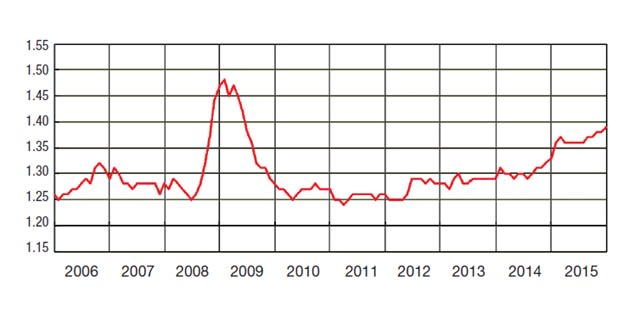
Source: U.S. Department of Commerce
Subscribe to Our Newsletter
More Fleet Management

Sponsored•September 16, 2026
Color Match Smarter: Tools That Restore & Perform
For fleet managers and collision repair professionals keeping heavy-duty trucks on the road, getting the color right the first time isn't just about appearance — it's about efficiency, turnaround time, and bottom-line results. Discover how today's digital color tools are transforming the repair process from guesswork to precision.
Read More →
FMCSA Pauses Biennial-Update Enforcement Amid Motus Transition
Carriers whose updates were due on or after June 1 have more time, while FMCSA works to stabilize its new registration system and warns of phishing sites impersonating its new carrier registration system, Motus.
Read More →
Sponsored•September 14, 2026
2026 Blueprint for Countering Smarter Supply Chain Theft
Cargo theft is no longer just the cost of doing business. It's a multi-billion-dollar criminal enterprise exploiting vulnerabilities across your fleet, drivers, and supply chain.
Read More →


Sponsored•September 1, 2026
How Telematics Improves Visibility, Control, and Performance in Refrigerated Fleets
Explore how telematics help refrigerated fleets improve visibility, uptime, efficiency, compliance, and cargo protection across connected cold chain operations.
Read More →
What the U.S.-Canada Trade War Means for Trucking
Escalating U.S.-Canada tariffs could disrupt cross-border freight, reduce truck volumes, raise costs, and create new uncertainty for carriers on both sides of the border.
Read More →
What Are Trucking’s Top Concerns for 2026?
The American Transportation Research Institute wants to know what's worrying trucking fleet managers, drivers, and other stakeholders in its annual Industry Issues survey.
Read More →
American Trucking Associations Looks for a New Leader
ATA President and CEO Chris Spear abruptly left his job at the association on August 21, at a pivotal time for the trucking industry.
Read More →
Public Wi-Fi Cybersecurity Risks: How Truck Drivers and Fleets Can Protect Their Data
Public Wi-Fi can expose truck drivers and fleets to credential theft, malware, and other cyber threats. Here’s how to reduce the risk on the road.
Read More →
For Nicky Cupp, Fleet Innovation Starts With Frustration
HDT Truck Fleet Innovator Nicky Cupp turns everyday pain points at Fraley & Schilling into opportunities for better technology and smarter processes.
Read More →
Adam Buttgenbach’s Approach to Electric Trucks: Start With Where They Fit
HDT Truck Fleet Innovator Adam Buttgenbach helped PepsiCo build one of North America’s largest EV fleets by focusing on where electric trucks make operational sense.
Read More →