




Related: Why Electric Trucks? Why Now?
Commentary: Electric Truck Progress is Real
James Dyson offers evidence that battery and electric motor technology are advancing more quickly than most of us think.
by Rolf Lockwood
December 11, 2018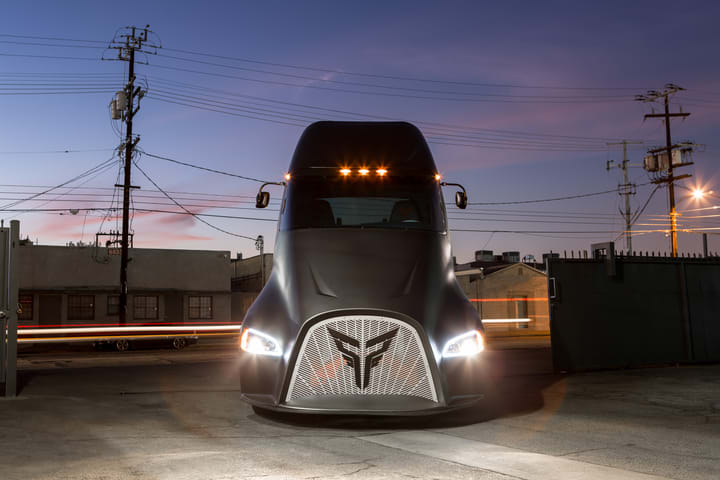
Battery and electric motor technology are advancing more quickly than most of us think .
Photo via Thor Trucks
3 min to read
You won’t catch me at the wheel of a plug-in electric car any time soon. Like most everyone else who considers but then rejects going that route, the issue is range. Which means the base issues are battery strength and electric motor efficiency. If I drove strictly in the city, it would be a maybe – but only if I could somehow attach the sound of a burbling V-8 through Flowmaster mufflers to an otherwise soundless car. And I’m only partly joking. The fact is, most of my driving is done well outside the urban limits, on roads where charging stations of any useful sort don’t exist. So electric locomotion is just not on.
It’s obviously different for local or short-haul trucks, where many run predictable routes and cover relatively few miles. They’re about to come on strong. But greater range, meaning better batteries and motors, would expand that market considerably.
Well, vacuum-cleaner star James Dyson offers evidence that battery and electric motor technology are advancing more quickly than most of us think, according to an article by Nathaniel Bullard on Bloomberg.com. Dyson Ltd., with real expertise in electronics, motors, and batteries, has said it’s ending the production of corded vacuums because cordless models are just as good, maybe better.
Why? As Ballard writes, “Twelve years ago, the company’s digital motor weighed about one-third of a pound and produced 85 air watts of suction power; today, the motor weighs a little more than a quarter of a pound and has more than three times the power at 290 air watts.”
That’s a mighty big advance, and the development pace is only going faster still.

Rolf Lockwood
Which leads me to an interesting research report done by UPS in collaboration with Greenbiz, entitled Curve Ahead: The Future of Commercial Fleet Electrification. It says electrification is leading the way in making the transition to a clean energy future. This shift is driven by various factors, including a technology and market evolution, renewed attention on global climate risks, and the improving economics based on a more favorable total cost of ownership.
Electric options are increasingly becoming more cost-competitive, offering features comparable (or even favorable) to their diesel alternatives, and becoming more widely available from a range of manufacturers. While curves are ahead in the road to widespread electric adoption, more and more fleet operators are seeing opportunities and challenges. Overall, says the report, signs indicate progress is being made and we’re moving in the right direction.
The research revealed several key findings from large companies and government agencies, including:
● The primary motivators for electrifying fleets are achieving sustainability goals (83% of respondents) and lowering total cost of ownership (64%).
● The top barriers are a prohibitive initial purchase price (55%), lack of EV charging infrastructure at facilities (44%), and lack of product availability (35%).
● 92% of GreenBiz web-survey respondents indicated that their organization is not well equipped with onsite EV charging infrastructure for commercial vehicles.
● There is an opportunity for businesses to work together with suppliers, government and utilities; 70% of survey respondents indicated that they collaborate with suppliers; but less than half currently collaborate with government or with utilities.
You can download the report free of charge.
Subscribe to Our Newsletter
More Fuel Smarts

How Volvo Updated Its D13 for EPA 2027 [Watch]
Volvo’s updated D13 promises lower emissions without sacrificing performance or fuel economy. Take a closer look at what changed inside the engine in this HDT Spotlight video.
Read More →
Diesel Price Spike Shortens Payback for Natural Gas Trucks, Report Says
Energy Vision estimates fleets could recover the higher purchase price of an RNG-fueled Class 8 tractor in 1.3 to 2.8 years under current fuel-price scenarios.
Read More →
Calstart Becomes Catalyst Mobility, Reflecting Broader Focus
Calstart is now Catalyst Mobility, reflecting the nonprofit’s growing national role in clean transportation, including zero-emission trucks, infrastructure and incentive programs.
Read More →

Record Diesel Prices Squeeze Trucking Fleets
Average U.S. diesel prices have climbed to nearly $6 a gallon, surpassing the 2022 record as tight refinery capacity and Middle East disruptions keep fuel costs elevated.
Read More →
Sponsored•September 9, 2026
How Fuel Delivery Shapes Engine Performance
Fuel delivery depends on more than what happens at the injector. For fleet, maintenance and technical professionals, looking at the full path from pump to injector can provide useful context for understanding engine performance.
Read More →
East Coast Port Launches $45M Electric Truck Push
The Port Authority of New York and New Jersey announced millions in incentives for zero-emission drayage trucks, yard tractors, and new charging hubs near the port.
Read More →
California Bill Could Shed Light on Electric Truck Prices
Why do battery-electric Class 8 trucks remain so expensive? A California bill headed to Gov. Gavin Newsom would give fleets and state agencies more visibility into what manufacturers charge.
Read More →
Detroit Opens Orders for EPA 2027 Engines
Detroit isn’t starting from scratch to meet EPA 2027 diesel emissions standards. Its Gen 6 DD13 and DD15 engines keep much of today’s platform while updating the fuel and aftertreatment systems.
Read More →
Zero-Emission Truck Corridor Planned for West Coast
California, Oregon, Washington, British Columbia and Baja California are coordinating plans for truck charging and hydrogen fueling from Canada to Mexico.
Read More →
A Closer Look at Kenworth’s Electric T880E Vocational Truck [Video]
Learn more about Kenworth's T880E battery-electric vocational truck at the Paccar Technical Center, including its range, applications, upfitting considerations, and PTO options, in this HDT Spotlight video.
Read More →