




Case Study: Walmart's Efficiency Goals
In 2005, Walmart set a goal of doubling the fuel efficiency of its truck fleet to 13 mpg by 2015, according to widely published reports. By 2008, Walmart got its mpg up to 7.1 from 5.9 in 2005
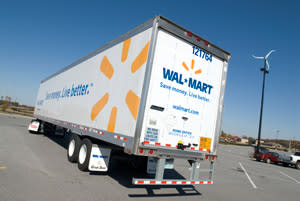
Since 2005, Walmart has managed to improve fleet efficiency by 60 percent.
In 2005, Walmart set a goal of doubling the fuel efficiency of its truck fleet to 13 mpg by 2015, according to widely published reports. By 2008, Walmart got its mpg up to 7.1 from 5.9 in 2005.
The fuel economy improvement was achieved with enhanced tractor aerodynamics, trailer skirts and spec'ing its trucks with equipment designed to save fuel, such as lighter tag axles, wide-based single tires and auxiliary power units, the company said in published reports. In 2008, Walmart added more than 1,100 aerodynamic trucks to its fleet, with plans to add 1,300 more in 2009.
When contacted for an update, Walmart officials told us the goal was to double fleet efficiency from 2005 through the end of 2010, rather than an mpg goal. The company's calculating this by dividing the number of miles traveled by the average fuel efficiency, measured in mpg. Then, the number of cases delivered during the same time period is divided by the amount of fuel used to deliver the cases.
So far, the company has achieved a 60 percent increase in fleet efficiency and continues to work toward that goal this year. Including all carriers, the company said 77 million more cases were delivered in 2009 than 2008, eliminating more than 100 million miles.
The company says it's been loading its trucks and cases more efficiently, improving routing and reducing the number of empty miles its trucks traveled. Fuel-saving technologies, such as improved engine calibration, have also helped.
The company is also making an effort to use trucks that run on alternative fuels. A full-propulsion ArvinMeritor hybrid is being tested in the Detroit area. The vehicle can operate on electric power below 48 mph.
Fifteen trucks operating out of the Phoenix area have been converted to run on reclaimed grease fuel, which is made from waste brown cooking grease collected at Walmart stores. Other trucks at the Phoenix center will use an up to 80/20 blend of biodiesel made of reclaimed yellow waste grease.
Walmart has five Peterbilt Model 386 heavy-duty hybrid trucks with diesel-electric hybrid power assist systems operating in Dallas, Houston, Atlanta, Baltimore and Apple Valley, Calif. These hybrid power assist systems were developed by Eaton and Paccar. Through a partnership with the Mojave Air Quality Management District, Walmart has four Peterbilt Model 386 trucks and one yard truck fueled by liquid natural gas.
"In order to meet our goal of doubling our fleet efficiency, we are taking an active role in the development of these technologies," says Chris Sultemeier, senior vice president of transportation. "We look forward to determining if these technologies will help reduce our environmental footprint, are viable for our business and provide a return on investment."
From the June 2010 issue of Heavy Duty Trucking.
More Fuel Smarts

How Volvo Updated Its D13 for EPA 2027 [Watch]
Volvo’s updated D13 promises lower emissions without sacrificing performance or fuel economy. Take a closer look at what changed inside the engine in this HDT Spotlight video.
Read More →
Diesel Price Spike Shortens Payback for Natural Gas Trucks, Report Says
Energy Vision estimates fleets could recover the higher purchase price of an RNG-fueled Class 8 tractor in 1.3 to 2.8 years under current fuel-price scenarios.
Read More →
Calstart Becomes Catalyst Mobility, Reflecting Broader Focus
Calstart is now Catalyst Mobility, reflecting the nonprofit’s growing national role in clean transportation, including zero-emission trucks, infrastructure and incentive programs.
Read More →

Record Diesel Prices Squeeze Trucking Fleets
Average U.S. diesel prices have climbed to nearly $6 a gallon, surpassing the 2022 record as tight refinery capacity and Middle East disruptions keep fuel costs elevated.
Read More →
How Fuel Delivery Shapes Engine Performance
Fuel delivery depends on more than what happens at the injector. For fleet, maintenance and technical professionals, looking at the full path from pump to injector can provide useful context for understanding engine performance.
Read More →
East Coast Port Launches $45M Electric Truck Push
The Port Authority of New York and New Jersey announced millions in incentives for zero-emission drayage trucks, yard tractors, and new charging hubs near the port.
Read More →
California Bill Could Shed Light on Electric Truck Prices
Why do battery-electric Class 8 trucks remain so expensive? A California bill headed to Gov. Gavin Newsom would give fleets and state agencies more visibility into what manufacturers charge.
Read More →
Detroit Opens Orders for EPA 2027 Engines
Detroit isn’t starting from scratch to meet EPA 2027 diesel emissions standards. Its Gen 6 DD13 and DD15 engines keep much of today’s platform while updating the fuel and aftertreatment systems.
Read More →
Zero-Emission Truck Corridor Planned for West Coast
California, Oregon, Washington, British Columbia and Baja California are coordinating plans for truck charging and hydrogen fueling from Canada to Mexico.
Read More →
A Closer Look at Kenworth’s Electric T880E Vocational Truck [Video]
Learn more about Kenworth's T880E battery-electric vocational truck at the Paccar Technical Center, including its range, applications, upfitting considerations, and PTO options, in this HDT Spotlight video.
Read More →