




BlackBerry Targets Trucking Industry with Latest Technology
Once known mostly for its smartphones, BlackBerry has pivoted toward developing technologies for the transportation industry.
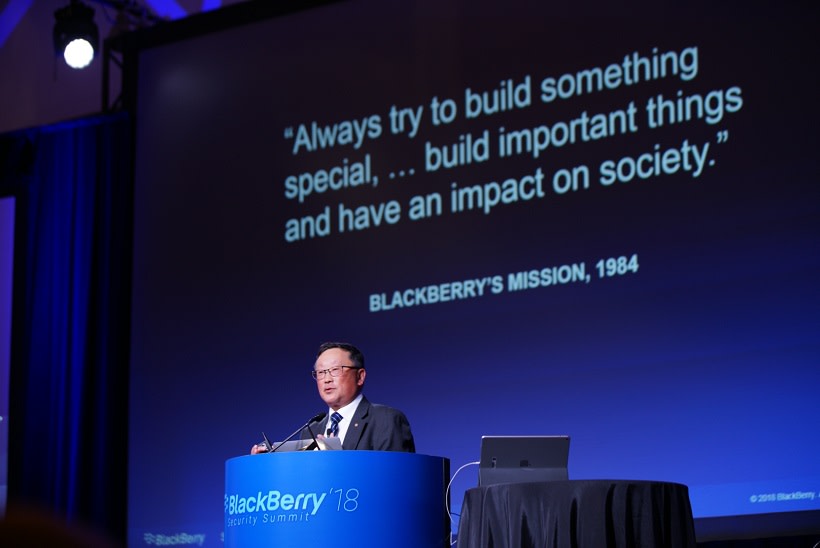
BlackBerry CEO John Chen spoke about how technology will play an increasingly important role in the trucking industry.
Photo via Today's Trucking
BlackBerry chief marketing officer Mark Wilson says the Internet of Things is rapidly transforming the transportation industry. And the driving force behind such change, he believes, is nothing less than the driver shortage.
In a room full of tech watchers and analysts at the company’s fifth annual security summit in New York City, Wilson admitted many people would be surprised. But he noted that asset tracking systems like BlackBerry Radar and other technologies can help offset traditional frustrations associated with jobs behind the wheel.
For instance, Contract Transport Services installed 1,000 Radar units in three months and began tracking everything from open doors to freight status and humidity, he explained. Through the tracking capabilities, the company also was able to save drivers about 20 to 30 minutes a day that would otherwise have been spent trying to locate trailers.
“The more time they’re driving, the more money they’re making,” Wilson told the decidedly non-trucking crowd. And quoting one of the fleet’s executives: “Whoever has the drivers is the one that’s going to win this game.”
Securing the systems
As transportation-related technologies like tracking systems, electronic logging devices and autonomous vehicles emerge, BlackBerry is betting future success on the need for robust security it’s creating through a platform known as Spark, and by further developing the QNX software now loaded into 120 million vehicles.
“There’s a big backlog of connected products that are isolated from other connected products,” said chief technology officer Charles Eagan, referring to opportunities that exist. Spending on the Internet of Things in transportation and logistics hit US $10 billion worldwide in 2015. The investment is expected to grow fourfold by 2020.
But security concerns remain the top technical barrier to realizing the possibilities that come through what BlackBerry refers to as the Enterprise of Things (EoT), Wilson said. “The Enterprise of Things enables digital transformation using hyper-connected things that are ultra-secure.”
“How do you basically secure all the connectivity of these physical and digital things?”
Many of the devices that have emerged in trucking and other industries are not as secure as they need to be.
“In general, as different organizations bring different devices on, they have different levels of security,” Eagan said, when asked about potential security weaknesses in something like electronic logging devices. “There’s a lot of things you can do to protect yourself.”
The developers of such systems, for example, can prepare for the future by leaving the “head room” to allow for future encryption algorithms and ensure devices can be updated. This is particularly important if a device is expected to be used for an extended period of time.
“This is a changing industry. People might plan [to use something for] 10 years, but there might be a disruptive device in two years,” he said. Future security measures will even need to account for quantum computing power that can easily break through a traditional code.
Admittedly, the added security comes at a cost.
“These are also very price-sensitive products,” he agreed. But security-related work is most effective when it’s completed at the front end. “It’s hard to retrofit security. There’s so many things you need to be able to do.”
Radar devices, for example, secure data through a combination of encryption processes, user authentication, and best practices. “It’s extremely important to have that secured,” Eagan said, referring to the value of freight that could be stolen if thieves had the time to work behind hacked or spoofed monitoring systems.
“We’re doing something different and we’re doing something impactful,” CEO John Chen said, referring to the goal of developing secure platforms.
Blackberry’s future
While Blackberry is a well-known brand, few would be familiar with the type of work it’s conducting these days. Executives admit they still field questions from people who are surprised they’re still around. The Canadian tech darling, once a maker of smart phones for world leaders, hasn’t manufactured a phone since 2016.
But under Chen, BlackBerry has manufactured a corporate turnaround. In the latest fiscal quarter it earned $43 million, more than a double what it recorded a year ago, and is topping analyst expectations. Perhaps not surprisingly, Chen’s contract has been extended to November 2023.
Chen says Radar has been adding new customers along with repeat orders. That product alone is expected to generate $100 million in revenue over the next three years. And it’s already secured users including Titanium Transportation and Caravan Transport Group.
The Radar-M units scatter infrared light inside a trailer to measure the percentage of available space, which can identify opportunities to broker freight for an LTL operation. A stripped-down version known as Radar-L is used for flatbeds, chassis, containers, and heavy machinery, and tracks equipment locations, motion, and opening or closing doors. One advantage is that the related antenna-tuning technology allows the device to be mounted under a trailer chassis or between frame rails, rather than requiring a clear view of the sky.
Most of today’s users have applied Radar to intermodal containers, Chen told a crowd at the summit.
Consumer to Commercial
Some of BlackBerry’s current work involves adding a level of security to consumer devices that could find their way into business settings.
Consider emerging speaker-based systems like Amazon’s Alexa as an example. “Voice is the most natural input,” Chen said, referring to the attraction to the devices. But an extra layer of privacy and security will be needed if a tool like that is used in a boardroom or to perform functions like requesting shipping costs.
An upgrade version of the voice-activated system might monitor all other connections in a fleet’s office, sounding the alarm if another connection mysteriously appears.
Autonomous Vehicles
BlackBerry is also actively involved in the steps that will secure the systems used to support autonomous vehicles, using everything from its QNX system to Jarvis automotive security software.
In the meantime, Virginia Tech associate professor Alfred Wicks, stresses the importance of funding competitions used to develop the technology. Tony Tether, the former director of the Defense Advanced Research Projects Agency (DARPA), accelerated the development of autonomous vehicles in 2003 by offering a $1 million prize to the winning team.
“What he got was a step change in technology – impactful step change,” Wicks said during a speech at the summit.
Other competitions such as the GM Auto Drive challenge underway in Canada and the U.S. continue taking steps to developing Level 4 autonomous technology that doesn’t require any driver interaction.
“For us to make impactful technologies, we also have to provide a workforce to keep it going,” he added, noting how such research will establish personnel to keep the industry moving forward.
For its part, BlackBerry is partnering with Virginia Tech to train future mechanical engineers in the company’s QNX software. It’s equipping concept cars competing in the Auto Drive Challenge, too.
Protecting Yourself
But what can existing fleets do to protect themselves? Seventy percent of Enterprise of Things devices have serious security issues, said Rory Macleod, global head of professional services for BlackBerry. As consumers and businesses buy new devices and link them through the internet, many leave default passwords in place; valuable information that’s uploaded when a phone is plugged into a vehicle is often not deleted.
The threats are not just about hacking into a vehicle to apply the brakes or change the speed. The ability to tap into information can be valuable in its own right.
And no longer are threats limited to kids in a basement, Macleod said. Organized crime and even governments are using it to access intellectual property.
Even corporate information technology teams can create weaknesses, perhaps bypassing a firewall to more easily load some software. In one case, a public sector administrator’s computer included a file called passwords. “If they had sticky notes with the passwords all over their desk it would have been more secure,” he said.
In another case, hackers monitored social media to identify a senior executive’s hobby, created a fake website about it, found someone to friend the person, and then shared a pdf about an inventory list for the hobby. The pdf carried the hackers’ malware. “You don’t think of it. You click,” Macleod said.
Access is not even limited to digital-only approaches.
BlackBerry teams conducting a test for one retailer bought some golf shirts in the retailer’s colors, added a logo at a local print shop, walked in and said they were IT personnel and needed access to servers. They were led inside and offered coffee. “No challenging was occurring,” Macleod said. “Even with the advent of machine learning and artificial intelligence. And that’s critical to where cybersecurity is going. People are going to continue being that weakest link.”
Some of the protection involves updating systems, keeping backups, and ensuring there is a disaster recovery system in place should things be compromised.
Macleod refers to something that’s become known as “cyber resilience." Rather than avoiding a breach, it’s about recognizing that it will happen at some point.
“Do you even have a plan in the event of a breach occurring?” he asked. “Are you testing yourselves?”
John G. Smith is the editor of the award-winning Canadian publication Today's Trucking. This article was used under a cooperative editorial sharing agreement between HDT and its Canadian counterpart.
More Fleet Management

Color Match Smarter: Tools That Restore & Perform
For fleet managers and collision repair professionals keeping heavy-duty trucks on the road, getting the color right the first time isn't just about appearance — it's about efficiency, turnaround time, and bottom-line results. Discover how today's digital color tools are transforming the repair process from guesswork to precision.
Read More →
FMCSA Pauses Biennial-Update Enforcement Amid Motus Transition
Carriers whose updates were due on or after June 1 have more time, while FMCSA works to stabilize its new registration system and warns of phishing sites impersonating its new carrier registration system, Motus.
Read More →
2026 Blueprint for Countering Smarter Supply Chain Theft
Cargo theft is no longer just the cost of doing business. It's a multi-billion-dollar criminal enterprise exploiting vulnerabilities across your fleet, drivers, and supply chain.
Read More →


How Telematics Improves Visibility, Control, and Performance in Refrigerated Fleets
Explore how telematics help refrigerated fleets improve visibility, uptime, efficiency, compliance, and cargo protection across connected cold chain operations.
Read More →
What the U.S.-Canada Trade War Means for Trucking
Escalating U.S.-Canada tariffs could disrupt cross-border freight, reduce truck volumes, raise costs, and create new uncertainty for carriers on both sides of the border.
Read More →
What Are Trucking’s Top Concerns for 2026?
The American Transportation Research Institute wants to know what's worrying trucking fleet managers, drivers, and other stakeholders in its annual Industry Issues survey.
Read More →
American Trucking Associations Looks for a New Leader
ATA President and CEO Chris Spear abruptly left his job at the association on August 21, at a pivotal time for the trucking industry.
Read More →
Public Wi-Fi Cybersecurity Risks: How Truck Drivers and Fleets Can Protect Their Data
Public Wi-Fi can expose truck drivers and fleets to credential theft, malware, and other cyber threats. Here’s how to reduce the risk on the road.
Read More →
For Nicky Cupp, Fleet Innovation Starts With Frustration
HDT Truck Fleet Innovator Nicky Cupp turns everyday pain points at Fraley & Schilling into opportunities for better technology and smarter processes.
Read More →
Adam Buttgenbach’s Approach to Electric Trucks: Start With Where They Fit
HDT Truck Fleet Innovator Adam Buttgenbach helped PepsiCo build one of North America’s largest EV fleets by focusing on where electric trucks make operational sense.
Read More →