




How Truckers Can Avoid Common Parking Lot Crashes
Did you hear about the driver who backed into the transformer for a huge regional mall, shutting it down for a Saturday during the Christmas shopping season?
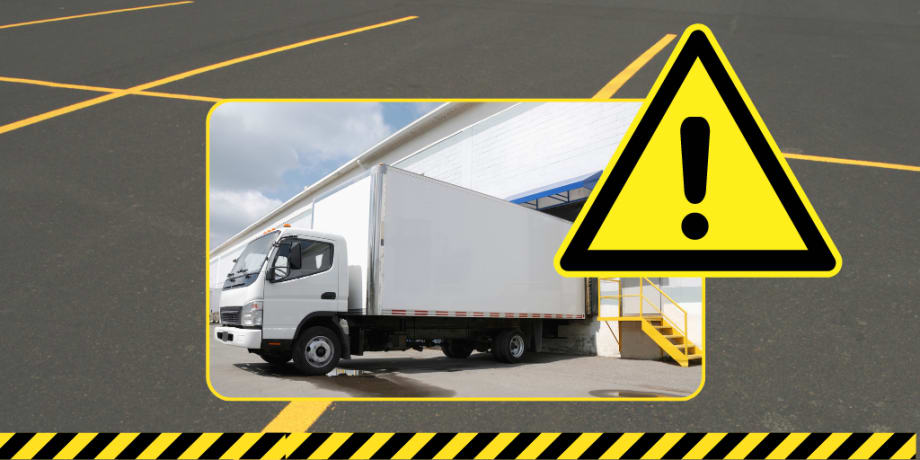
Parking lots are a common site for truck accidents — which are almost always deemed preventable.
Image: HDT Graphic
Did you hear about the driver who backed into the transformer for a huge regional mall, shutting it down for a Saturday during the Christmas shopping season?
True story. And while this is an extreme example, two-thirds of a medium-duty fleet’s collisions happen in a parking lot and involve a fixed or stationary object. The sheer number of incidents and costs of parking-lot types of collisions mean you cannot afford to overlook them.
From Pro-Tread's research and experience, the most common types of collisions and injuries in parking lots are:
Hitting fixed or stationary objects,
Backing and docking collisions.
Liftgate injuries.
Entry/exit from the truck injuries.
Slips, trips and falls.
Intersection crashes.
In this article, we’ll look at the first two.
A fixed-object collision most commonly refers to collisions where the truck was in drive and moving forward when it hit a fixed or stationary object.
In contrast, a backing collision refers to any type of collision when the truck was in reverse and backing up.
Rushing leads to accidents
Whether it is a fixed object, stationary object or backing collision, these types of crashes are often caused by driver inattention or rushing.
Drivers often face tremendously tight time schedules and overlapping delivery windows to accommodate 12 to 18 deliveries per day. Delivery time slots have been narrowed to as little as a two-hour window, with as many as three deliveries sharing the same time window.
The medium truck fleet also contends with customer preference time windows and 30-minute call-ahead notifications, further contributing to time pressures. Constantly remind drivers about focusing, and finishing a task before moving onto the next one.
As we heard one wise driver manager say once, “I ask you to do a lot, but I demand you do just one thing at a time.”
For example, don’t start thinking about paperwork until the truck is in park. Focus.
If drivers are rushed, fleet managers and safety trainers should remind them that they’ll finish faster if they get it right the first time. Nothing slows a driver down more than hitting a pole.
Fixed and stationary objects
For medium truck fleets, the two most common types of collisions involve other vehicles or trailers (stationary objects) and low clearance awnings (fixed objects).
Despite the slow speeds in a parking lot, the size and weight of medium trucks can cause significant damage to anything they hit. It’s estimated that the forward-moving fixed and stationary object accidents can account for 30% or more of a fleet’s total annual collisions.
The best approach to avoiding fixed and stationary object collisions is to:
Approach slowly,
Scan the area you are approaching, including looking up,
Get out and look: It’s not just for backing.
At these low speeds, it is easy to stop, activate the truck’s flashers, and hop out for a quick visual scan before making a tight maneuver or pulling under an awning.
Another idea is simply to ban the truck from unusually busy or congested areas. For example, if you can keep your trucks out of busy fueling stations and tight parking lots, you’ll avoid a lot of incidents.
When you know an area will be busy during a certain time frame, work with the store manager to avoid having your delivery windows during that time.
Backing crashes
Backing accidents with a fixed or stationary object are always considered 100% preventable. Most backing accidents will occur within or in the immediate area of a parking lot. They account for about 30% or more of a fleet’s total annual collisions.
While we classify backing accidents separately from fixed/stationary object collisions, they can involve fixed or stationary objects, such as:
Other vehicles, especially passenger vehicles,
Narrow objects such as poles that can be difficult to see,
Low-clearance awnings.
The best defense is training. The best option is to teach your drivers techniques for avoiding the need to back up at all. This may require scouting a delivery area or talking to the manager of the facility beforehand, if possible.
When backing up is necessary, drivers must be aware of their surroundings and know what is behind them. Remember to apply the GOALden rule of backing: “Get Out And Look.”
Remind them that the company expects them to re-inspect their surroundings as often as needed. It is a good practice to “get out and look” several times on a long back or in a very tight lot.
Many medium truck fleets deliver products that require a driver and a helper or team driver. Training on how to back with a spotter is a key to reducing these accidents, so make this part of a road test.
You should require the driver and helper teams to properly demonstrate backing with a spotter as part of a safety meeting.
Ask your experienced teams of drivers and spotters for ideas about close calls and tricky situations.
This article is adapted from a Pro-Tread white paper, “Avoiding Common Parking Lot Crashes.” Author J. Scott Roberts served as a police officer untilhe entered the transportation industry in 1998.
More Drivers

Truck Drivers Need More Than Another Alert
Fleets have more visibility into truck health, safety events, and driver activity than ever. The next challenge is turning all that information into useful guidance for the person who has to decide what to do next.
Read More →
FMCSA Removes 110 Truck Driver Training Schools from Certified ELDT List
Federal regulators also are targeting more than 160 additional training providers and launching a nationwide audit of third-party CDL skills testers as part of a broader crackdown on trucking fraud.
Read More →
Hours of Service Pilot Programs: FMCSA Readies for 2027 Rollout
Two pilot programs could eventually reshape hours-of-service rules, giving truck drivers options to pause their 14-hour clock or use longer split sleeper rest periods.
Read More →
Medical Cards, English Proficiency Reshape Roadcheck Violations
Medical-card violations jumped to the top of the driver out-of-service list during CVSA’s 2026 International Roadcheck, while English-language proficiency violations appeared among the leading violations for the first time.
Read More →
Driver Trust Can Make or Break the Success of Fleet Safety Technology
New Teletrac Navman research suggests that onboarding, transparency about driver data, and positive feedback can play a significant role in how commercial drivers respond to safety and coaching technology.
Read More →
EEOC Sues KLLM Over Alleged Sex Discrimination in Driver Training
KLLM is facing a federal sex-discrimination lawsuit over policies the EEOC alleges put female truck driver trainees at a disadvantage.
Read More →
FMCSA Moves to Codify English Language Requirements for Commercial Drivers
By changing regulations on English-language proficiency requirements for commercial drivers, rather than relying on a guidance memo, the FMCSA said future administrations won't be able to walk back the Trump administration's stricter enforcement with just a memo.
Read More →
Drivers Put Western Star Trucks to the Test at Star Nation Experience
Watch to get an inside look at the Western Star trucks, technology, and community behind the Star Nation Experience 2026!
Read More →
Trump Administration Looks to Put More Veterans Behind the Wheel
The Freedom Haulers program pulls together existing and expanded programs at several federal agencies to recruit veterans to drive commercial heavy-duty trucks and cut the red tape for them to get a CDL, training, and employment.
Read More →
Putting Mack’s Command Steer to the Test
A test drive of Mack’s Command Steer active steering system evaluates how it can make truck driving easier and less tiring.
Read More →