




Related: FTR Conference: Expect 'Sauntering' Economy to Continue
Analysis: Why GDP Numbers Are Better Than You Think
In the early 1990s, it was common to hear economists define a healthy economy as one with gross domestic product growth of around 3% annually.These days, when growth gets close to that “magic number,” it’s greeted with a yawn — and it shouldn’t, says business contributing editor Evan Lockridge.

Evan Lockridge・Former Business Contributing Editor
3 min to read
When I started covering trucking in the early 1990s, it was common to hear economists define a healthy economy as one with gross domestic product growth of around 3% annually.
These days, however, when growth gets close to that “magic number,” it’s greeted with a collective yawn — and it shouldn’t, at least for trucking.
Despite oft-cited disappointment with the rate of recovery since the Great Recession, the fact is, an overheated economy can suddenly slow and can even turn negative after blistering performances such as the much larger spikes in the late 1990s and the first decade of the 2000s – you know, the period that led up to that recession.
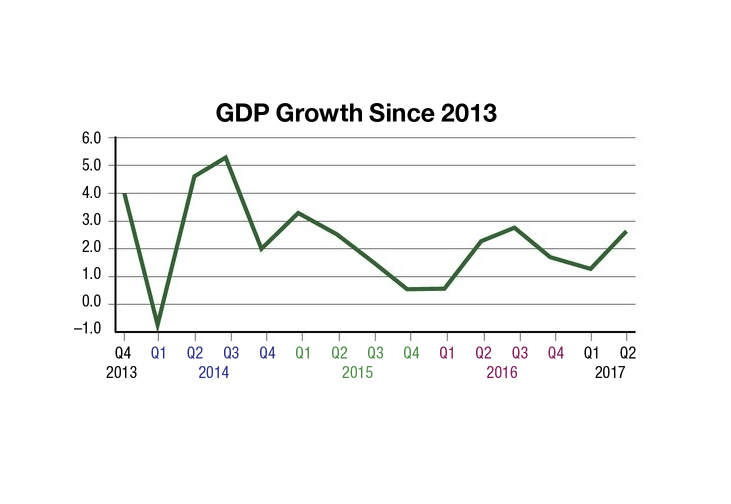
The GDP, a total measure of the country’s output of goods and services, increased at an annual rate of 2.6% in the second quarter of this year from the same time last year. This is sharply up from a paltry 1.2% increase in the first quarter. It’s only the first of three monthly estimates for the quarterly GDP figures; typically the expectation is it will be revised slightly higher as Uncle Sam goes through more data.
For trucking, the second quarter GDP figures are a positive sign, according to American Trucking Associations Chief Economist Bob Costello.
“The good news is that consumer spending is decent and business investment is improving again, which will help trucking,” he told me. He believes the second half of this year looks even better, after the first six months of the year resulted in a 1.9% improvement in the GDP, compared to the 2.3% pace during the same time in 2016.
“I think the second half of 2017 should grow 2.8% on average, due to consumers, business investment, and residential investment,” Costello said. “Plus, the drawdown in inventories is getting closer to ending, which means it won’t be a drag on GDP calculations.”
Other analysts are a bit less bullish. Wells Fargo Securities, for instance, expects an average of 2.5% in the second half. But that’s still better than the six-month pace the first half of this year and better than a year earlier.
One possible reason for the lack of excitement about the nation’s economic performance — the third longest period of expansion since World War II — is that GDP growth has been averaging just 2.1% annually. This compares to a rate of a little more than 3% from the 1970s through the end of the last century.
However, achieving the same growth rate as yesteryear simply may never happen today, as Bob Dieli, chief economist at the commercial trucking market research firm MacKay & Company, explained to me earlier this year following the release of first quarter GDP numbers.
“It’s kind of like trucks. How many RPMs does Class 8 turn today versus one 10 or 20 years ago?” he said. “We talk about a transition in the economy, but remember in 1978 we deregulated the trucking industry, and as a consequence of doing that we have made all sorts of changes in the way the freight moves today that would have been incomprehensible to the people back then.”
Dieli argues that the way we move freight today is far more efficient that it used to be, due to better scheduling of trucks, more efficient equipment and other factors. In short, comparisons to history, whether about trucking or the economy, have to be made “somewhat carefully.”
With the U.S. GDP estimated to be around $18.5 trillion in 2016, whether it increases 1% or 3% this year, or somewhere in between, that translates into between $185 billion and more than $500 billion in additional economic activity — and that’s nothing to yawn at.
Evan Lockridge covers trucking business and economic news for HDT, both in his monthly column in HDT's Hotline section and on Truckinginfo.com. A freelance writer, he has been covering the trucking industry in print, online, and on the air since 1991.
Subscribe to Our Newsletter
More Fleet Management

Sponsored•September 16, 2026
Color Match Smarter: Tools That Restore & Perform
For fleet managers and collision repair professionals keeping heavy-duty trucks on the road, getting the color right the first time isn't just about appearance — it's about efficiency, turnaround time, and bottom-line results. Discover how today's digital color tools are transforming the repair process from guesswork to precision.
Read More →
FMCSA Pauses Biennial-Update Enforcement Amid Motus Transition
Carriers whose updates were due on or after June 1 have more time, while FMCSA works to stabilize its new registration system and warns of phishing sites impersonating its new carrier registration system, Motus.
Read More →
Sponsored•September 14, 2026
2026 Blueprint for Countering Smarter Supply Chain Theft
Cargo theft is no longer just the cost of doing business. It's a multi-billion-dollar criminal enterprise exploiting vulnerabilities across your fleet, drivers, and supply chain.
Read More →


Sponsored•September 1, 2026
How Telematics Improves Visibility, Control, and Performance in Refrigerated Fleets
Explore how telematics help refrigerated fleets improve visibility, uptime, efficiency, compliance, and cargo protection across connected cold chain operations.
Read More →
What the U.S.-Canada Trade War Means for Trucking
Escalating U.S.-Canada tariffs could disrupt cross-border freight, reduce truck volumes, raise costs, and create new uncertainty for carriers on both sides of the border.
Read More →
What Are Trucking’s Top Concerns for 2026?
The American Transportation Research Institute wants to know what's worrying trucking fleet managers, drivers, and other stakeholders in its annual Industry Issues survey.
Read More →
American Trucking Associations Looks for a New Leader
ATA President and CEO Chris Spear abruptly left his job at the association on August 21, at a pivotal time for the trucking industry.
Read More →
Public Wi-Fi Cybersecurity Risks: How Truck Drivers and Fleets Can Protect Their Data
Public Wi-Fi can expose truck drivers and fleets to credential theft, malware, and other cyber threats. Here’s how to reduce the risk on the road.
Read More →
For Nicky Cupp, Fleet Innovation Starts With Frustration
HDT Truck Fleet Innovator Nicky Cupp turns everyday pain points at Fraley & Schilling into opportunities for better technology and smarter processes.
Read More →
Adam Buttgenbach’s Approach to Electric Trucks: Start With Where They Fit
HDT Truck Fleet Innovator Adam Buttgenbach helped PepsiCo build one of North America’s largest EV fleets by focusing on where electric trucks make operational sense.
Read More →