



Part 1: Regular Tire Inspections Save Time in the Long Run
Part 2: Keep up the Pressure
 MENU
MENU SEARCH
Your tires will tell you if your vehicle is running straight and true. Don't wait 'till it's too late. Part 3 in a special National Tire Safety Week series.

Misaligned tires increase vehicle rolling resistance and waste fuel -- that's on top of chewing up tires. Photo by Jim Park
Only a small percentage of truck fleets regularly perform alignments on their tractor and trailers. Many prefer to wait until the need arises, such as when they get a handling complaint from a driver or a set of steer tires gets chewed up much sooner than expected.
If the alignment had been done before the expensive steer tires were installed they might still be out there earning their keep.
"You can't shove a tire down the road at any kind of an angle other than straight ahead and not get some kind of wear pattern that will indicate the truck is not going straight down the road," says Fred Staugh, vice president of maintenance at CRST.
Your tires will tell you whether or not the vehicle is running straight and true. Staugh says tires should be examined at every PM interval for tell-tale signs of alignment-related wear, such as feathering, or excess wear on opposite shoulders of the steer tires.
Many tire problems can be traced to mechanical conditions on the vehicle, and not necessarily the obvious ones.
"Alignment refers not only to the various angles of the steer axle geometry but also to the tracking of all axles on a vehicle, including the trailer," notes Sharon Cowart, director of product marketing, Michelin Heavy Truck Tires.
Improper steer axle geometry can do its share of damage to steer tires, but drive axle misalignment and even trailer axle problems can affect steer tires. For example when the two drive axles are not running exactly parallel to each other and a precisely 90 degrees to the longitudinal axis of the truck, they will push the truck to the right of to the left. You counter that by steering slightly in the opposite direction. It may be hardly noticeable to the driver, but the effects of that sideways push will show up fast on the steer tires.
"If the left and right steer tires have the opposite wear pattern (i.e. the outside shoulders of both tires is worn fast), then a toe-in or toe-out condition is present," says Gary Schroeder, director of Commercial Vehicle and Global OEM Sales for Cooper Tire & Rubber Company, assigned to the Roadmaster brand. "If the left and right steer tires have the same wear pattern (i.e. inside shoulder of left steer and outside shoulder of right steer worn fast), then you have a misaligned drive axle."
Vehicle misalignment often shows up as an irregular wear condition on steer tires, such as feather wear, rapid wear on one shoulder and one-sided wear. Drive tires are not immune either. You can see and the same sort of feathered wear on the tread face. If you run you hand along the tread in one direction it will feel smooth, but in the opposite direction you'll feel distinct hard sharp edges on the tread blocks.
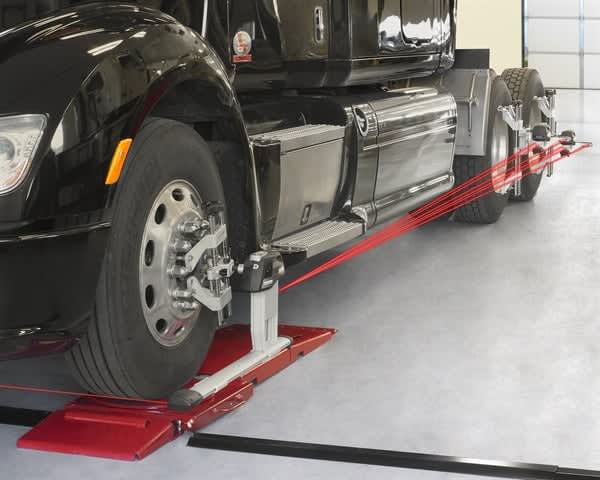
While many fleets view alignment as an expence, it can be a real cost saving measure.Photo from Hunter Engineering Inc.
Checking trailers for alignment is a fairly simple process, measuring from the kingpin to the front axle, and then from the front axle to the rear. The dimensions should be nearly identical -- the closer the better. If they are out by a quarter of an inch or more, the bogey should be aligned. It only takes a few minutes to check and it can save many 32nds of an inch of trailer rubber.
Getting all your tires headed in the same direction isn't going to hurt fuel economy either. But there's also tire life improvements to be had, and since the most fuel efficient part of a tire's life cycle is the latter half, why not try to extend that life as long as possible?
To keep tires wearing evenly, The ATA's Technology & Maintenance Council suggests vehicle alignment should be checked every 80,000 to 100,000 miles or every 12-18 months. A good source of information on total vehicle alignment can be found in the TMC recommended practice RP 642B.

Fleets have more visibility into truck health, safety events, and driver activity than ever. The next challenge is turning all that information into useful guidance for the person who has to decide what to do next.
Read More →
Federal regulators also are targeting more than 160 additional training providers and launching a nationwide audit of third-party CDL skills testers as part of a broader crackdown on trucking fraud.
Read More →
Two pilot programs could eventually reshape hours-of-service rules, giving truck drivers options to pause their 14-hour clock or use longer split sleeper rest periods.
Read More →
Medical-card violations jumped to the top of the driver out-of-service list during CVSA’s 2026 International Roadcheck, while English-language proficiency violations appeared among the leading violations for the first time.
Read More →
New Teletrac Navman research suggests that onboarding, transparency about driver data, and positive feedback can play a significant role in how commercial drivers respond to safety and coaching technology.
Read More →
KLLM is facing a federal sex-discrimination lawsuit over policies the EEOC alleges put female truck driver trainees at a disadvantage.
Read More →
By changing regulations on English-language proficiency requirements for commercial drivers, rather than relying on a guidance memo, the FMCSA said future administrations won't be able to walk back the Trump administration's stricter enforcement with just a memo.
Read More →
Watch to get an inside look at the Western Star trucks, technology, and community behind the Star Nation Experience 2026!
Read More →
The Freedom Haulers program pulls together existing and expanded programs at several federal agencies to recruit veterans to drive commercial heavy-duty trucks and cut the red tape for them to get a CDL, training, and employment.
Read More →
A test drive of Mack’s Command Steer active steering system evaluates how it can make truck driving easier and less tiring.
Read More →