




Additives For Fuel Economy
The price of fuel is enough to sway even the most hardcore oil additive skeptic.

The whole field of oil additives and fuel economy enhancers has me confused. If they work, why hasn't the world beaten a path to their door? Especially now, with fuel prices at unprecedented highs.
Fuel prices are expected to continue up - possibly to more than $4 a gallon, if the pundits are right. (And I'm about as skeptical of pundits as I am of fuel additive claimants.)

But maybe this fuel crisis is what it will take to propel skeptical users to take a look at fuel economy enhancers.
I happen to know there's one major truckload carrier taking a very serious look at Go-15, an oil additive whose name tells the claim: up to 15 percent fuel economy improvement.
Now, I have never believed a 15 percent improvement in economy is possible. But Go-15's prospectus and promotion say it is. And many user testimonials claim that treatment of vehicles in their fleets with Go-15 has achieved such remarkable fuel economy gains - even more.
And these Go-15 people are very persuasive.
In fact, they tend to downplay the results. But company president Jim Novorr is absolutely confident that no one will see less than an 8 percent gain in fuel economy when using their product.
You don't need me to tell you that's huge. For the truckload carriers, this year is going to be tough. We have seen predictions that margins are going to be eroded from the 4 percent of 2007 to as little as 2 percent for 2008. With fuel accounting for 33 percent of costs, an 8 percent saving could wipe out that loss. And a little bit more.
Go-15's marketers claim it's a surface conditioner, treating sliding surfaces so the metal-to-metal friction is lower. Talk to lubricant engineers and they'll tell you metal-to-metal contact is zero because the oil film maintained by conventional mineral - and especially synthetic - lubricants is there to prevent exactly that.
But it's hard to argue the oil analysis results that the Go-15 people lay in front of you: The amounts of wear metals in successive oil samples before and after engine treatment show significantly lower numbers for iron, lead, zinc and so on - all indicators that something is going on inside an engine that is minimizing the contact between sliding metal components.
Subjective comments support the notion. Truck specifiers I know and respect say engines idle more smoothly, transmissions and axles are quieter. One Harley distributor says heat transmission through the seats of the bikes is significantly reduced.
And the micrograph analysis on metal surfaces tends to back this up. The surfaces under extreme magnification show a much smoother, less jagged appearance. And lest you doubt the claim, the source is the highly respected Southwest Research Institute, the same body that oil companies use to qualify their lubricants to meet API "doughnut" standards.
But in reference to the oil companies, I have to offer a cautionary word from my friend and colleague George Morrison, founder of AV Lubricants in Columbus, Ohio, who a few years ago helped author our award-winning feature on fuel filtration, "Trucking's Dirty Little Secret."
"From my experience with additives, there is just no free lunch," he writes. "There are additives that appear to be the greatest stuff since sliced bread, but in every single case some major oil producer had already researched the component and found that the additive produces side effects in the long term or some other component that makes the additive not cost effective. ExxonMobil, for example, has a research lab in Paulsboro, N.J., where a whole gaggle of Ph.Ds do nothing but try and re-invent the wheel in terms of energy-saving additives."
So he's a skeptic, too.
But it's not the promoters, it's the people who use Go-15 who seem to be such believers. It's tough to ignore their enthusiasm.
See their website at www.go15.com, see their claims, and you can decide for yourself. With fuel prices sky high, it might be worth a shot. Even for this skeptic.
More Fuel Smarts

Calstart Becomes Catalyst Mobility, Reflecting Broader Focus
Calstart is now Catalyst Mobility, reflecting the nonprofit’s growing national role in clean transportation, including zero-emission trucks, infrastructure and incentive programs.
Read More →
Record Diesel Prices Squeeze Trucking Fleets
Average U.S. diesel prices have climbed to nearly $6 a gallon, surpassing the 2022 record as tight refinery capacity and Middle East disruptions keep fuel costs elevated.
Read More →
How Fuel Delivery Shapes Engine Performance
Fuel delivery depends on more than what happens at the injector. For fleet, maintenance and technical professionals, looking at the full path from pump to injector can provide useful context for understanding engine performance.
Read More →

East Coast Port Launches $45M Electric Truck Push
The Port Authority of New York and New Jersey announced millions in incentives for zero-emission drayage trucks, yard tractors, and new charging hubs near the port.
Read More →
California Bill Could Shed Light on Electric Truck Prices
Why do battery-electric Class 8 trucks remain so expensive? A California bill headed to Gov. Gavin Newsom would give fleets and state agencies more visibility into what manufacturers charge.
Read More →
Detroit Opens Orders for EPA 2027 Engines
Detroit isn’t starting from scratch to meet EPA 2027 diesel emissions standards. Its Gen 6 DD13 and DD15 engines keep much of today’s platform while updating the fuel and aftertreatment systems.
Read More →
Zero-Emission Truck Corridor Planned for West Coast
California, Oregon, Washington, British Columbia and Baja California are coordinating plans for truck charging and hydrogen fueling from Canada to Mexico.
Read More →
A Closer Look at Kenworth’s Electric T880E Vocational Truck [Video]
Learn more about Kenworth's T880E battery-electric vocational truck at the Paccar Technical Center, including its range, applications, upfitting considerations, and PTO options, in this HDT Spotlight video.
Read More →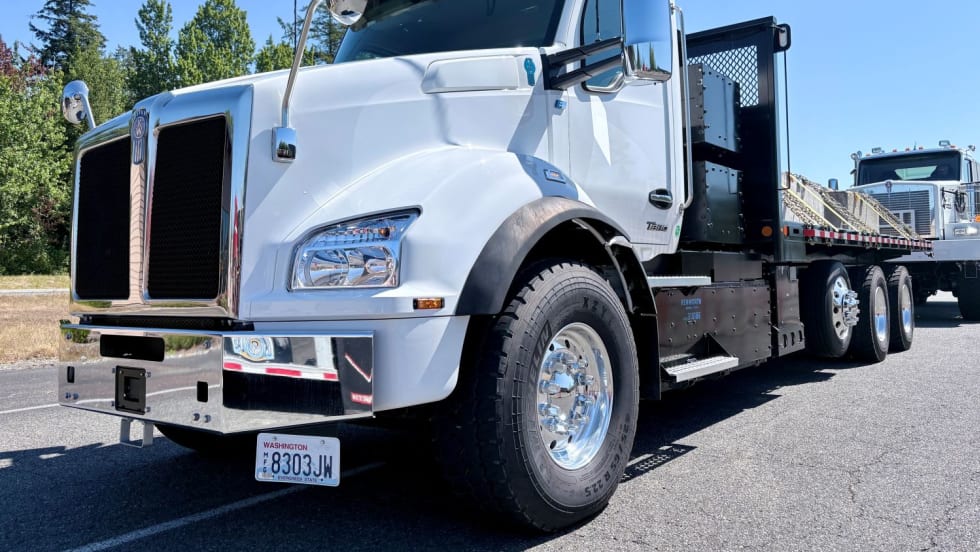
Kenworth T880E Brings EV Power to Vocational Trucks
A closer look at the Kenworth T880E’s range, charging, powertrain and upfit options — and where fleets are showing the most interest.
Read More →
Jennie Abarca Is Proving Electric Trucks Can Do the Job
HDT Truck Fleet Innovator Jennie Abarca is building confidence in fleet electrification one load at a time while openly sharing the challenges she encounters along the way as a small-fleet owner.
Read More →