




A Safer Way to Clear Snow and Ice From Van Trailers
Although laws in several states require owners to clean off the roofs before the vehicles head for the road, that’s easier decreed than done, as Tom Berg explores in January's Once Around the Yard.

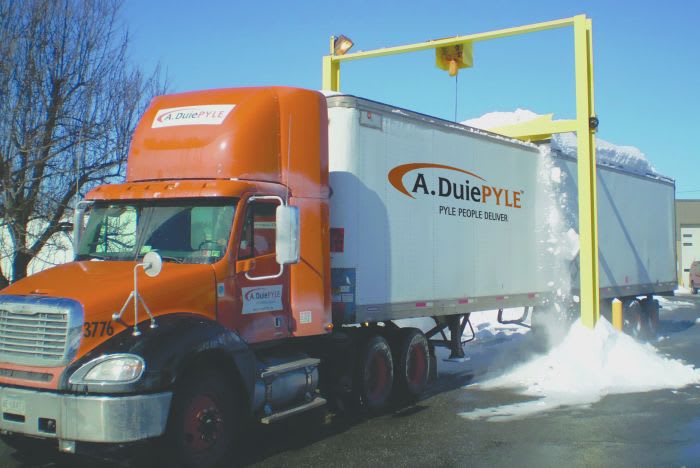
The plow-like scraper removes snow as the trailer moves under the device. A rubber tip on the steel blade protects the roof. Pyle has 15 installed at its terminals in the Northeast, with two more scheduled.
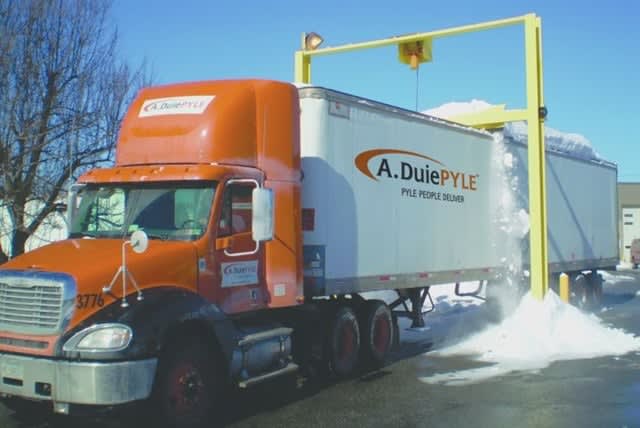
The plow-like scraper removes snow as the trailer moves under the device. A rubber tip on the steel blade protects the roof. Pyle has 15 installed at its terminals in the Northeast, with two more scheduled.
Blocks of snow and ice blowing off the roofs of trailers while they’re moving down the highway are common sights in winter, irking motorists and sometimes causing damage and accidents. Although laws in several states require owners to clean off the roofs before the vehicles head for the road, that’s easier decreed than done.
However, A. Duie Pyle, the old-line freight carrier operating in the Northeast, has found the answer in the “snow scraper” from Scraper Systems. The fleet has installed the equipment at 15 of its 17 terminals, and the other two should have them soon, says Randy Swart, the chief operating officer based at the company’s headquarters in West Chester, Pa., outside of Philadelphia.
The devices are built not far west from there, in Lancaster, by Quintin Machinery. A video on the company’s website shows how the plow-like device works on high-roof trailers or truck bodies.
The video says a driver can operate the scraper alone, but Swart says rigs can be cleaned off much faster, one after another, if the drivers just drive and a second man operates the blade. If a lot of snow has fallen, a third person might have to use a plow or wheel loader to keep the lot near the scraper clear.
“Prior to purchasing these scrapers, we ‘de-snowed’ the roofs by hand,” Swart says. “Employees would climb up a ladder onto the trailer roof and shovel the snow off. This posed a very real safety risk for our employees working 13 feet off the ground in slippery conditions.”
Plus, newer, lighter-weight trailers with fewer ribs and translucent roofs are susceptible to damage when walked on.
Pyle bought the first scraper in 2004, well before the laws were passed requiring snow removal, because “it was the right thing to do,” Swart explains. “It is dangerous to all motorists who share the road to have snow blowing off the roof of a trailer, creating a mini blizzard and minimizing visibility of what lays ahead of them.”
Light, fluffy snow is bad enough, but ice, formed when snow melts and refreezes, is more dangerous. It sometimes comes off in large sheets and can damage cars and injure motorists, and other drivers have to dodge pieces left on the pavement. The scrapers can remove much of the ice, as well. This also minimizes the company’s legal liability.
The installed cost is around $15,000 each, and there is minimal maintenance, other than lubricating moving parts.
More Equipment

How Volvo Updated Its D13 for EPA 2027 [Watch]
Volvo’s updated D13 promises lower emissions without sacrificing performance or fuel economy. Take a closer look at what changed inside the engine in this HDT Spotlight video.
Read More →
Michelin Tire Improves Efficiency and Durability for Regional Fleets
The Michelin X Multi Energy D2 is a regional haul drive tire engineered to help fleets improve fuel efficiency, durability and traction in demanding stop-and-go operations.
Read More →
ZF Expands Commercial Vehicle Push in North America
ZF is expanding its North American commercial-vehicle presence with new transmission applications, electrification, trailer technology and autonomous-driving systems.
Read More →
Tesla Wants a Self-Driving Semi. Are Cameras Enough?
Could Tesla’s camera-only autonomous driving technology work on an 80,000-pound Semi? In this commentary, HDT's Deborah Lockridge takes a look at Tesla, Cybercab, and how autonomous trucks see the road.
Read More →
Kodiak: Driverless Long-Haul Truck Launch on Track for 2026
Kodiak AI says its driverless long-haul safety case is 93% complete and it remains on track to begin commercial operations by year-end 2026.
Read More →
What DOT’s Automated Vehicle Strategy Means for Trucking
The U.S. Department of Transportation issued a new automated-vehicle strategy that outlines plans for driverless-truck regulations, cross-state freight corridors, and federal safety standards.
Read More →
East Coast Port Launches $45M Electric Truck Push
The Port Authority of New York and New Jersey announced millions in incentives for zero-emission drayage trucks, yard tractors, and new charging hubs near the port.
Read More →
PlusAI Going Public to Fund Autonomous Truck Launch
A SPAC deal could provide PlusAI with up to $300 million as it works toward a 2027 commercial launch of factory-built autonomous trucks.
Read More →
NHTSA Moves to Rewrite Truck Fuel-Economy Rules
The National Highway Traffic Safety Administration says it lacks authority to regulate medium- and heavy-duty truck engines separately from complete vehicles, but the existing standards have not yet been eliminated.
Read More →
Detroit Opens Orders for EPA 2027 Engines
Detroit isn’t starting from scratch to meet EPA 2027 diesel emissions standards. Its Gen 6 DD13 and DD15 engines keep much of today’s platform while updating the fuel and aftertreatment systems.
Read More →